
Spider-Man: Maximum Venom part 4, 2020
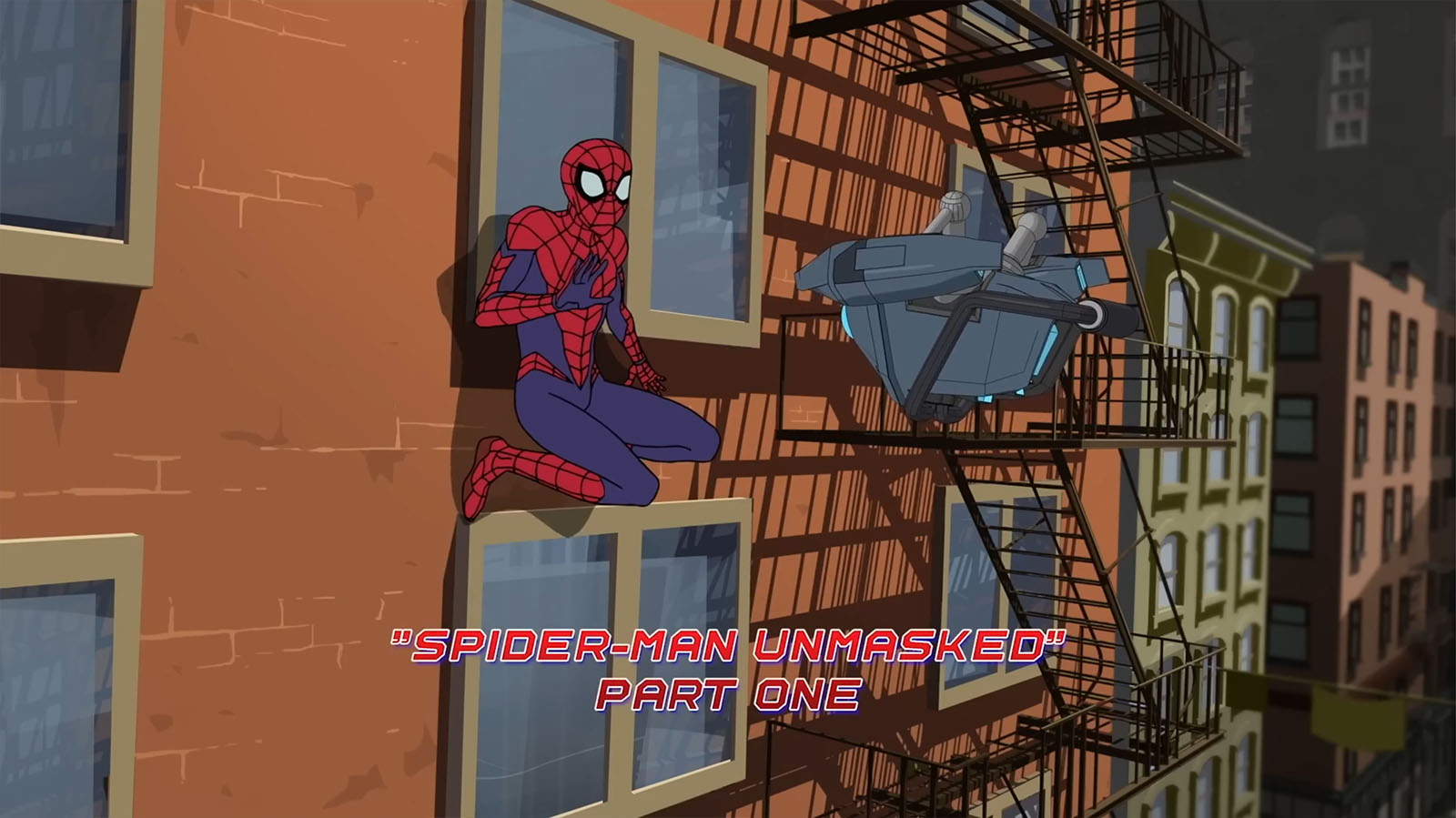
All rise! In this episode you get what everyone wants from a TV cartoon: courtroom drama!
Seriously, a big chunk of this one happens in a courtroom. That’s a single environment with a limited number of characters, most of them seated, talking to each other. Exactly what you look for in a cartoon, right? So you may be wondering, how does one make a courtroom drama watchable in a cartoon?
The first thing you need, of course, is characters you care about. That’s a foundation you have to build over the course of a series. If nobody cares about the characters, nobody will care what happens to them. But that’s outside the scope of this essay, so we’ll move on.
The second thing you need is a good script with well-paced dialogue that doesn’t get bogged down in procedure. We only have 22 minutes, after all, and there are other things to do in this episode. This is the responsibility of the writer. The filmmaking begins once we have the finished script.
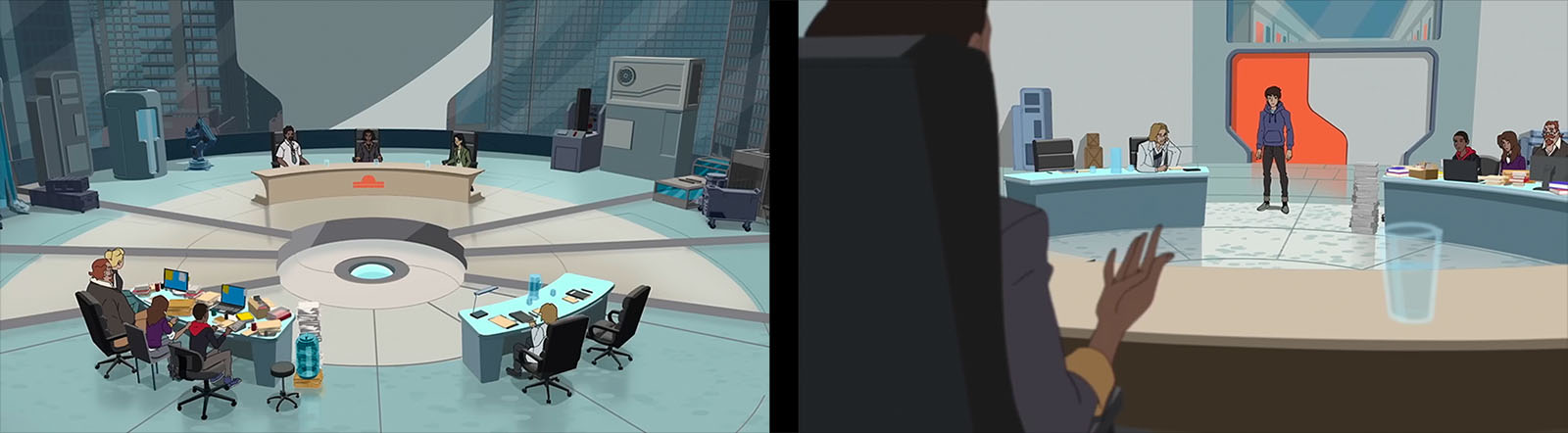
I say “filmmaking” because that’s exactly what we do in a storyboard. We use the same toolbox everyone in live-action uses. We decide what the camera needs to see, how the characters perform, whether a shot should be wide, medium, or close, where the lights are, when to amp up the drama, and on and on. Really, it’s no different from a busy action scene. You just have a more limited space to play in and you need to make the most of it.
If an artist can’t get interested in their subject, you end up with a very bland storyboard. If they think, “this scene boring, so I can’t make it interesting,” maybe they’re not cut out for the job. Everything will be boring if you approach it that way. And the opposite is also true: everything can be made interesting if you’re imaginative enough to find some interest in it.
Courtroom drama can be highly engaging in a live-action setting, even if most of the actors aren’t moving. The director and camera operator make up for that by anticipating what the viewers want to see, and then by turns granting that wish or subverting it for effect. It’s another version of what I wrote about over here: setting a baseline and then finding ways to spike it.
The major difference between live-action and animation, though, is that when you build a live-action set you can shoot anywhere you want in it. In animation, you have to pay a separate fee for every background because they all have to be individually drawn and painted. This is what drives us to reuse backgrounds whenever we can. If it’s already been paid for, it costs nothing to use it again. As you watch the courtroom scenes in this episode, you’ll see the same angles and backgrounds many times.
With that as a given limitation, it’s all on you as the storyboard artist to make sure it doesn’t feel repetitive. So that’s where you drill down on what a courtroom drama is all about; people conveying information and other people reacting to it. That allows you to cut back and forth a lot, but this too can get repetitive if you don’t find ways to spike it.
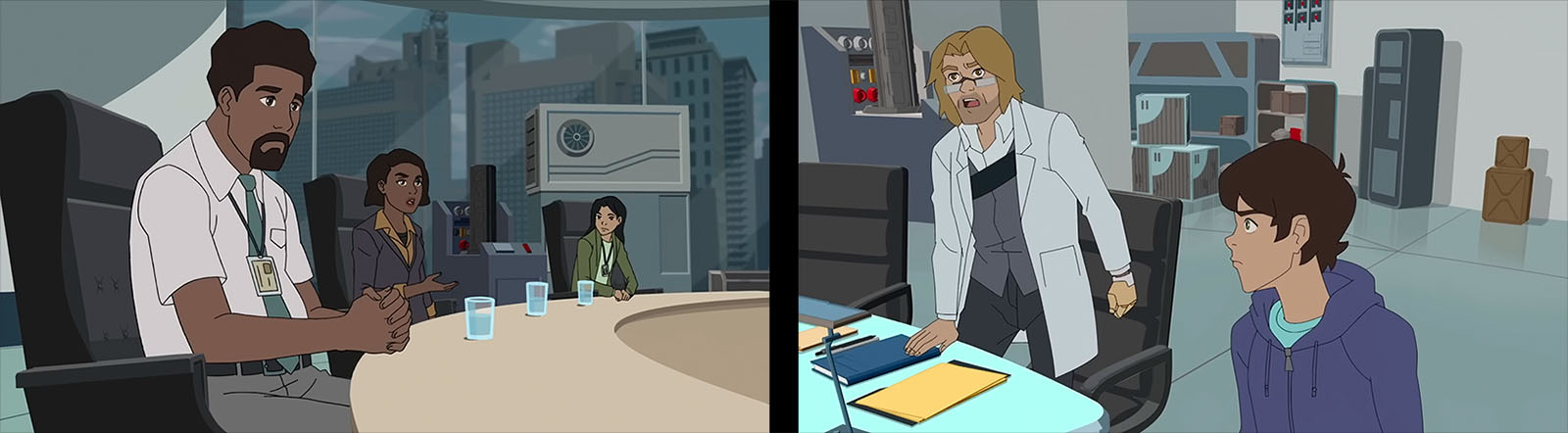
My approach to this springs from my cardinal rule about all animation filmmaking: let the dialogue do the talking. By that I mean, examine what’s being said and focus on who’s saying it, but also be conscious of who’s listening and who is affected. The content of a line will tell you if it’s broad or intimate. Broad lines call for big scenes with several people listening. Intimate lines tell you to move the camera in for close-ups. If someone in particular has a specific reaction to what’s being said, that’s your cue to put them on screen while they’re listening.
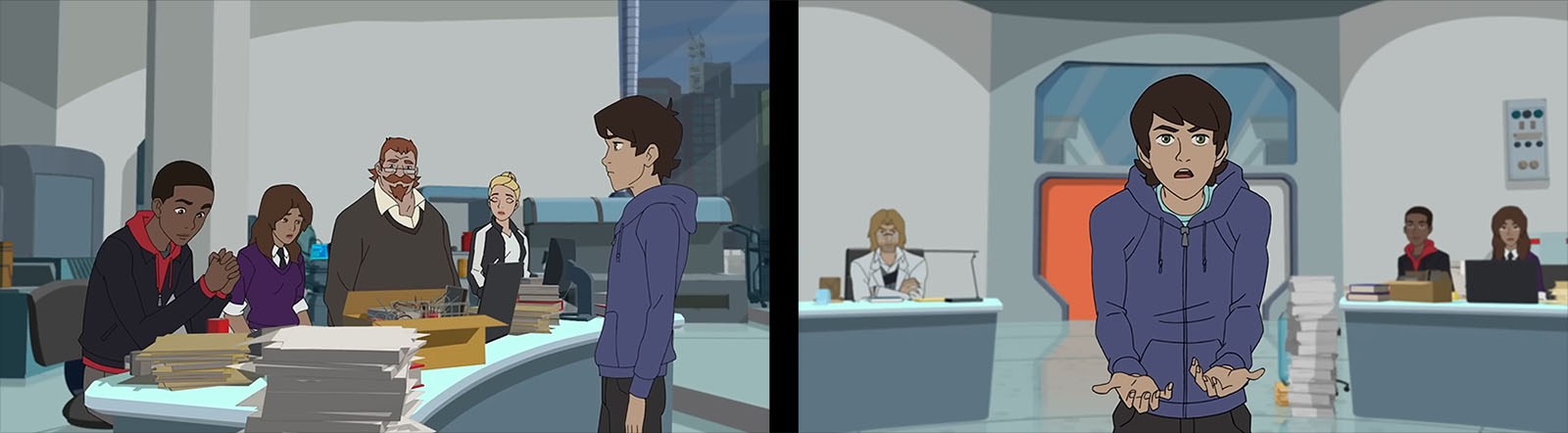
I could cite more examples, but the key word is MOTIVATION. Your camera represents your audience. They’re an invisible character observing the scene you’re creating. Whatever they’re motivated to look it is what your camera should look at. That’s the baseline. When you want to surprise them with something unexpected, that’s the spike.
Dialogue is another form of motivation. If you let the dialogue motivate your choice of angles and subjects, you’ll almost always get it right. And your scene will be anything but boring. Court dismissed.
For my episode (part 1 of 2), our storyboard team was joined by new arrivals named Jarelle Dampier and Eric Meister, who would remain on through the second half of our short season. I’m pretty sure Ibraheem Jara and Shaan Khan were still busy with the previous episode, so they didn’t contribute this time.
Storyboard breakdown for this episode
Start to 3:08 / My boards, cleanup by Gerald Kaye, revisions by Supervising Director Dan Duncan
3:08 to 07:02 / Jarelle Dampier, revisions by Supervising Director Dan Duncan
7:02 to 08:53 / Jess Cuffe
8:53 to 10:50 / My boards with Gerald’s cleanup (inserts by Jess)
12:00 to 12:47 / Jess Cuffe
12:47 to 15:37 / My boards with Gerald’s cleanup
15:37 to 19:30 / Jess Cuffe (with others on revision)
19:30 to end / My boards with Gerald’s cleanup
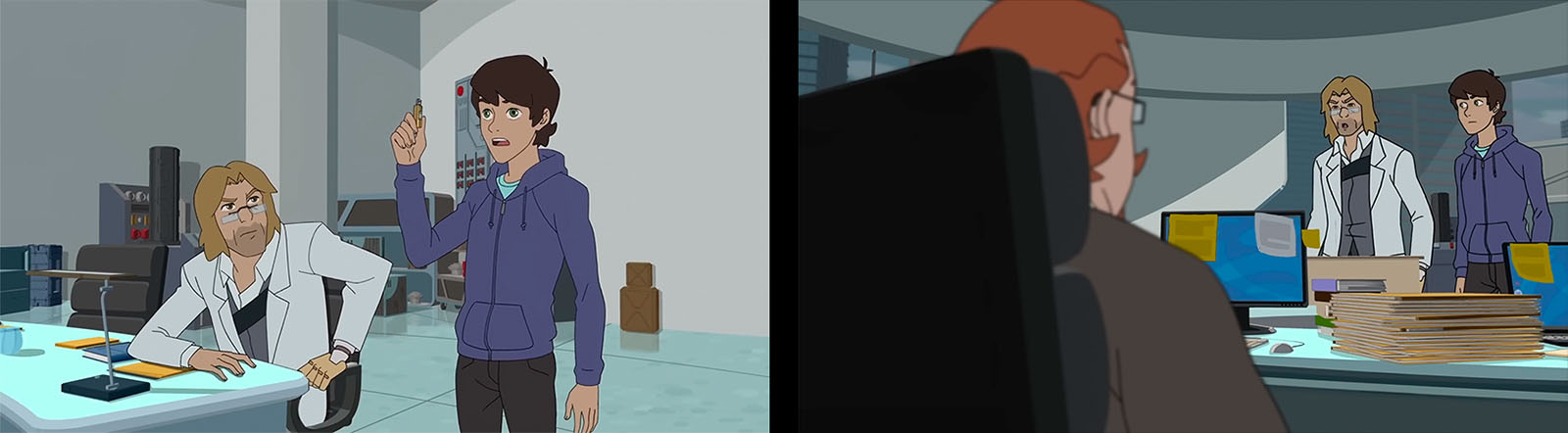
Surprise Witness: Jarelle Dampier thwips in!
It was 2019 and I had just finished storyboarding on a project that pushed me to my limits. Every pro artist knows the feeling: You’ve put it all on the line on one show and it’s already time to look for the next. It can be quite the blur of a lifestyle, coupled with the fact that my son was just born and that left you with a fairly tired and burnt out Jarelle.
But here’s the thing, though… I love Spider-man.
In my professional life I’ve found two things to be true;
There’s always time for Super Smash Bros.
There’s always energy for Spider-man.
I’ve been something of a Marvel boy my entire life leading up to my career in animation but, funny enough, I broke in working on DC stuff. It was life-changing working with Superman, Batman, and Wonder Woman – but there was this itch I couldn’t scratch watching the incredible artists at Marvel Animation put out such a great show in Marvel’s Spider-man.
When I got the email about helping out with Season 4, Maximum Venom, I didn’t hesitate to answer the call. Days leading up to my handout, I trained my skills at drawing Spider-man in all kinds of poses and fights. Finally, I get to play with the web-slingers.
I was determined to do a good job.
If I did well here, maybe I’d get invited to work in-house? The possibilities were exciting…
But when I opened the script, and I found my name, and I made my way to the scene I was assigned… I found 4 pages of…
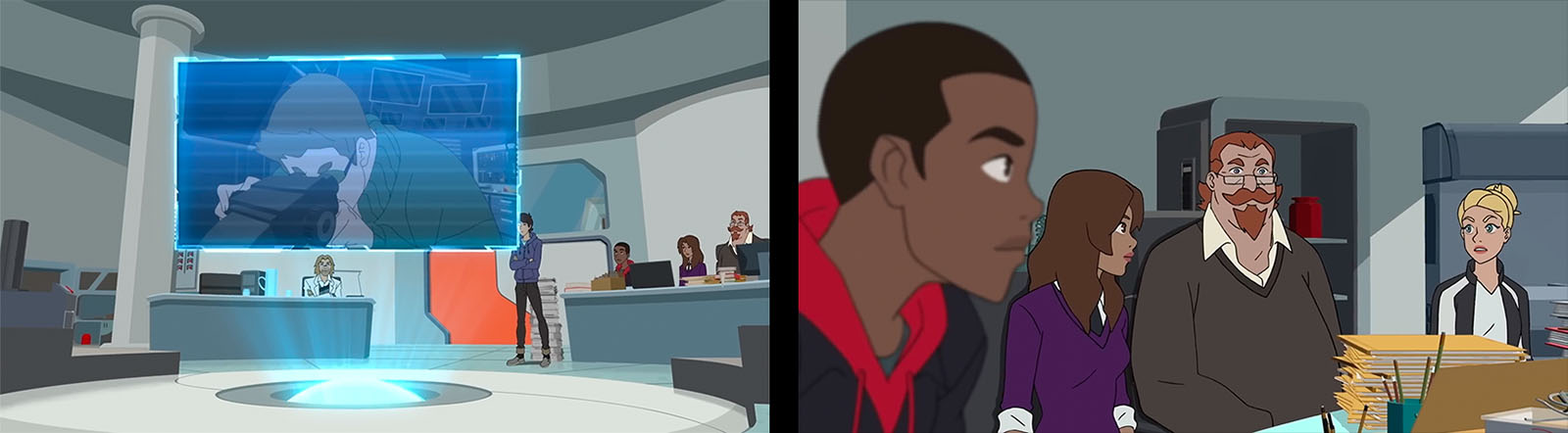
COURTROOM DRAMA!? WHAT!?
You should see the sketchbook I was filling in anticipation for this scene. The flips, the kicks, THE THWIPS! But no…courtroom drama. And you know what?
It was some of the most fun I’ve ever had on a scene. No web-slinging, no costumes, no crazy set pieces. The Spider gang was on trial dealing with some serious business, Max Modell was in the hot seat, and of all people Otto freaking Octavius was being helpful for once – no fighting at all. I had a few days to do the scene, and I poured myself into it as much as I could. By the time I was boarding the next episode, it would be in a cubicle in Marvel Animation as an in-house artist. The show didn’t last very long, but I would’ve stayed on for years.
I was so grateful for my little courtroom scene, and I think the entire episode really sings thanks to the direction of Tim Eldred, who taught me to be intentional with every moment of a super-hero show – even the quiet ones. I’ll take a courtroom scene any day of the week now.
Thanks, Tim!
Get you some more Jarelle here!
Spider-Man Unmasked
Broadcast on DisneyXD August 16, 2020
Storyboard production period: June/July 2019
Watch it on Amazon Prime, Disney+, Apple TV, Roku Channel, and Hulu. Or right here if you scroll down.
Part 1, directed by me
Finished Animatic
Synopsis:
After having to fight his way past Tinkerer, Spider-Man rushes to deliver a flash drive containing a post-mortem transmission from Octavius that could help to prove Max’s innocence to the board of education. Upon seeing the evidence, the head administrator states that they can get additional testimony from Aleksei Sytsevich. Spider-Man looks for Aleksei while the others stall, but finds that he has been transformed into Rhino by Swarm using Jackal’s old Rhino formula.
Finished Episode
Part 2, directed by Sol Choi
Finished Episode
Synopsis:
Curt Connors blackmails Spider-Man into unmasking himself before the board of education, resulting in Max’s firing and Connors becoming the interim headmaster until the end of the term. Knowing that Swarm is turning other people into human/animal hybrids for his gladiatorial-type contest called the “Underground Monster League,” the Spider Team must battle for their lives in front of the criminal underworld. Peter must also find a way to reconcile with Gwen and Anya for keeping his identity as Spider-Man a secret from them.
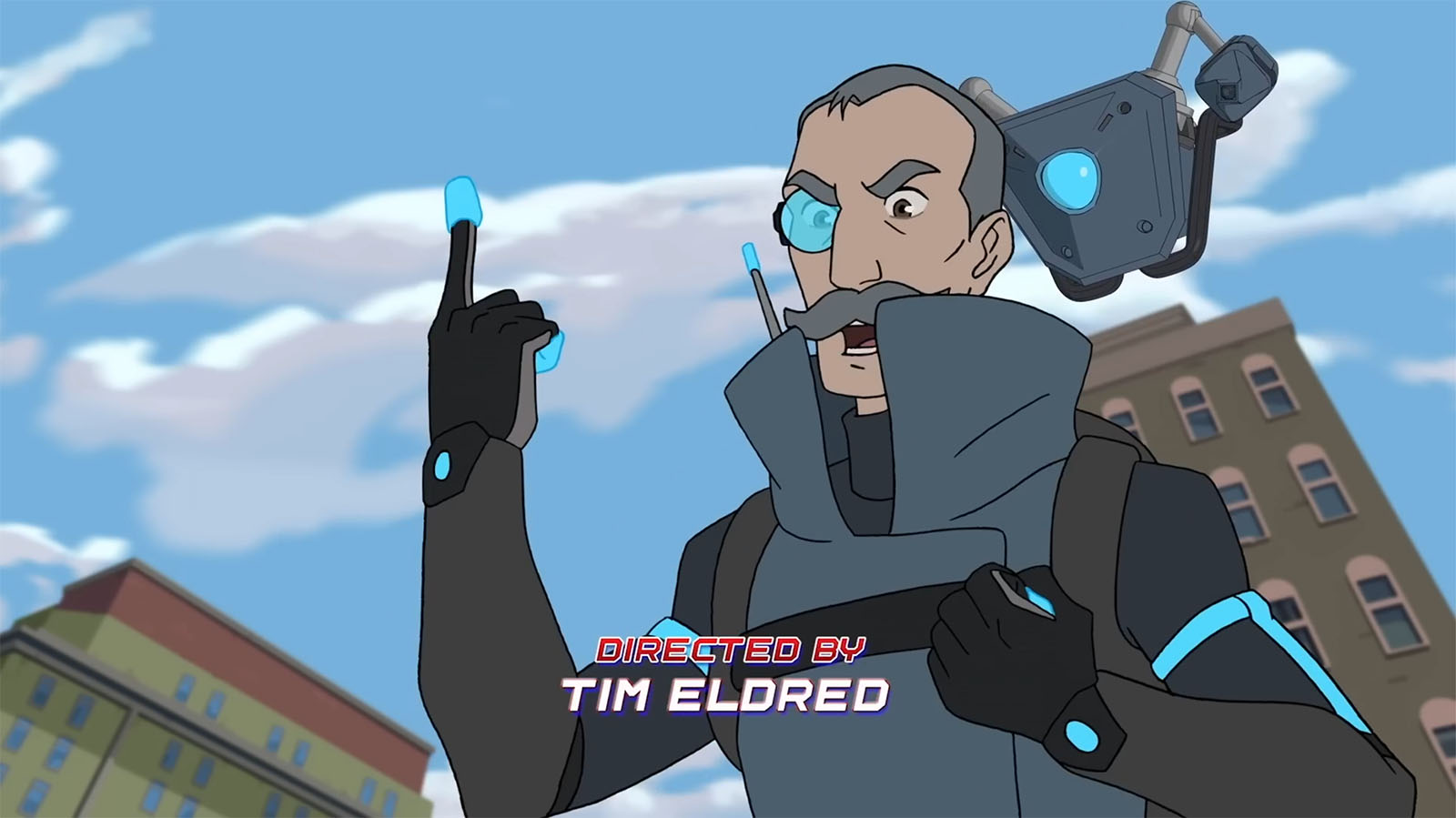
Next time: Generations