
My fourth Spider-Man, 2016
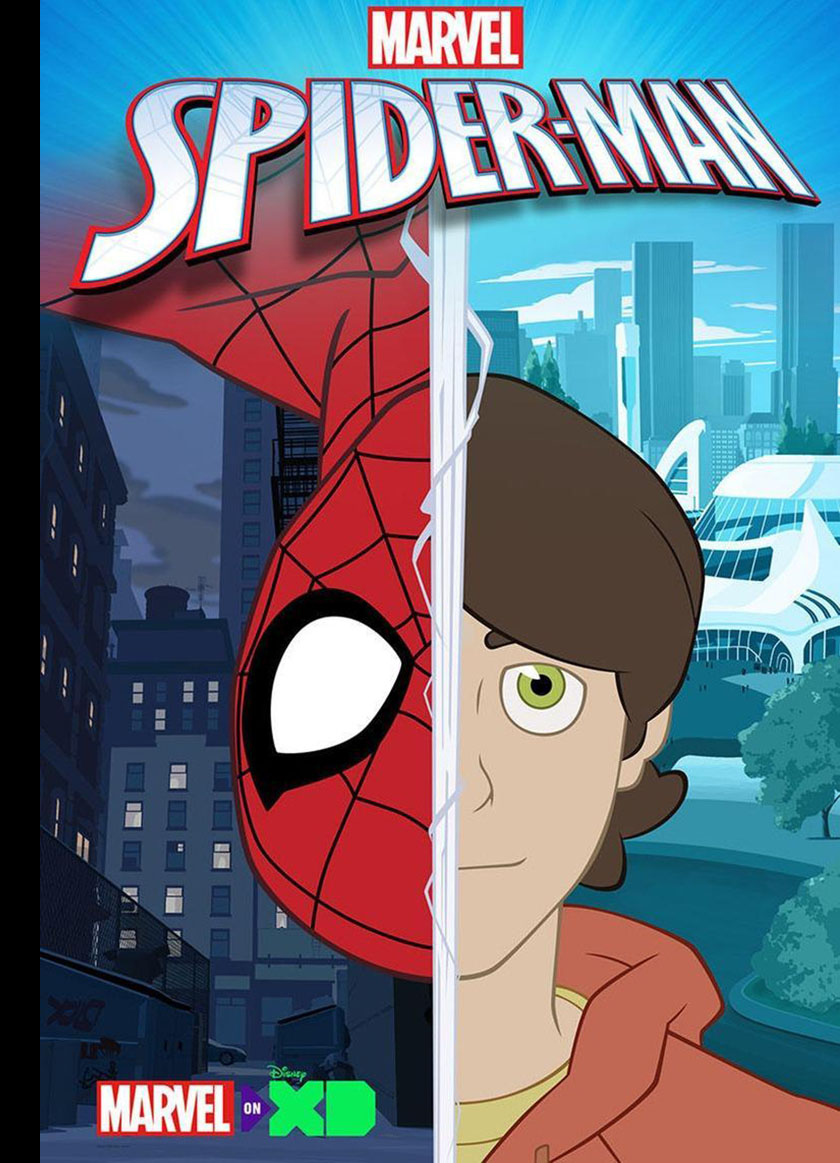
For a while there, Spidey and me had an understanding. If he got a new animated series, I would somehow end up working on it. This streak lasted from 2002 to 2020 with me being involved in six different incarnations. 10-year-old me, who picked up his first Spider-Man comic book in 1975, would have been overjoyed to know that was coming. As a result, I can submit claims to have (A) worked on more Spidey cartoons than anyone else and (B) drawn Spidey himself more times than anyone else, including in the comics. Dubious honors, but I’d be fascinated to see the rankings.
In May of 2016 I already had three Spidey shows under my belt (written about elsewhere here at ArtValt). I was ensconced at Marvel Animation Studio (MAS) in between seasons of Marvel’s Avengers Assemble (MAA) and was asked to do some storyboards for an episode of Marvel’s Spider-Man (MSM). Those 3-letter anagrams were part of our daily lexicon, as was HAS (Hulk and the Agents of Smash). MAA was a dream job, because we always had advance notice that another season was coming and if there was a gap between them MAS would keep me in-house for special projects and fill-ins. Thus came a chance to make MSM my fourth round with Spidey.
I worked on only part of an episode (totaling less than 4 minutes of screen time), but I was delighted to take it. The most interesting part of stepping into a new series was seeing how the characters had been redesigned and the structure of the world had changed. Peter Parker was always a student, but he wasn’t always surrounded by the same circle of supporting characters. And those who appeared again were always reinvented in some way.
MSM was the first show to follow the MCU version of Spider-Man, so it was tailored to fit that tone. It didn’t have continuity with the movies, but it did put Peter back in high school with both Miles Morales and Gwen Stacy to become a spider team. It was an elite high school for gifted science geniuses, so there were all sorts of shenanigans among teachers destined to become villains.
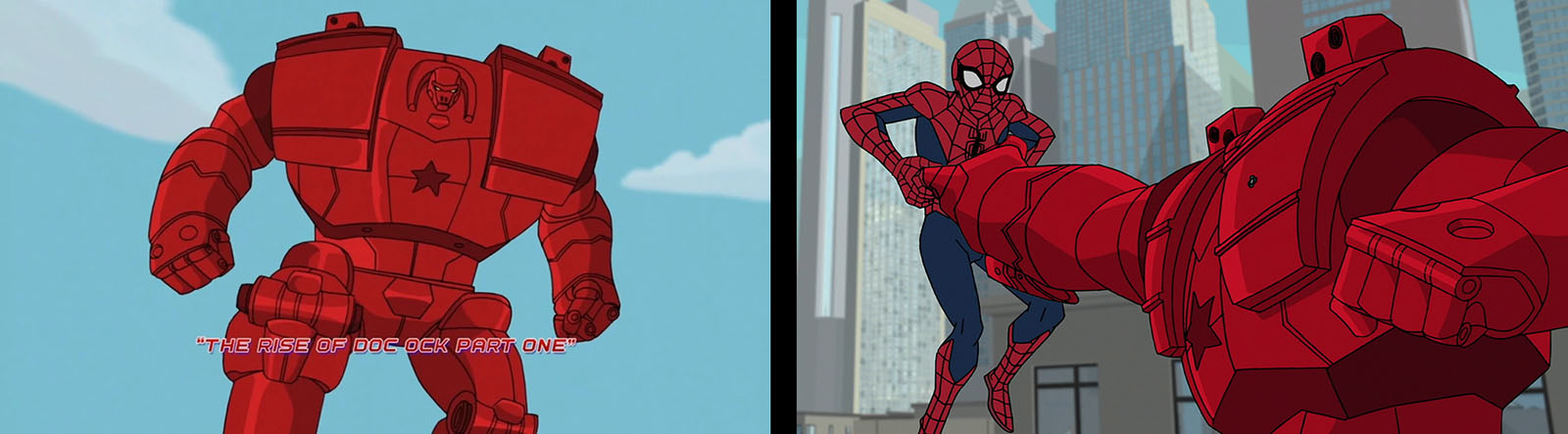
I contributed to Episode 15 of the series (it was script number 16, since they started with an Episode Zero), and it would be the first of a 4-part story that turned one of the teachers into Dr. Octopus. I was assigned the first five and a half script pages, covering the teaser and the opening of Act A. Other artists would pick it up from there and move on to cover the rest (including all of Act B and Act C).
I was only asked to draw a rough storyboard, which would be cleaned up by others, which was fine with me. I got it done in a couple weeks and then moved on to some other thing.
I could just end this article there and show you the animatic, but one of my goals in writing these things is to introduce you to the world of making TV cartoons. So I’ll take this opportunity to show you how storyboard assignments are decided, and what they give you to work with. Class is in session.
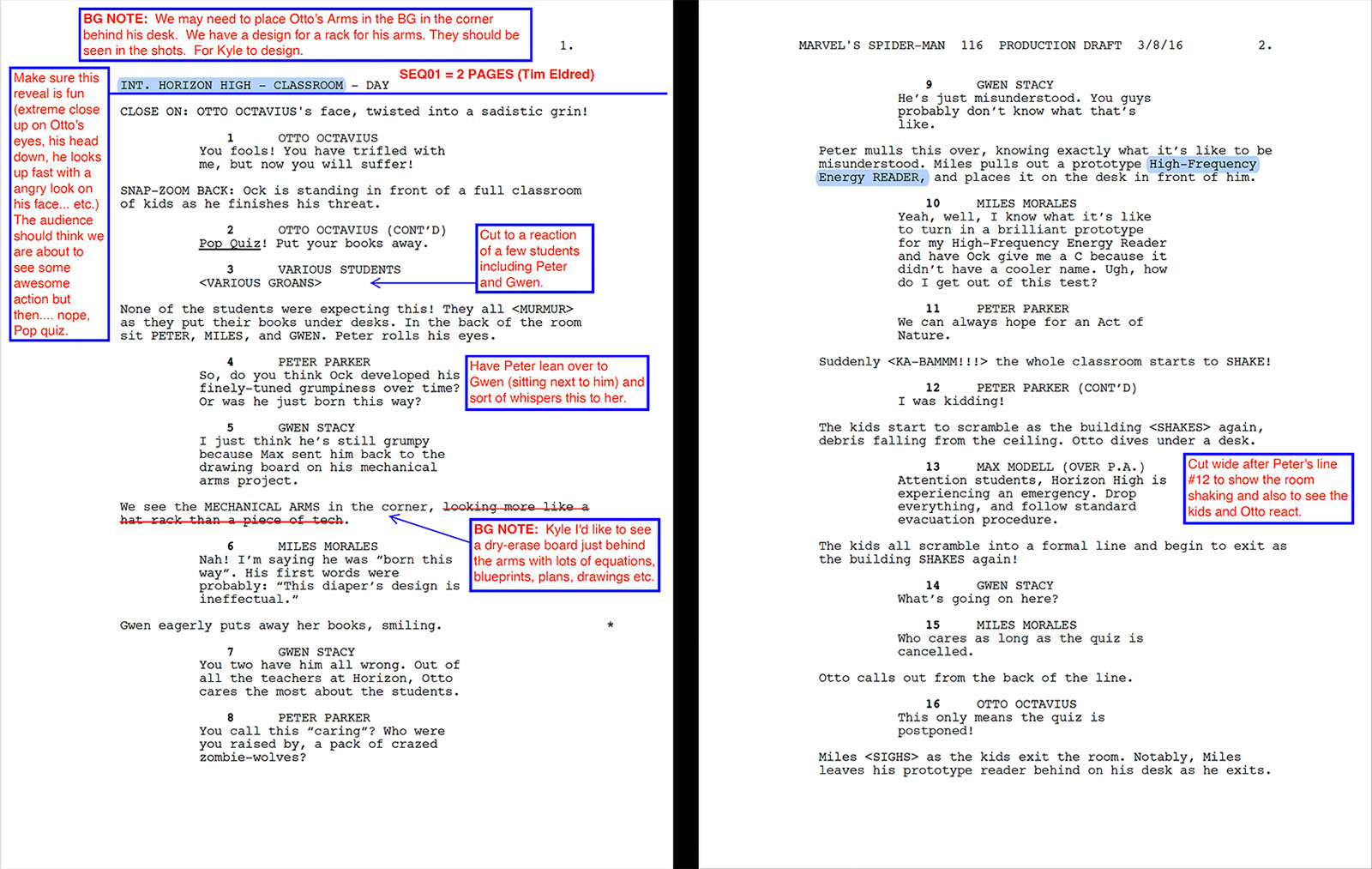
As soon as a script hits the director’s desk, the clock starts ticking. They’ve got a few days to study it, fill it up with notes, and decide how to split it up among the storyboard team. The number of people on a team is always dependent on the show’s budget. With this episode of MSM, the director (Sol Choi) had access to six artists, some senior and some beginners. Some were permanently attached to the director while others floated between directors. Some may have been freelancers. You could have referred to me as a “temp” since I wasn’t officially attached to the series yet. (That would change for season 3, but we’ll get to that later.)
When I’m directing, my goal is to give each team member an equal amount of material to cover. I also try to balance each portion between talking scenes (easy stuff) and action scenes (harder stuff). So it’s not just a matter of chopping up a script from front to back saying, “You get pages 1-5, you get 6-10, you get 11-15,” etc. Then there are other complications. You don’t want to split up a sequence in the middle, because it becomes a bigger challenge for the artists to coordinate with each other. And if you can find ways to give all the sequences in “location A” to one artist and all of “location B” to another artist, it reduces the amount of info they have to take in.
If that’s not complicated enough, you also have to know where an artist’s particular strengths are. If someone hasn’t yet mastered fight choreography, you don’t want to throw them in the deep end with a lot of fight choreography. If someone else (a freelancer, for example) is only available for a short time, you’ll have to give them a shorter assignment. People have often asked me what a TV cartoon director actually does, and this is a prime example.
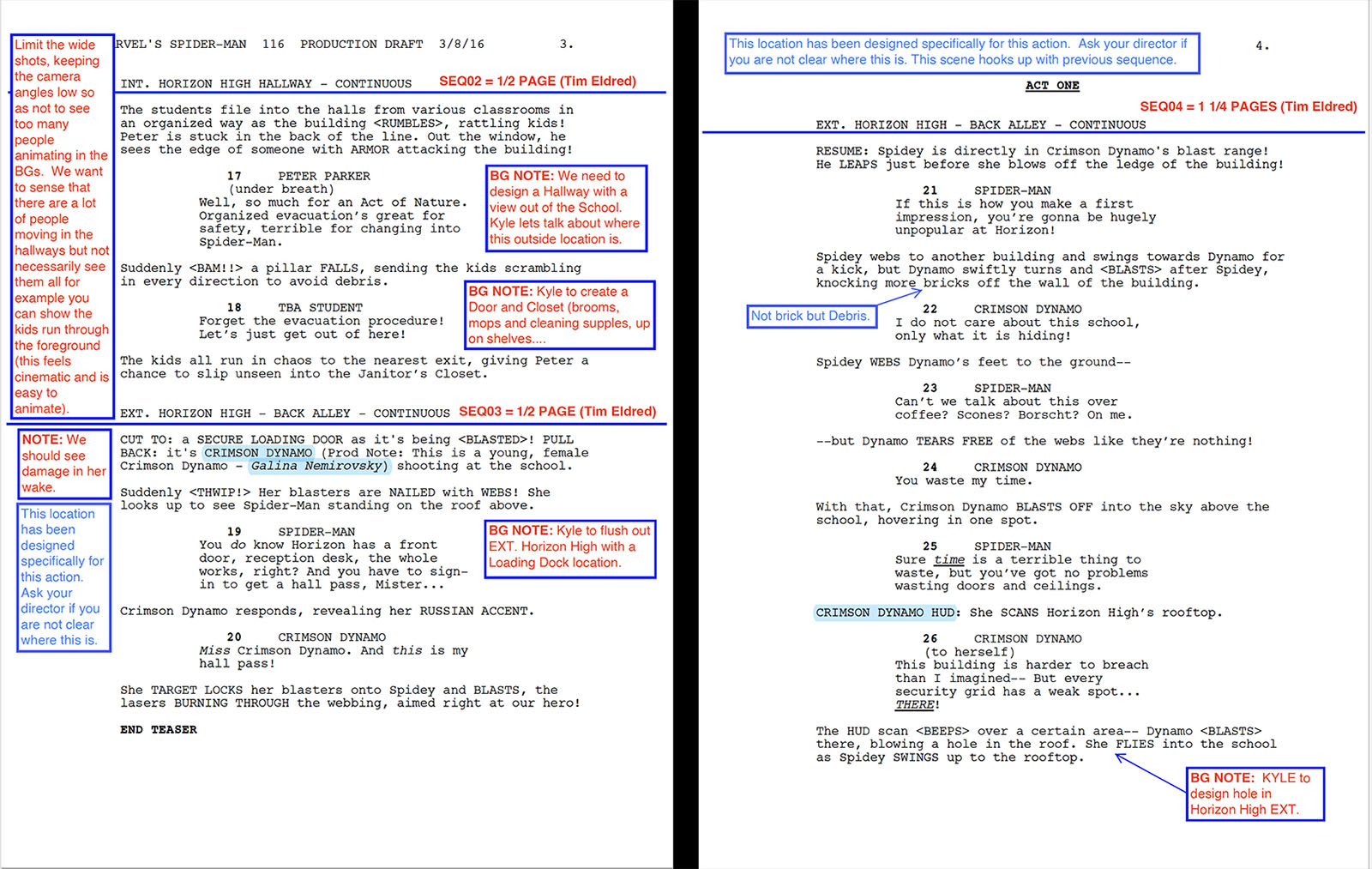
Then there’s the script itself, which always needs more information added to it before it’s ready to draw. The story is there, and all the dialogue is in place, but other things might need fleshing out. For example, writers aren’t always familiar with the set designs. If they’ve written something that doesn’t quite work with the geography of our high school, revisions are needed. If the director sees a way to visually solve something and save screen time, scene descriptions can be shortened or dropped. If the writer didn’t properly anticipate all the details needed for staging a scene (like, say, how many members are in a bad guy gang), a director can fill that in.
For this episode of MSM, my copy of the script came with a bunch of notes plugged into it by the director. When I direct, I typically do a full rewrite; copy/paste all the text into a Word doc and incorporate my notes into it. I started doing that on Avengers Assemble, since my entire storyboard team was based in another country (Canada) and I had to make sure the script was as clear and streamlined as possible to simplify our communication. I always did this with a clear understanding of what I could change and what I could not. Story and dialogue were set in stone. How we told that story visually was mostly up to me.
And now you know another thing a TV cartoon director actually does.
When your script is fully noted up and you’ve decided how to divide it, you’re ready for a storyboard handout. Whenever possible, you get your crew into one room to review the entire script as a group. This gives them a sense of the whole episode, so they’re aware of how their sequences fit together. I got off easy with this episode of MSM, since my part was at the beginning of the episode. It’s more common to get multiple sequences spread out over the script, which means you have more hookup points to be aware of.
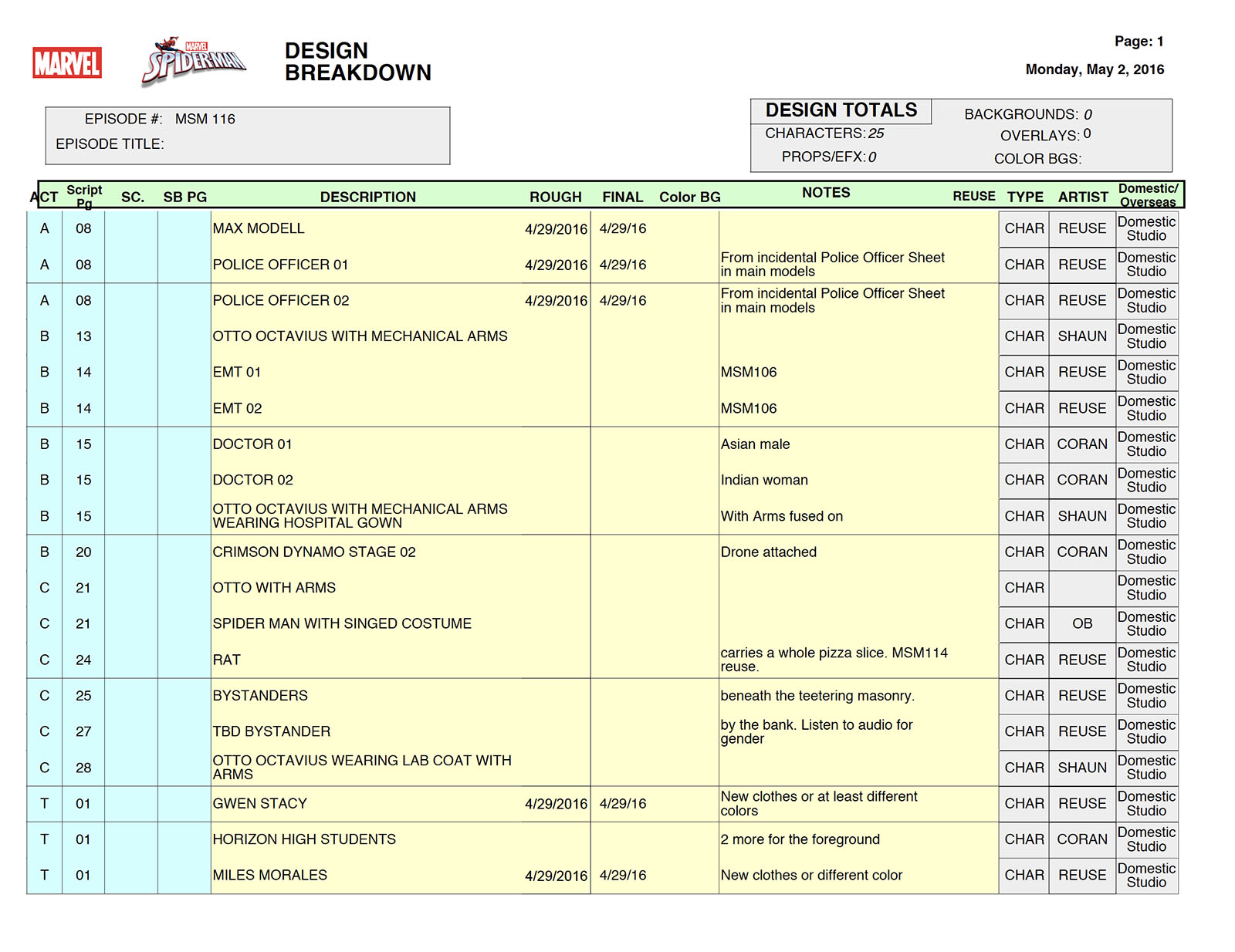
This is also when you receive what we call a “model pack.” This is a set of all the character, set, and prop designs that appear in the episode. Keeping track of this stuff is the job of a design coordinator who keeps a database of everything that gets designed for the series. A “design breakdown” is assembled prior to the handout with a spreadsheet of all the different elements that appear.
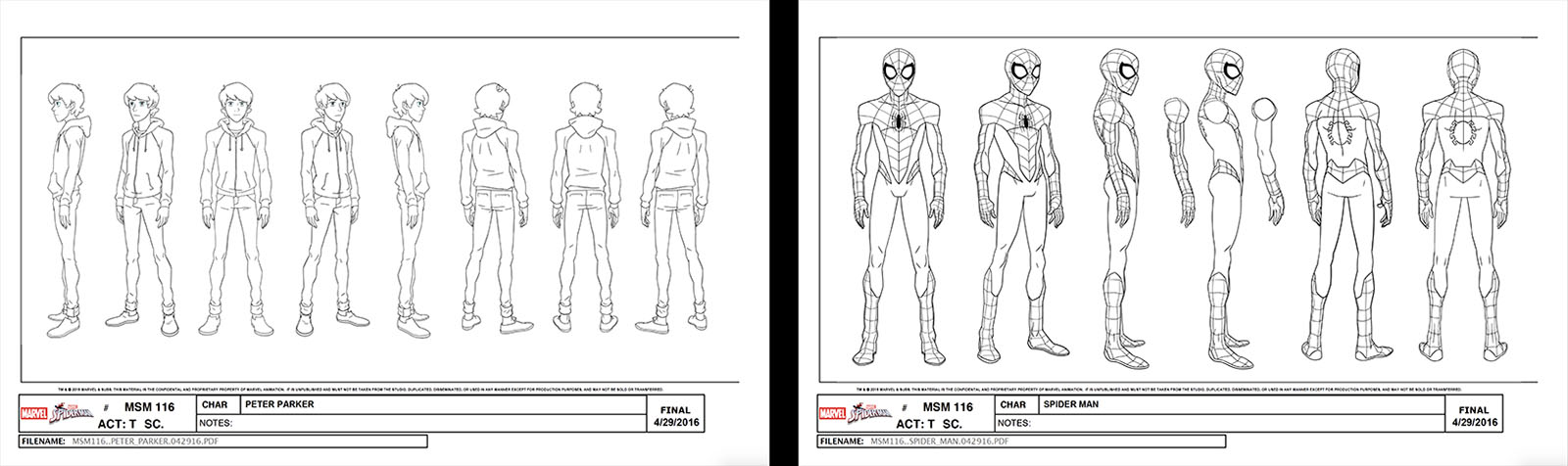
Some of the models follow traditional formats with head shots, expressions, and turnarounds for each character. Since this was my fourth Spidey show, I got to draw my fourth version of Peter Parker et. al. I liked this version quite a bit. The design theory was a sound one; since most of the world’s hand-drawn animation is done in Korea, and most Korean animators are accustomed to working on Japanese anime, we’d probably get better results if we give them anime-based character designs. This turned out to be correct.
Model packs used to be on paper, but these days they’re all digital. Mostly jpeg images. But when I came on board at Marvel in 2012, I was introduced to a new animal: FBX files. (Also sometimes called .obj files.) These are marvelous little time-savers that are another dividend of the CG era. Anything built in CG for the show (backgrounds, vehicles, etc.) can be simplified into a low-rez, rotatable model that can be viewed in a 3D program like Sketchup. We open these up, rotate them to whatever position we need, take a screen shot, and BANG. Instant background for your storyboard. Way easier than trying to accurately draw the thing every single time. You’ll see them in my animatic below.
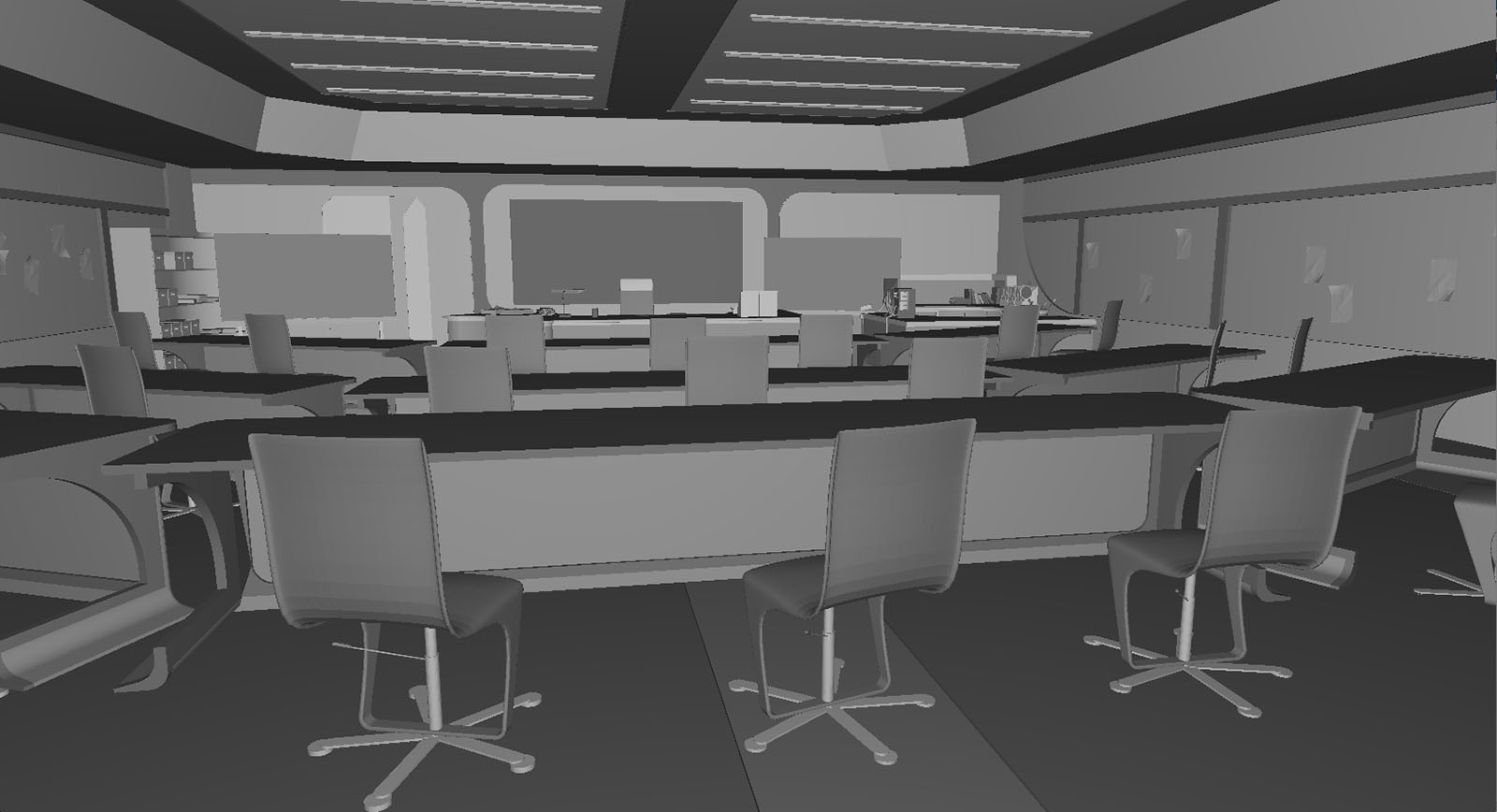
If a new design was needed for this episode, the coordinator flagged it when they got the script and the director worked with a design team to figure it out. This can range from very simple (like a fork) to extremely complicated (like a multi-level spaceship) or somewhere in between (like a new room in the high school). Whatever it is, an approved design is needed in time for the storyboard handout, even if it’s just a rough sketch.
This is another place where a director may have to step in. On Avengers, I found myself constantly having to invent things very quickly to stay on schedule. This would include designing new sets and mapping out how the action would move through them, working out what special effects should look like (sooooo many different energy blasts), reviewing existing designs to find economic ways to reuse them (I once flipped a room over to become a different room), and even flipping through comic books to see if something already existed that we could put on screen.
Every script came with different demands, and working through them was always the most creative part of my job. After that, it was mostly about fixing problems. Which was less fun, but the main part of being a director.
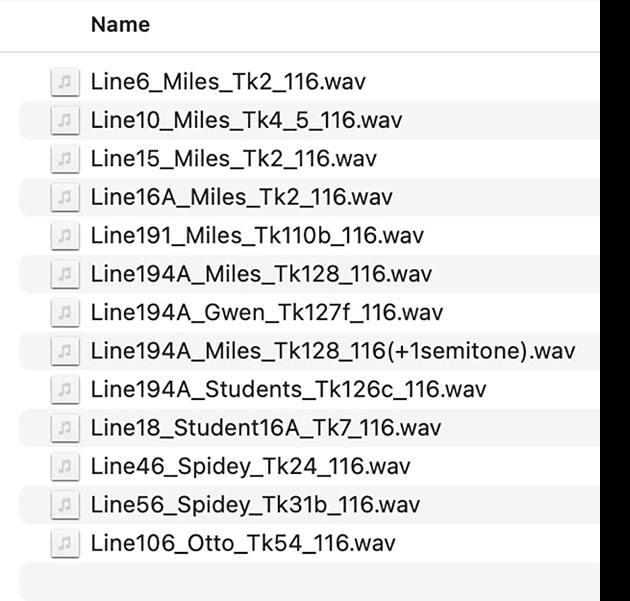
One more item for the handout: audio recordings. Back in the old days, when we were still drawing storyboards on paper, we’d get cassettes with recordings of the voice actors reading their lines. This told us a lot about how the characters should perform in our boards. They had to actually look like they were saying the words, so their expressions and body language had to match. We’d find out if we got it right when an animatic editor put the words and pictures together. Then we’d start revising.
In the era of digital drawing, cassettes were replaced by digital files. Each line is a separate file, numbered to match the corresponding line in the script. We draw the storyboards in an app called Storyboard Pro (there are others, but that’s the most common one), which also gives us the ability to make our own animatic on the spot. We drop the audio files in, use them to time the individual frames that we’ve drawn, and massage everything together. This adds more tasks to the job of “storyboard artist,” but also gives us more control of our work, so I for one appreciate it.
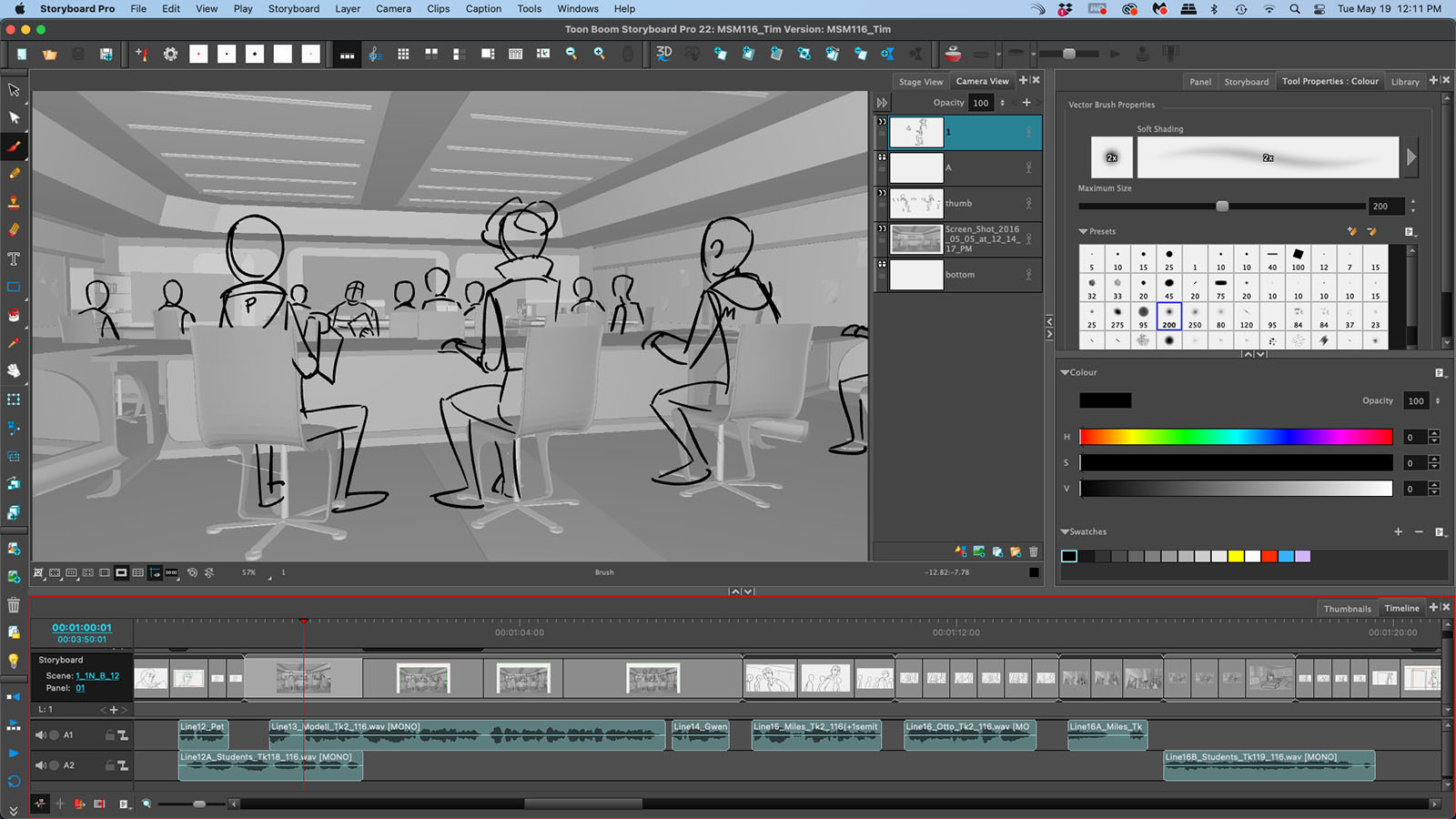
Storyboard Pro in action: drawing space at the top, timeline at the bottom with audio tracks
And with that, the storyboard team has everything they need to start working. The director gives them a deadline for their first rough, and we’re off to the races.
Can the director relax now? Nope. Because if they’ve already gone through this process on previous episodes, there are other trains to be tended farther down the track. The same day you hand out your current episode, you might put the finishing touches on a previous one. Then there are other episodes in between, all in need of different input. At the peak of production, you can have five or six all in progress concurrently, all in different phases.
The toughest phase is usually when you submit the storyboard for review by writers and producers. This is where they respond to what you and your team have done, and tell you whatever revisions they think are necessary. If you get a small number of notes, it doesn’t have a huge impact on your workload. But if you get swamped, it can blow your trains right off their tracks.
I’ve always been fortunate to received relatively few revisions on my episodes (which keeps me employable), and most directors get a revisionist or two to help out. The last thing you want is to derail the storyboard team from their current episode. But sometimes you get more than you bargained for, like a major script change, and you just have to find a solution that minimizes the pain.
Now you know a LOT about what a TV cartoon director does. Probably more than you wanted to know.
And so…class dismissed. Let’s watch some cartoons.
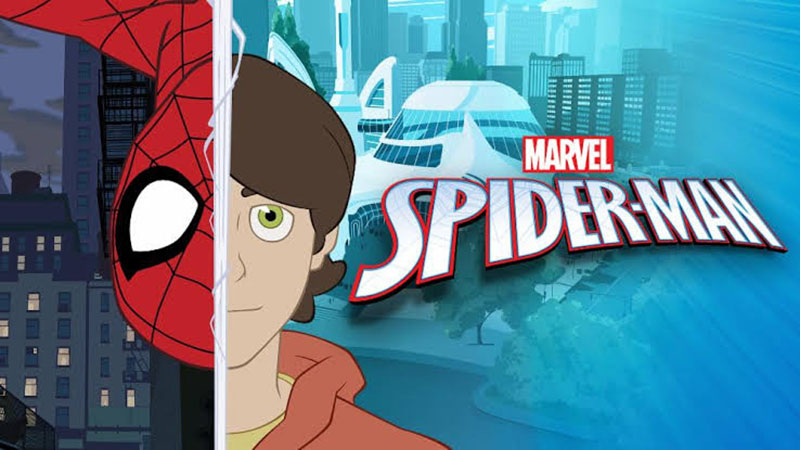
Season 1 aired August 2017 to February 2018 (25 eps) and can now be seen on Disney+
Episode 15: The Rise of Doc Ock Part 1 (of 4)
When Otto Octavius is caught in an explosion that fuses his robot arms to his body during Spider-Man’s fight with Crimson Dynamo, Spidey sees the opportunity to recruit “The Octopus” into becoming a hero.
My rough storyboard was completed in May 2016, and the episode aired January 21, 2018
MY ROUGH STORYBOARD ANIMATIC
Find the finished version on Disney+, or see a crappy, cut-up version on Youtube here
See a video review of the episode here
RELATED LINKS
Marvel Fandom Wiki | Spider-Man Wiki
Wikipedia page | Wikipedia episode list | IMDb page |
Overviews of all Spider-Man series: Version 1 | Version 2
Wow, great work Tim, i remember that show!
I have a few questions.
Did you enjoy working on Marvel cartoons?
(AVENGERS ASSEMBLE)
Why doesn’t Black Widow appear in several episodes? Which episode would you have liked to write, and what would its plot have been like? Which characters would you have liked to see in this series?
Why did the animation style change compared to Avengers EMH, and why did it change even more in Secret Wars?
Why this shows didn’t have a theme song intro like other marvel shows?
I hope you can answer some of my questions. I grew up watching those Disney XD shows. Have a good one, Tim.
Working on Marvel cartoons was very challenging and very satisfying. I felt like I was exactly in my element every day. Black Widow didn’t appear as often as the others because she didn’t have super powers, and the writers couldn’t figure out how to fit her into some of the bigger, cosmic-style adventures. The animation style changed from EMH because it was a new series under different leadership, and Disney wanted new versions of the characters to better match the tone of the MCU. It evolved from season to season to keep the look of the series from getting stale. Most shows didn’t last 5 seasons, after all. Theme songs are much rarer than they used to be. Partially to save screen time and lower the budget (music rights are expensive).