
The webcomic future: Pitsberg (part 1)
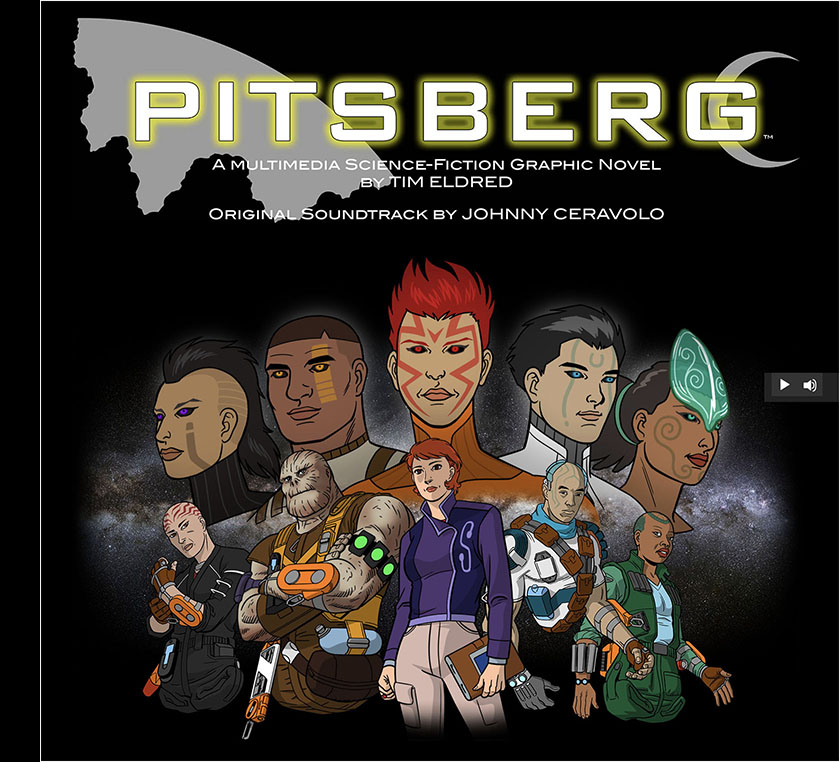
As work on my second Star Blazers webcomic was drawing to a close in 2015, a friend asked me what I was going to do next. I knew what it would be, because I’d been thinking about it for years: my first original concept since I invented Grease Monkey all the way back in 1992. I’d learned a lot about writing and drawing since then, and this new story was going to be utterly different from everything I’d done before. So different that it needed its own dedicated website.
From the moment I decided to make Pitsberg, everything about it was an experiment. The deeper I got into it, the more it felt like someone was whispering in my ear, feeding me ideas that steadily built upon each other. Whenever I described it to someone, I used the term “intergalactic radio,” because it felt like I was tuned into a frequency that no one else could hear. And just about everything coming through that radio was solid gold.
Sometimes it told me, “Try that thing you once thought about.” Other times it said, “If you do this over here, it will unlock that over there.” And still other times I heard, “This is going to sound crazy at first, but stick with me…”
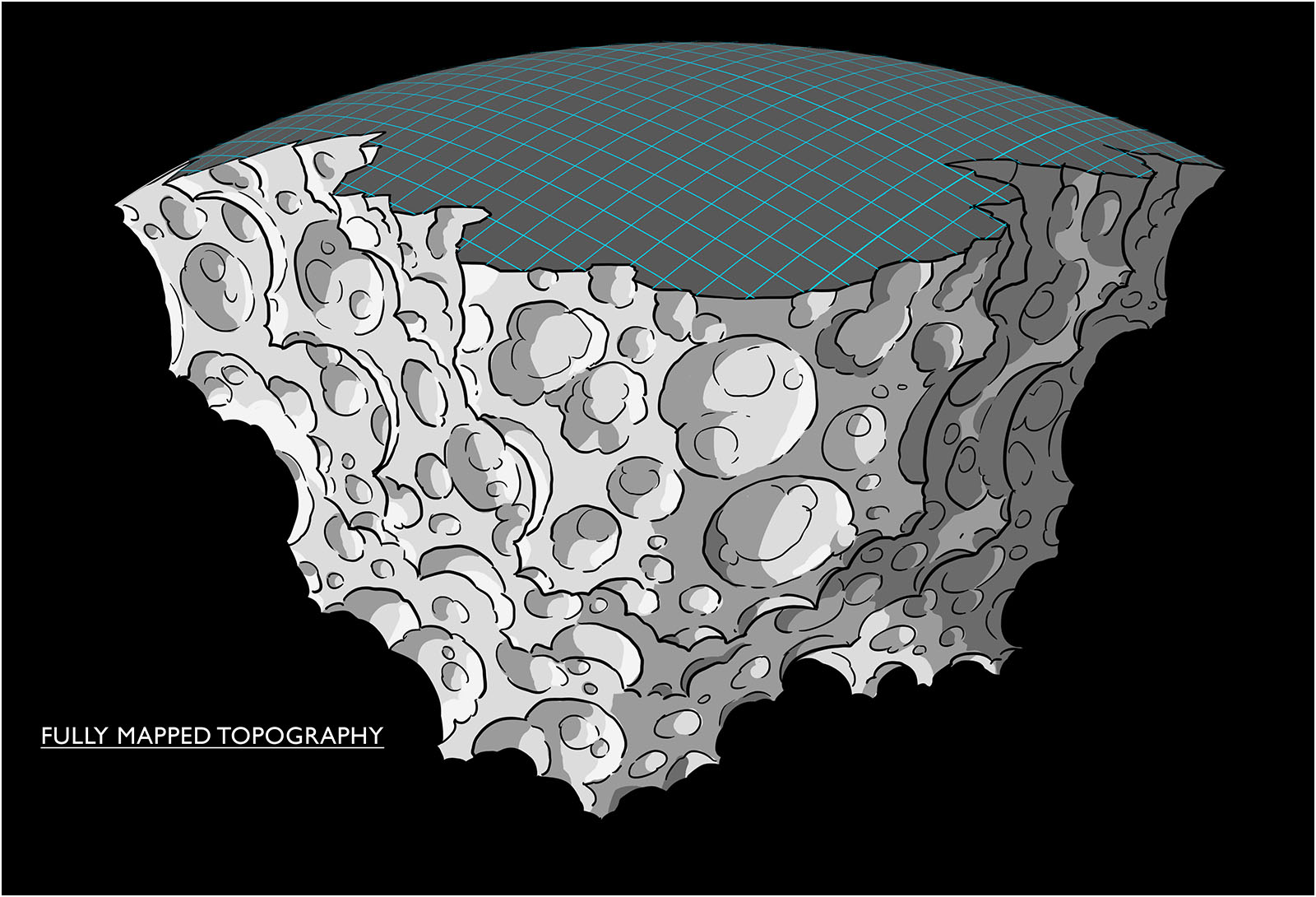
The room where it happens.
The sum total of all these experiments pushed me to an entirely new level of creativity. Writing the story was intoxicating, even if I started a script with no idea how I’d weave all the ideas together. When I finished a chapter, I couldn’t wait to start the next one. That’s exactly how it’s supposed to be when you’re working at the peak of your ability. The work pulls you along, using you as an instrument to get itself made.
The best way for me to describe the experience now that it’s over is to define the experiments one by one. When I wrote them out, the list was even longer than I thought, so it’s going to take a few articles to describe them all. That’s how it is when you fall in love.
(Images are all random pulls from the huge archive of elements created over the course of the story)
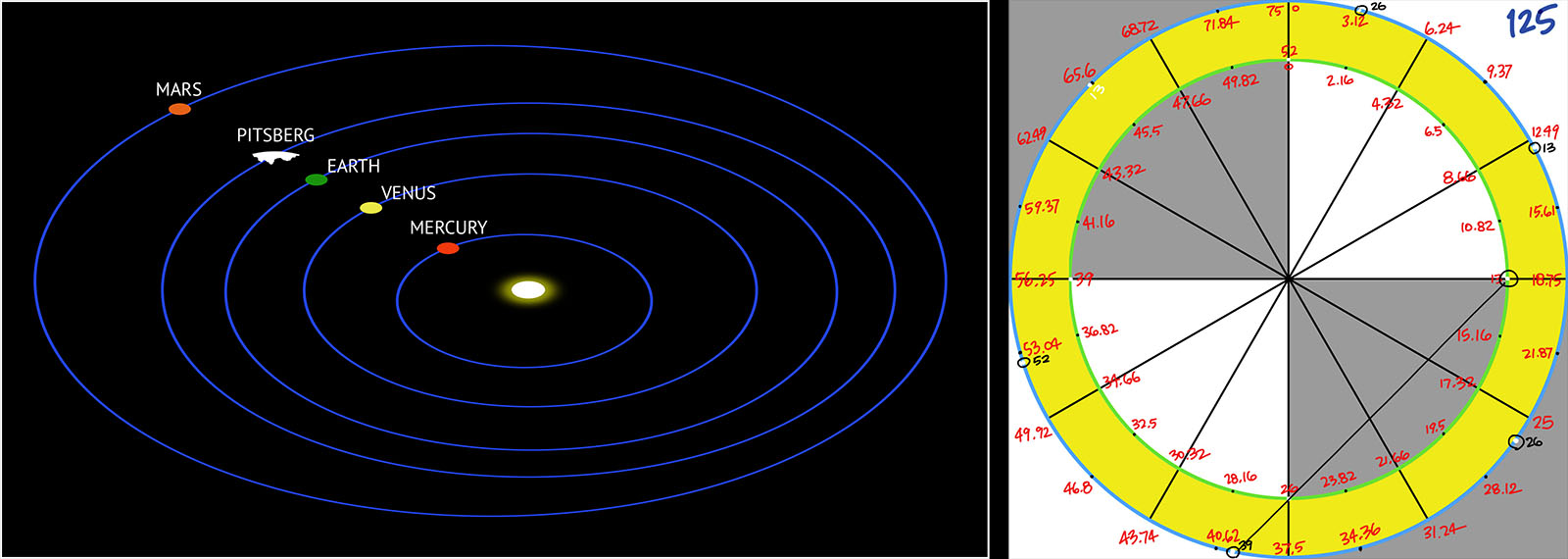
One of my earliest tasks was working out the orbital relationship
between Pitsberg and Earth to set a timeframe for the story.
Experiment 0: Development
I can’t identify a single starting point, because there was more than one.
1: A vivid dream set in a zero-G forest where critters were chasing each other around. One resembled a cat and the other resembled a rabbit. The name I gave it was “Cats and Rabbits” (like “Cops and Robbers”), but I knew that wouldn’t stick. The job was to come up with a story that could get us to that forest.
2: A sighting on a street, specifically in Seattle. Up ahead on the sidewalk were a man and a woman walking together. Except the man was half the height of the woman. Other than his height, he seemed to have a normal build. When I got closer, I saw the reason: he had no legs. He was positioned on a skateboard, pushing himself along with his hands, which were MASSIVE. Honed over time into solid, graceful muscle. It made me wonder, what if you put that man into a zero G environment? He’d be a superhero.
Then there were more lightweight topics, such as growing economic inequality, social media culture, and the steady ruin of our environment. You know, the fun stuff.
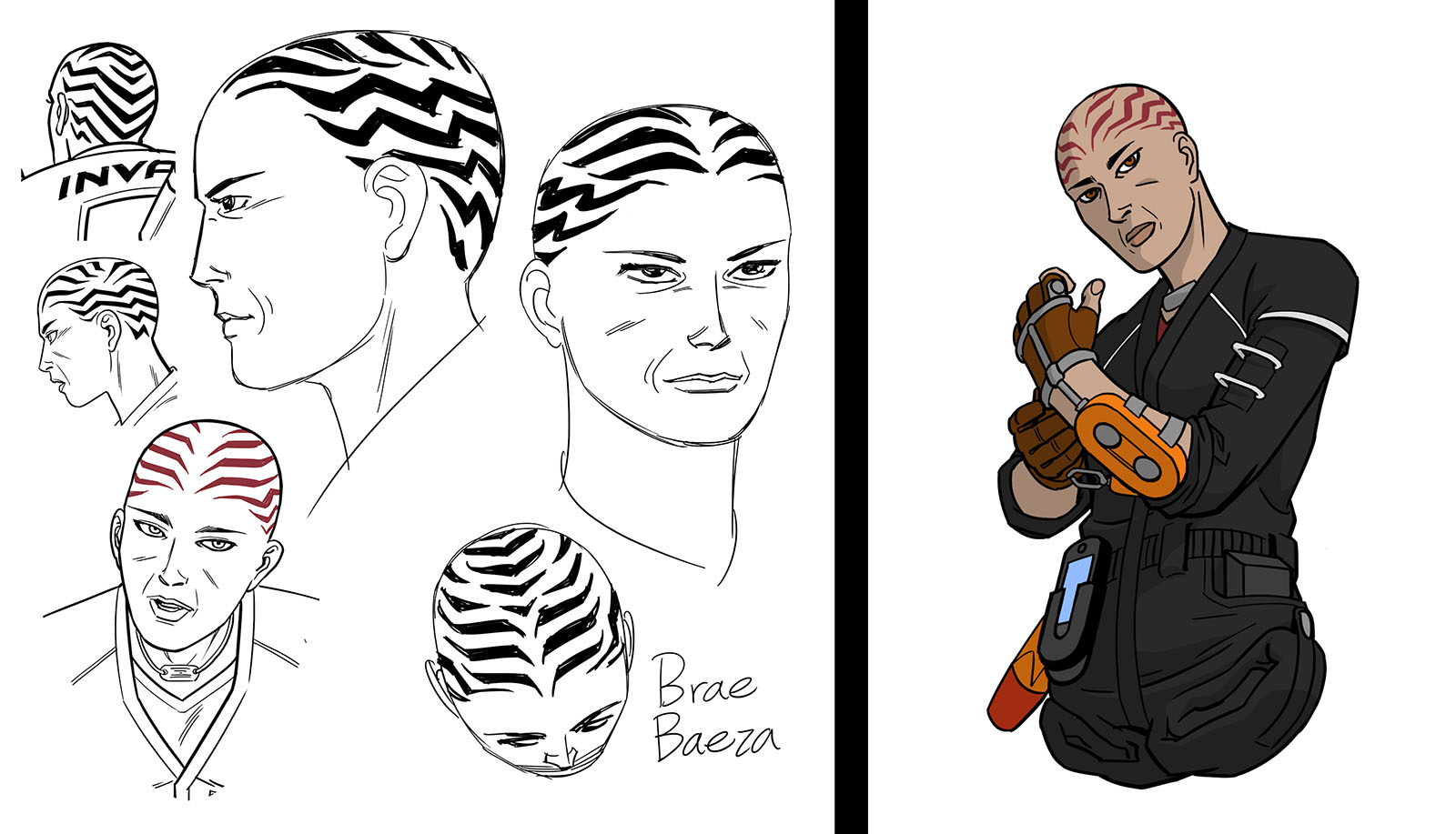
My favorite character. If I cast her in a movie, she’d be played by Sharon Stone.
Overlaying those ideas with a few others gave me a rough direction. The setting was obviously going to be space, and probably needed to take us inside an asteroid, so I dialed up my interest in the latest space science to see what I could use. This created a desire to make the whole thing as scientifically credible as possible without crushing the life out of it.
I developed the ability to “switch on” an idea faucet and let it pour over me. All the best stuff came to me when I was away from a work environment, either running or showering or driving. Sometimes dreaming, sometimes lying in a state of delirium. When something came to me, I knew from experience that I had to write it all down ASAP or it might be lost.
Everything that crackled in was fair game. A name. A line of dialogue. A joke. A gadget. A social condition. An exchange of dialogue. A character trait. I couldn’t use it all, but even the bits that went unused pushed me toward something else. Entire scenes and subplots were woven together out of sticks and crumbs.
In total, it took between three and four years to get the bones of the story enough to start writing scripts. Then the idea faucet became a firehose. I couldn’t stop it if I wanted to.
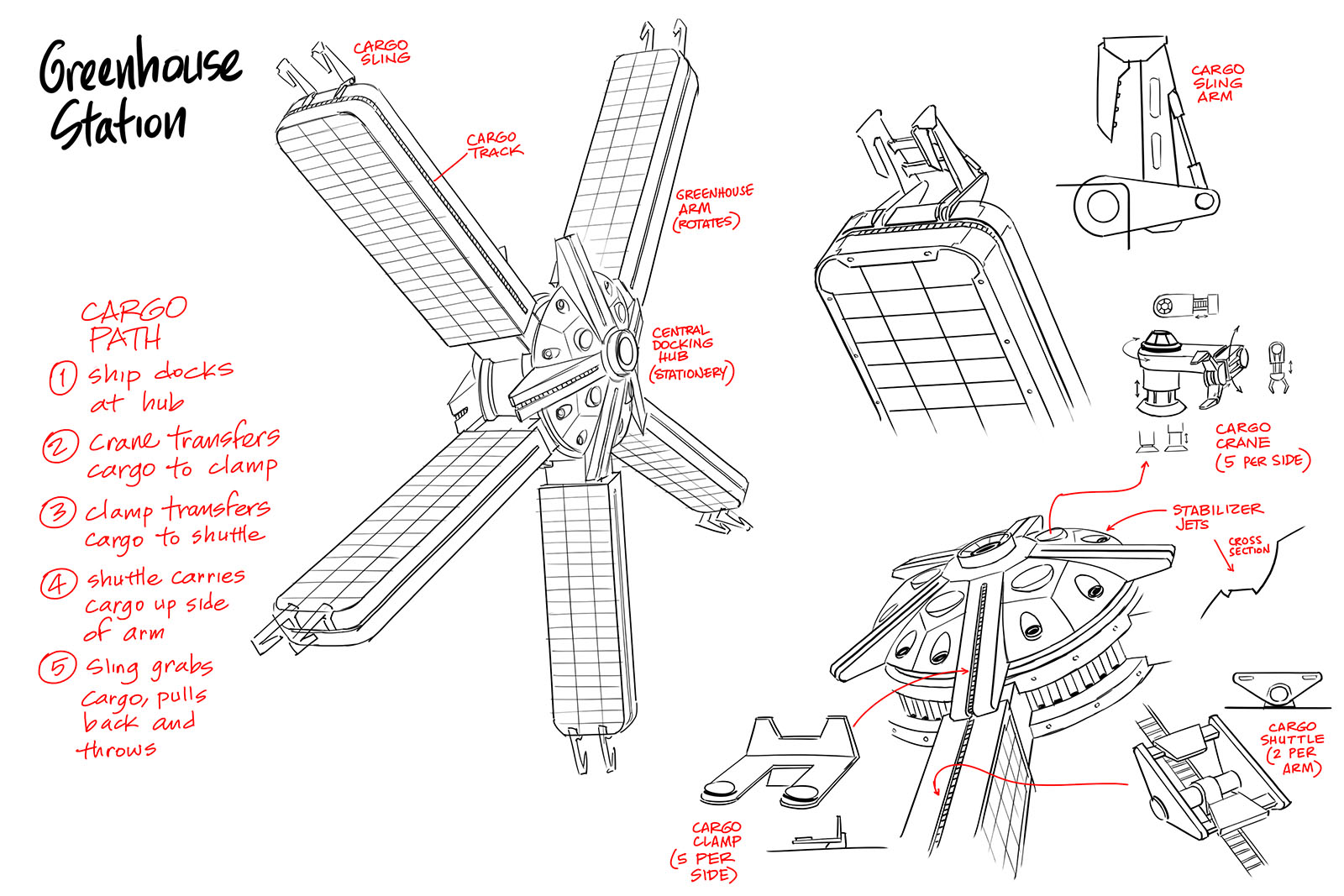
Figuring out a space greenhouse, the critical lifeline for everyone at Pitsberg.
You know what happens to critical lifelines in SF stories, right?
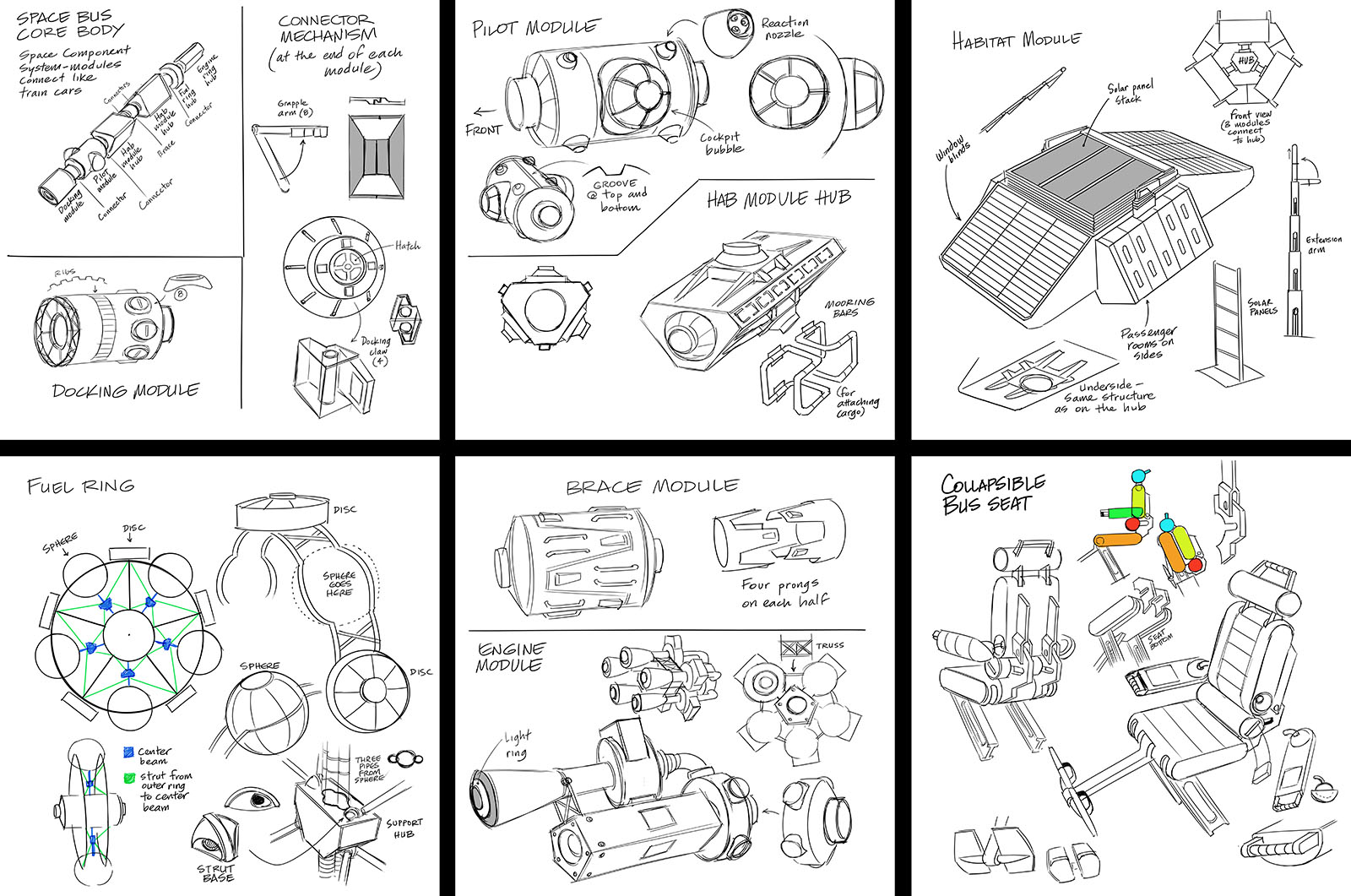
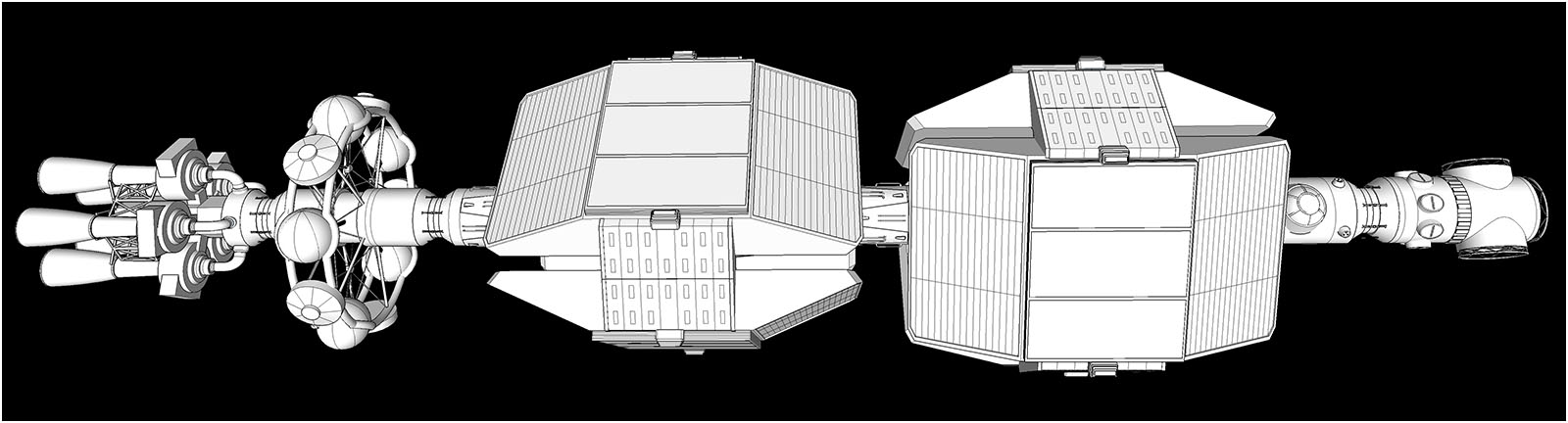
Design process for the Space Component System, which could be
configured into the bus shown below (CG model by Jeff Starling)
Experiment 1: Digital drawing
Back in the 00s, digital drawing invaded the world of animation storyboards. Suddenly, tablets were everywhere and you had to get one to stay employable. I’ve told the tale elsewhere about how I adapted (slowly and painfully) to this adjustment, but adapt I did. I didn’t use it for comics, though. Every page of Star Blazers was drawn on paper to the very end, but as I figured out how digital drawing could enhance the work (especially on the color side) I began to dabble.
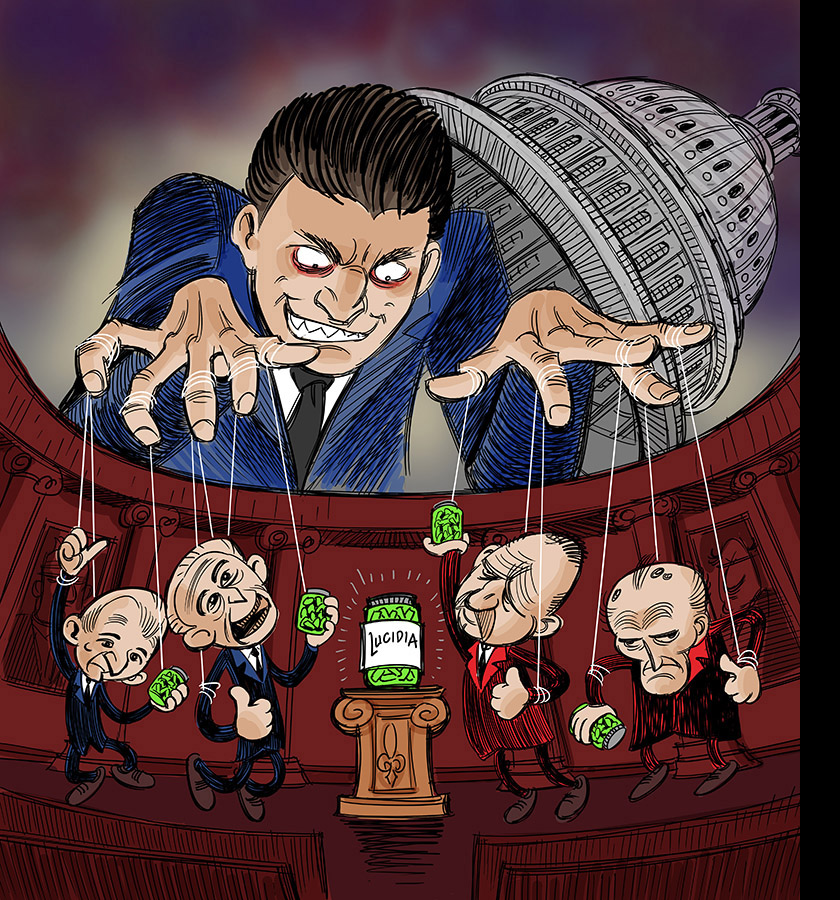
Political cartoon from the future
With Pitsberg, I decided to take the plunge and not look back. Once I found drawing tools that matched what I was used to in the analog realm, I only used paper for the thumbnail. That was scanned and formatted to become the base of a “page” that was built up one digital layer at a time. Photoshop layering had been part of the process since the 90s; multiple elements were drawn on several sheets of paper and composited in Photoshop, but that was limited to special effects. Now it would be the norm for everything.
The result of this was that no “original” art would exist, at least as it is traditionally defined. I would not have an original page to sell afterward. But that was never a priority anyway, so it went out the window in favor of easier production.
Drawing with precision is actually harder than you might think on a tablet. The pixels are just far enough removed from the tip of your pen to throw you off your game. That was the hardest thing to conquer, since a realistic high-tech SF environment demands a lot of precision.
One by one, the obstacles were grappled with and overcome. The versatility I gained in return payed off handsomely.
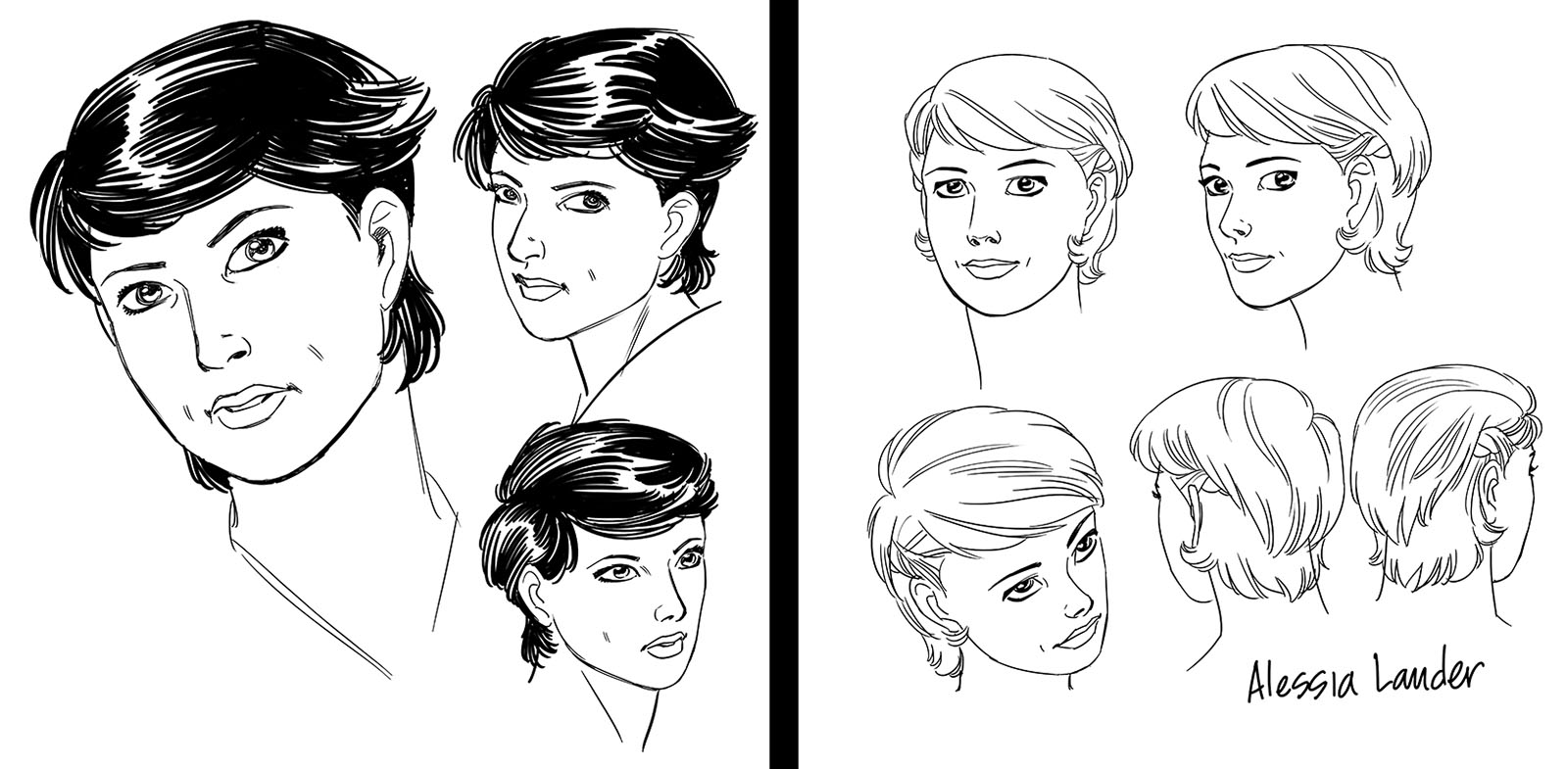
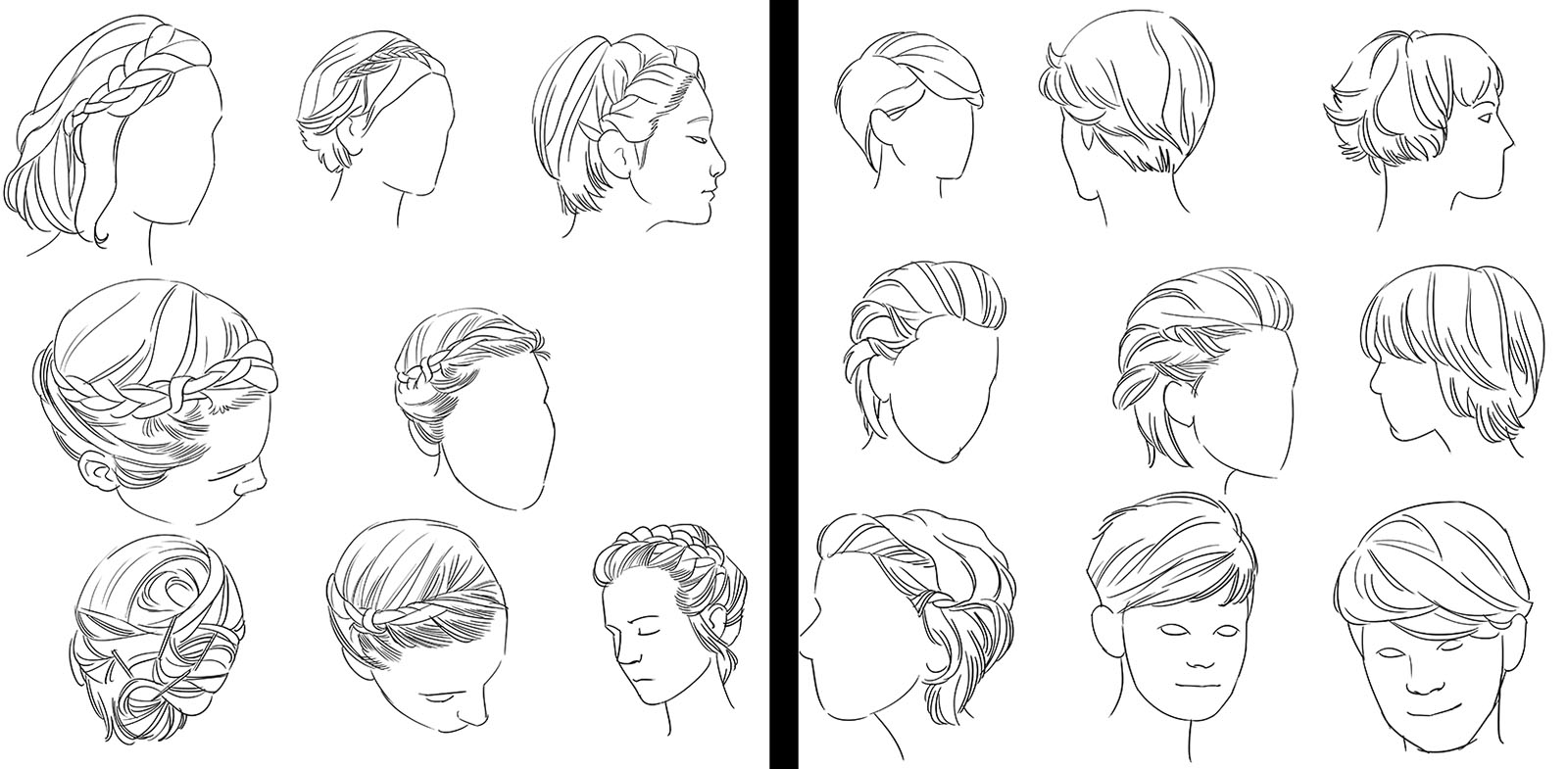
Design process for Alessia Lander. Instead of just making up a bogus hair style,
I did a bunch of research to figure out something practical and realistic for zero G.
Experiment 2: Female lead character
My comics have always had assertive female characters in them, but not until Pitsberg (I’m sorry to say) did I put one in a lead role. The experiment here was to get out of my head and into someone else’s. Rather than falling back on my own opinions and experiences, I wanted to stretch farther outward. And what better way than to swap genders?
Alessia Lander got her name from a talented young artist I worked with at the time (who also did some coloring for me) and a bit of wordplay. “Lander” would immediately put her at a disadvantage among spacers who used the term as a pejorative. The name came easily. But I had a tough time choosing a vocation that would put her on a path that served the story. Her job had to open doors (or hatches, in this case). I thought a medical profession would work before hitting on the idea of a sales representative. That would help to define her character and purpose without me taking a crash course in medicine.
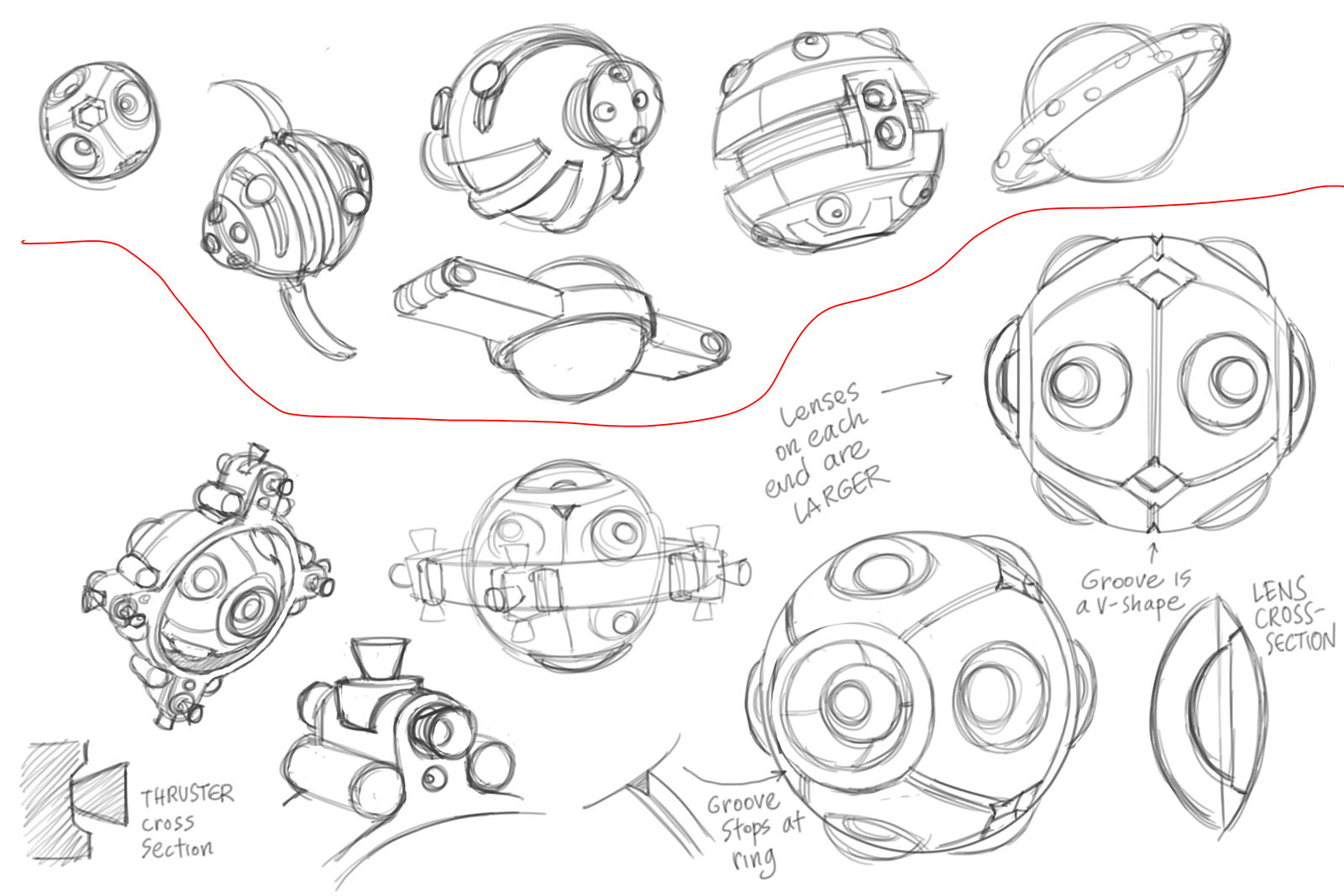
The product she sells: space sprites (to keep an eye on you from outside).
I needed to work out a background for her that would lead to this story, and kept coming up dry until one morning when I was lying in bed and the idea faucet turned on full blast and her life history suddenly poured all over me. It was another “galactic radio” moment where I felt like a listener rather than an author.
In the same moment, I knew how I would reveal her past – right at the start of the first chapter – through the use of a pharmaceutical. And then another giant piece of the puzzle clicked into place: Lucidia. In a flash, I knew exactly who Alessia was, and had Lucidia as a vehicle to drive the entire story.
To this day, I don’t know where all that came from. A switch was flipped, and it was suddenly inside my head. I don’t know what I would have done without it. Thanks, galactic radio!
Experiment 3: Infinite canvas
I’d like to shake the hand of whoever came up with that term, because it says it all.
Anything that gets printed on paper, by definition, has a limited canvas. The paper decides how large or small everything has to be on a given page. The action of turning a page drives compression and expansion to create moments of tension. Similar things happen on a movie or TV screen, we just call it a “field” instead of a “page.”
What if you could break outside of that canvas any time you want? What if your reader could scroll in one direction or another instead of turning a page? Now you have an infinite canvas. Now you’re talkin’ experimental!
When the option of unlimited space landed on the Pitsberg table, I was determined to use it for all it was worth. At least once per chapter, I wanted to find some way of turning the vertical scroll into part of the story. This gave birth to “mega panels” that could never exist on paper: long, immersive images that would take you somewhere a comic book couldn’t go.
That would mean irrevocably splitting Pitsberg away from the world of paper, but (as I’ve said over and over) that world was no longer my priority. It’s just too fraught with cost and compromise. Freeing myself from that concern gave me so much creative freedom, I felt no desire to ever look back.
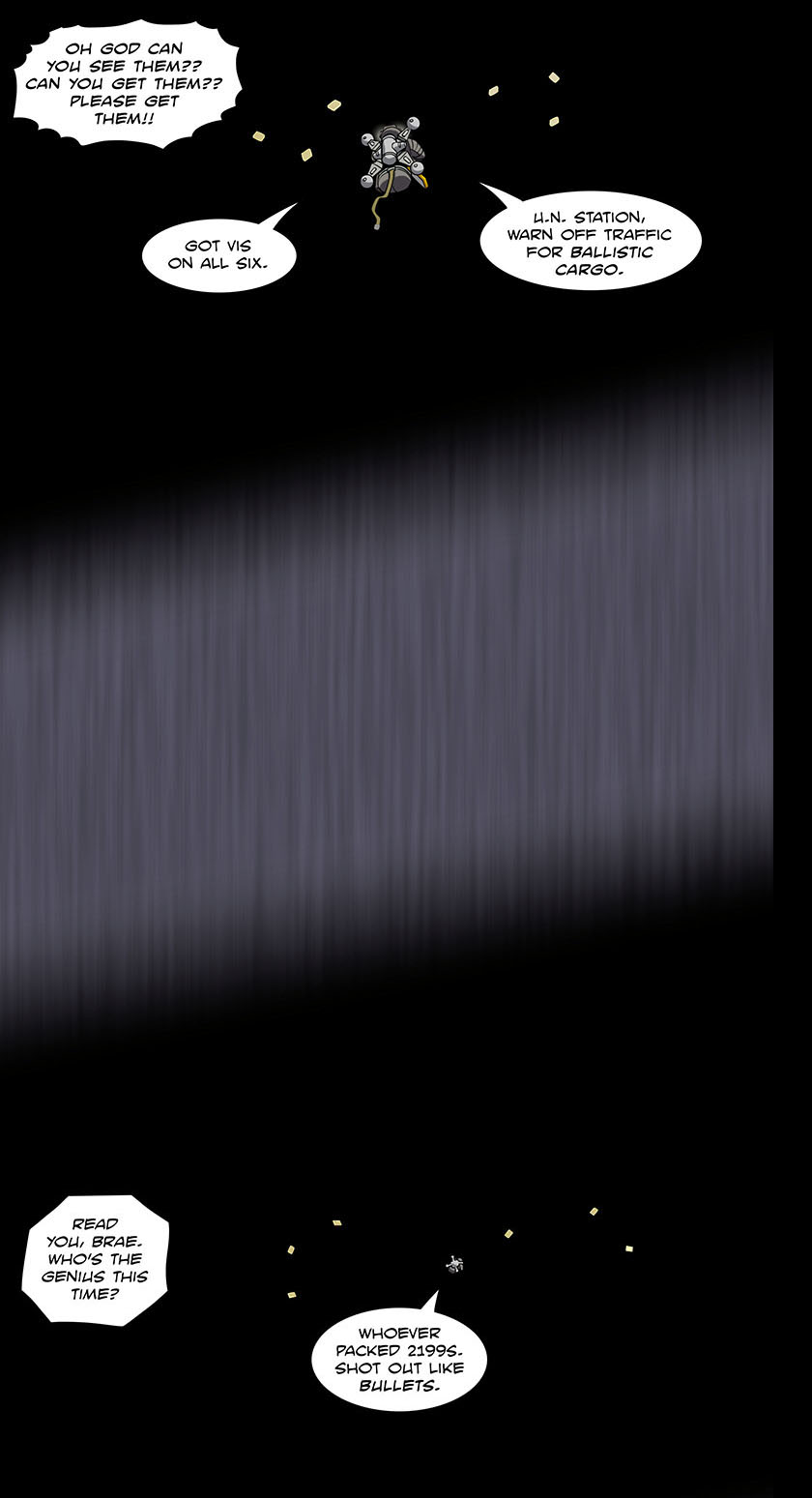
Once I even found a way to create artificial motion through scrolling. Alessia got stuck in a zero G tumble, and I could show her unbroken point of view with a mega panel that rolled through everything she saw (portion shown at left). Impossible on paper. You could do it on film for thousands of dollars, but I did it for free with pixels. It felt like discovering a magic trick.
This paid off in another way when I realized that the Fallen Heroes stories could travel in another direction with horizontal scrolling. This was partially to make it feel like a comic book, but here too there were ways to exploit the infinite canvas option.
Man, I feel drunk on freedom just typing these words.
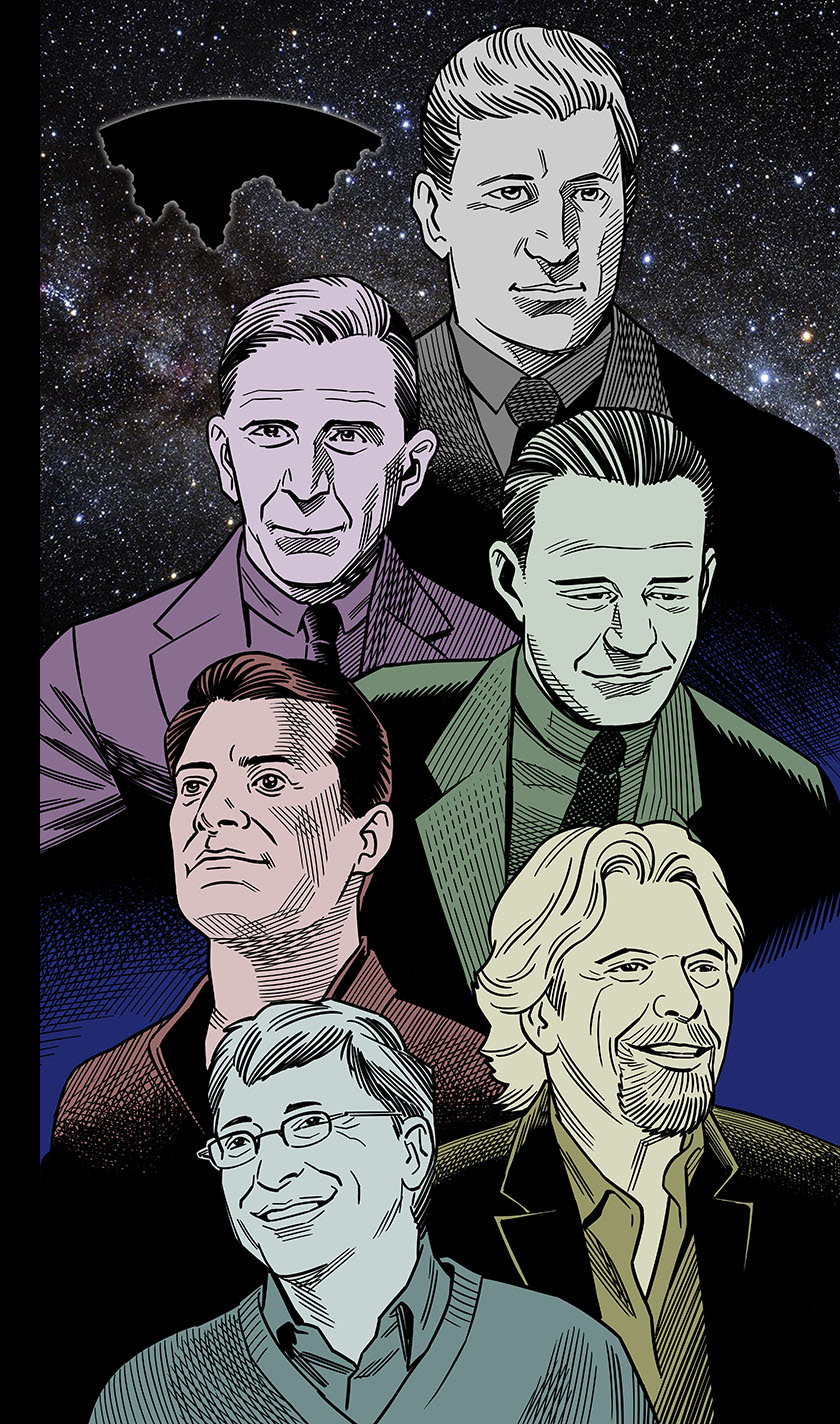
Famous rich people who moved private space development forward. The bottom three are from our time. Elon Musk was going to be one of them before he lost his mind,
so I replaced him with Peter Diamandis.
Experiment 4: parallel narratives
Why tell just one story, when you can tell three? Honestly, this was not one of the seminal ideas, but once I realized it could be done, it was fascinating. The main decision-maker was the sheer volume of world building that went on during the development phase.
The future of our world is going to be at least as complex as the present with multiple moving parts and politics and pop culture and economics and ideology and all the rest. It would all inform the scenario for Pitsberg. What would future media be like? Who would be at odds? What phase of the struggle between politics and religion would we be in? It all mattered.
As the layers built up, I had to think hard about how to communicate the info that was relevant to the story. The fancy writer word for that is “exposition.” The clumsy version of exposition goes something like this:
“Did you see the story on the news about [subject]? It made me think about how [historical fact] led to [social development] and resulted in us not having enough [resource].”
Who talks like that? Nobody. There are more subtle and nuanced ways to deliver exposition, but some of the info was just too dense to break down, like the backstory of the Libers. This was akin to a labor movement. The people in the story would already have that knowledge and not need to explain it. But that would leave out the reader, right?
I don’t remember how the solution came to me, but it was perfect: split that background info into a separate narrative. But don’t just make it a description, or nobody will stay interested. Instead, make it personal. Even better, give it a political bias that wouldn’t necessarily be correct. Give this task to an “unreliable narrator.” And thus, Astronymous was born. Not just to educate you, but also to function as another character in the story. When I realized I could weave an Astronymous presentation into the comic itself, there was no way I couldn’t use it.
The third narrative became the Fallen Heroes series. The driver behind it was wanting to find another way to make the Pitsberg world more like ours. How often do you see fictional media in fictional stories? Almost never. But in our world, we’re saturated with it. As an outgrowth of that, Pitsberg would have to have media. More specifically, its own fiction. I conceived all this while working at Marvel Animation Studio during the ascendent years of the MCU, and it felt entirely appropriate to give this world its own version of the MCU.
That was the starting point, anyway. I’ll have more to say about it later.
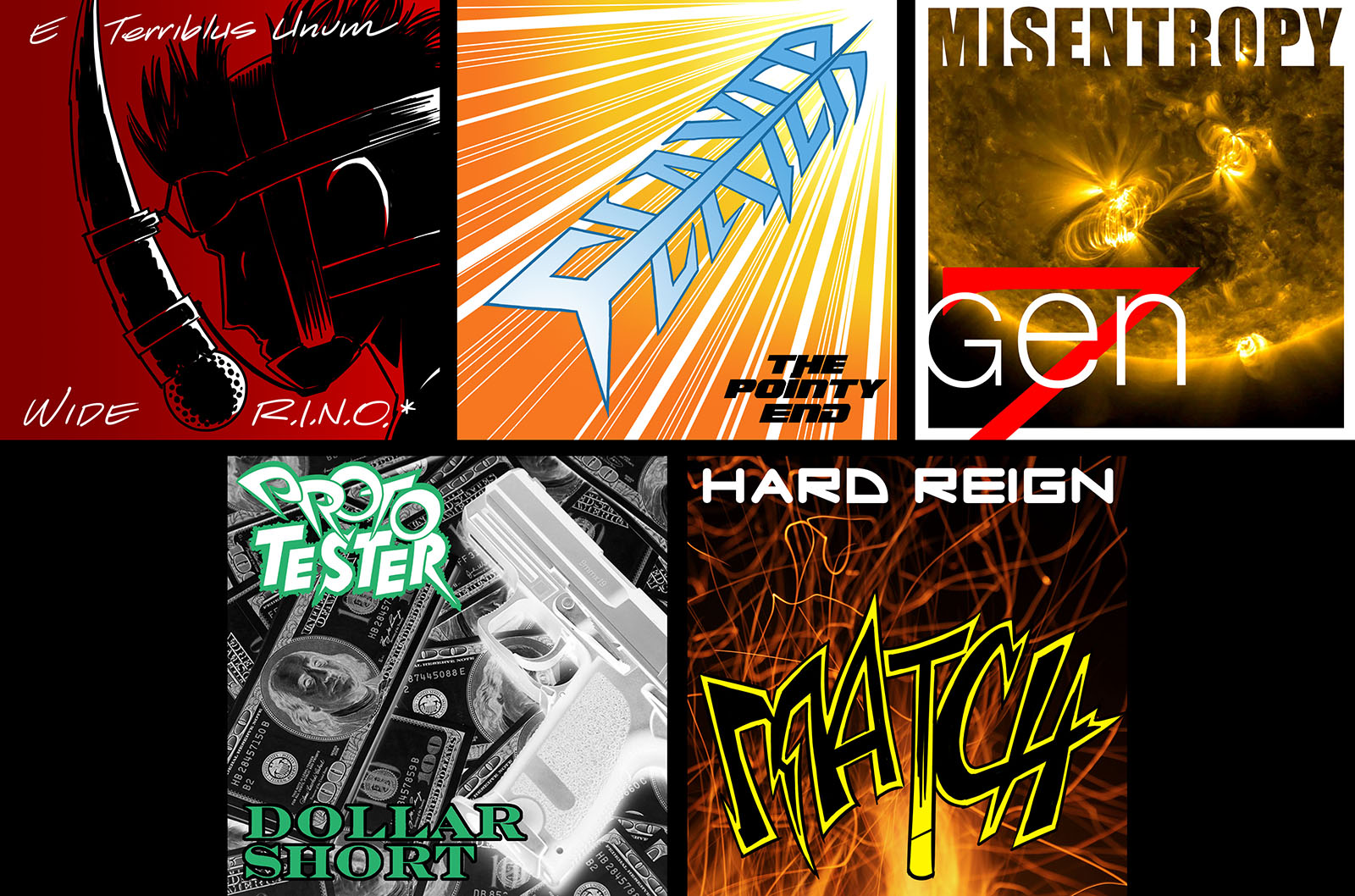
The world of Pitsberg also has its own protest music, called “rant rock.” Here’s some album art.
Experiment 5: Animated chapters
As soon as I decided to create a separate narrative stream to carry the exposition, I realized the best way to present it was via animation. If I tried to do it in a comic format, it would end up looking like a storybook with a few illustrations and big blocks of text nobody would want to read. And so…cartoons to the rescue!
Storyboard Pro, the software we used to make cartoons, was perfect for the task. Once I had a script written, I could work out several ways to illustrate it using both still and moving images. It was like creating a documentary from the future with multiple art styles, simulated photographs, diagrams, maps, the works. I could even subtitle it to make sure nobody got lost.
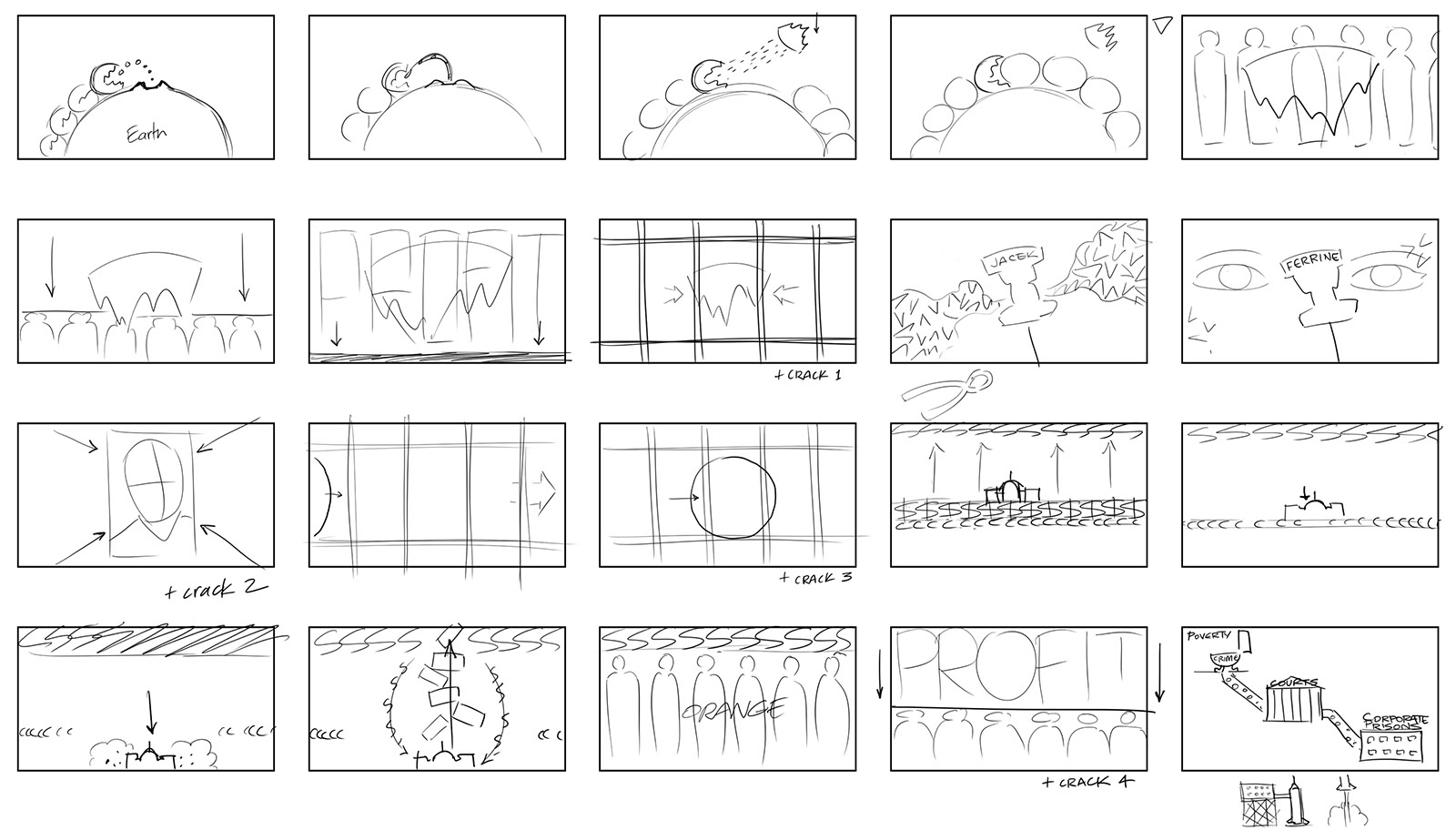
Every one of these had to be storyboarded first. Here’s a page from one.
This was where I really had to drill down on the content. I needed to determine what subjects to cover at what time so the information in an Astronymous video would allow you to keep up with the characters in the story. There was also some strategic misinformation from time to time that kept you guessing.
Once that was worked out, I could write a script and get an artificial narrator to read it. Astronymous would use a simulated voice to be untraceable, so I did the same thing using a website that would read your words in an artificial voice of your choosing. It took some careful rewriting to get correct pronunciation, then I asked my friend Thom Kercheval (a musician with his own recording studio) to produce a sound file that was pitched just right.
I plugged that into Storyboard Pro and started drawing the images that would reinforce and expand on what the voice was telling you. It was the hardest part of the whole project, but the challenge to keep topping myself made me look forward to the next one.
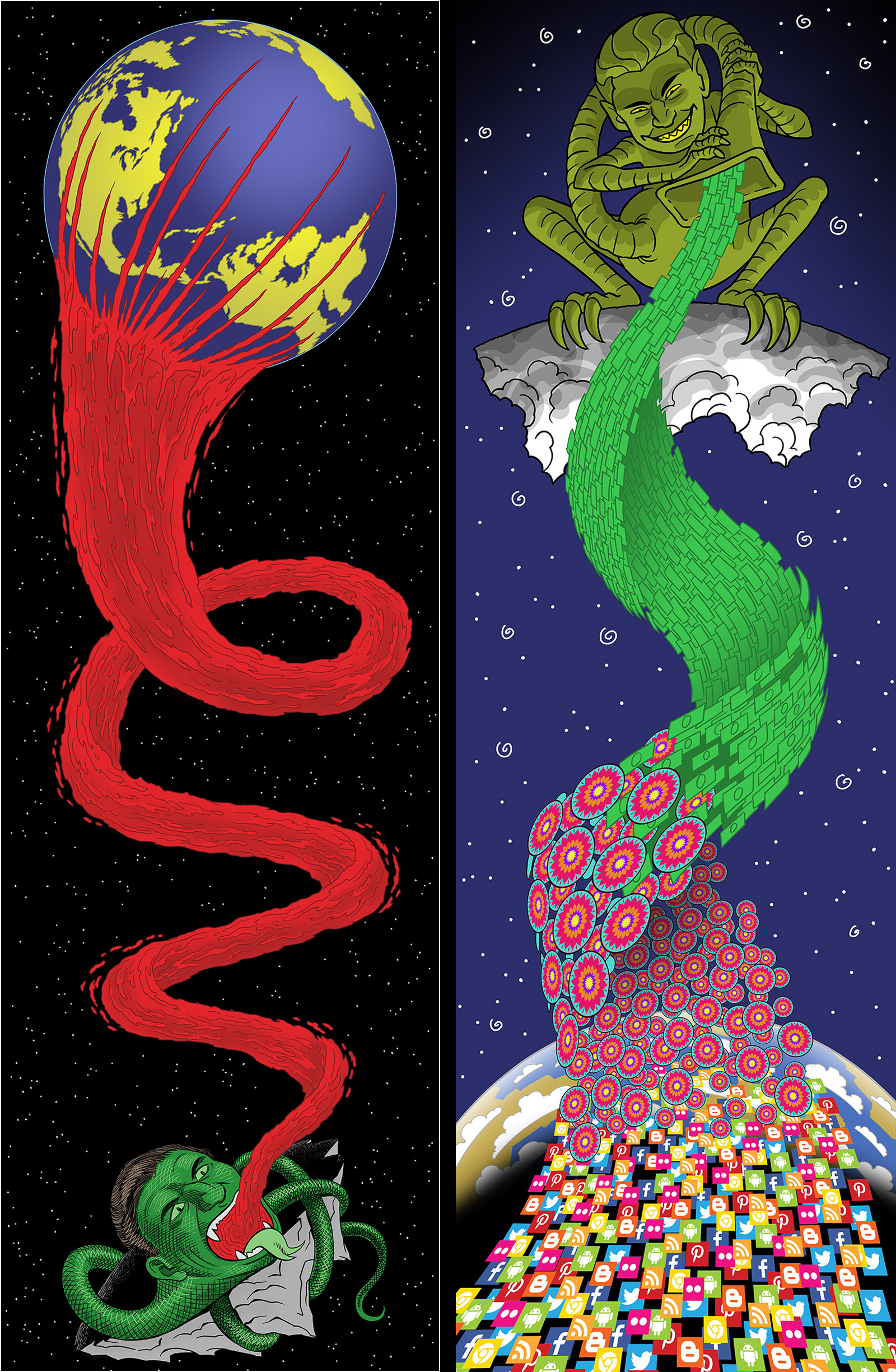
Character assassination cartoons, intentionally as lurid and unflattering as possible.
Next time: the experiments continue with creating super-heroes, writing a mystery, adding political & social commentary, drawing likenesses, and using CG models