
Comics go to the movies: King Kong
Hoo boy. When I decided to write this article, I thought it would be simple: look through the classic King Kong adaptation from 1968, share my impressions, and call it a day. No rabbit holes.
But then I went googling for some background on the comic…and the rabbit holes sucked me right in. I wasn’t surprised to find that Kong had an influence on other comics; since every kid with an art brain was entranced by the original movie, it was only natural that giant gorillas would invade the comic books they drew. Instead, I was surprised by where and when Kong made his various leaps to paper and how those leaps intertwined with his moving-picture career.
As the spiderweb branched out over nine decades (we’re just 7 years from the Kongcentennial as I write these words), I decided to limit myself to the projects that were based on the original story. But here too, the rabbit holes were impossible to ignore. My original goal is still accomplished herein, but the education I got along the way made it so much more interesting that I couldn’t leave anything out. I hope you’ll agree.
(Yes of course we’re also going to Japan. And other countries.)
1932: The Novel
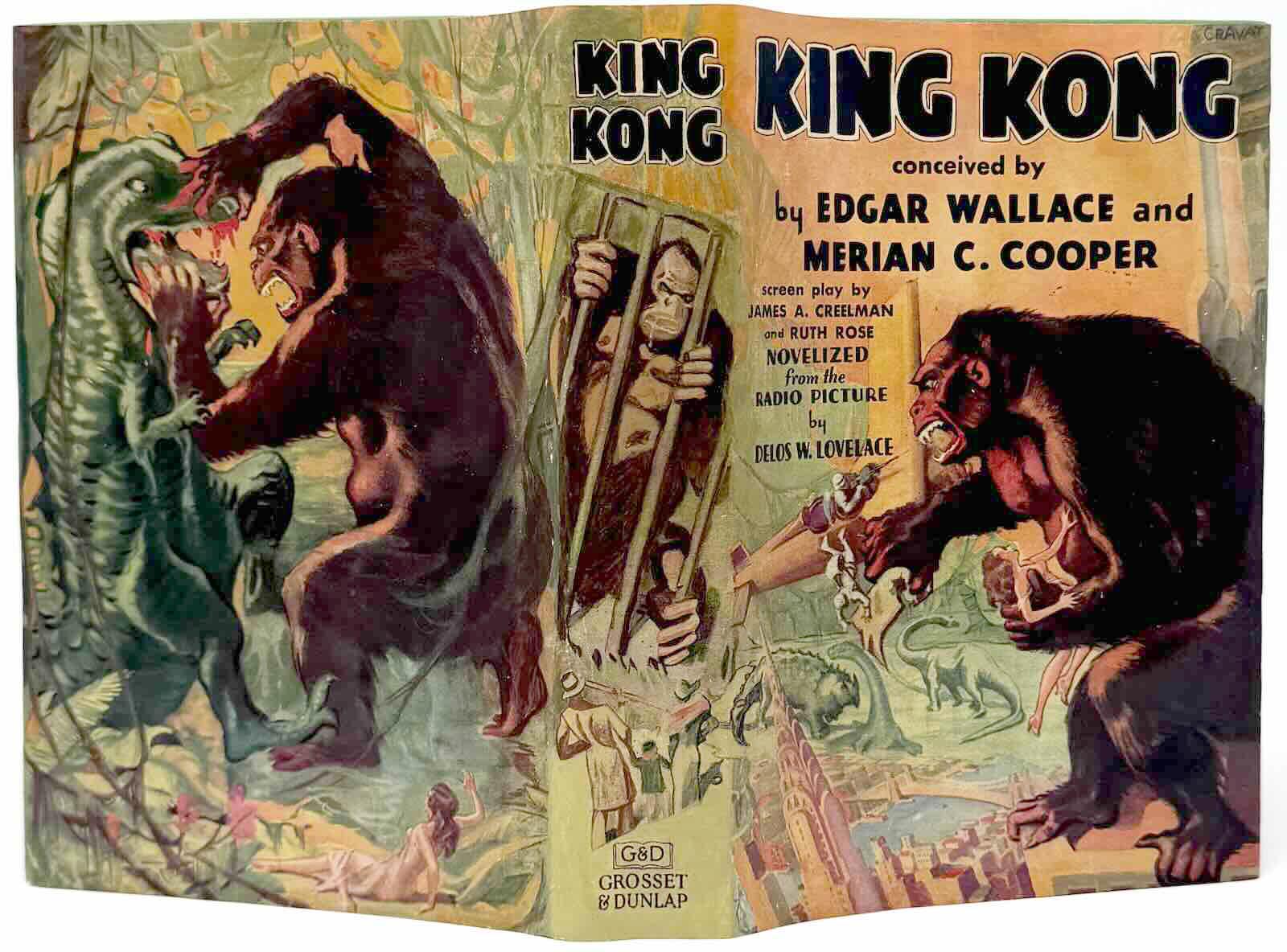
Based on a story by Edgar Wallace and Merian C. Cooper, King Kong was first novelized by Delos W. Lovelace. The film screenplay was acknowledged on the cover, but the difference in rights between the film and the novel would become a significant factor over subsequent decades.
As a story unto itself, the novelization is a banger. The contemporary references and dialects are part and parcel, but the prose is just as vivid and engaging now as it was then.
If you’re intrigued, and you have an Audible account, you can listen to it for free here.
Click here for a Youtube explainer that compares it to the film.
Enough time has passed for the novel to enter public domain, but anyone who goes looking to take advantage of this still has an obstacle course of visual rights to contend with. We’ll see how that affected later projects as we tour through Kong’s exploits in the 20th century.
Incidentally, the art for the novel’s dustjacket was created by Glen Cravath (1897-1964), whose name will come up again shortly.
1932: Preproduction
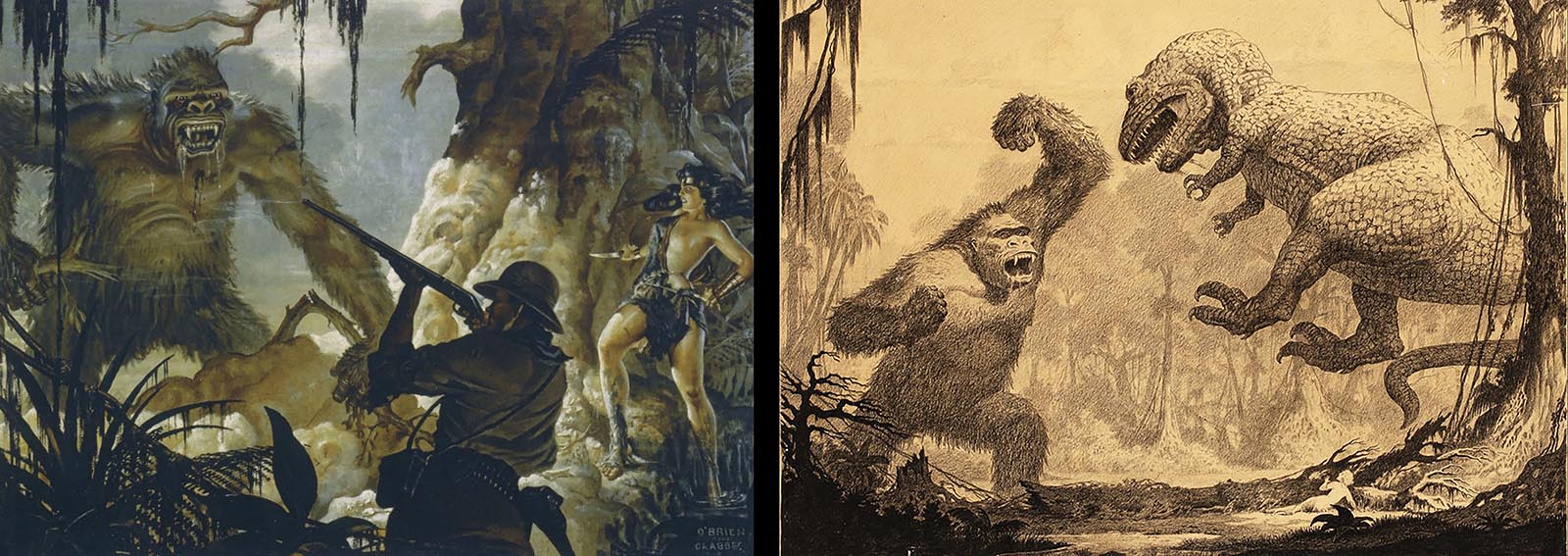
Today we call it “previz,” but it serves the same purpose; artists huddle with filmmakers to envision what a movie could look like. Regardless of whether the movie itself follows suit, previz art preserves a character of its own, a “what if” version of the story that adds flavor in an eternal time capsule.
Kong‘s previz art was created by Byron Crabbe, Mario Larrinaga, Ernest Smythe, and Willis O’Brien (who would go on to supervise the stop-motion animation). Some pieces captured scenes that didn’t end up on film while others had a direct influence. None of them fail to ignite the imagination of a comic book artist.
Thanks to the efforts of many online collectors, you can see a substantial gallery here, including some of the movie posters they led to.
Read a short article on the previz art here
1933: Movie promotion
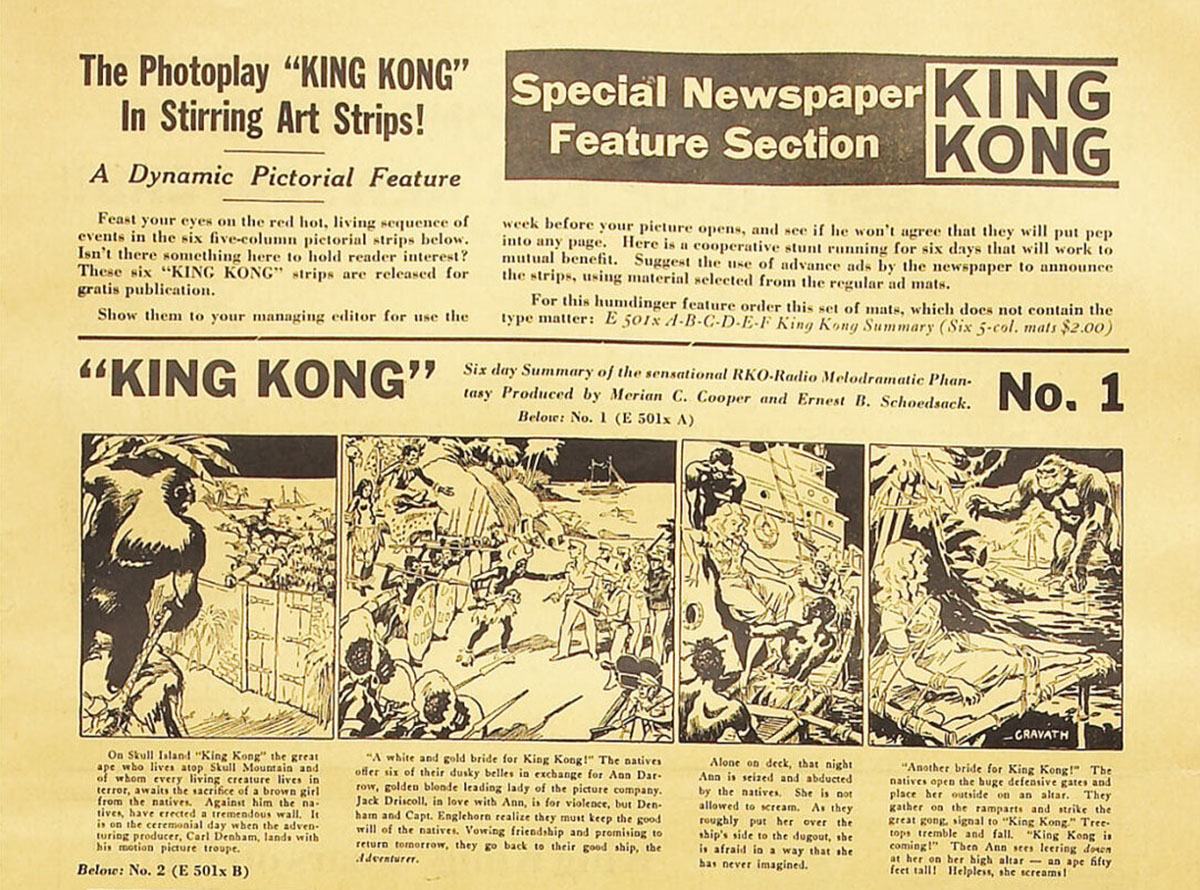
Believe it or not, the very first King Kong comics appeared just before the film. RKO Studio produced six narrative-style comic strips to be published in newspapers each day leading up to the premiere on March 2. This is where Glen Cravath re-entered the picture after creating the dust jacket for the novel. He was also called upon to illustrate one of the movie posters. Later in the year, he produced six more comic strips for Son of Kong, released in December.
Click here to see the comics and more art by Glen Cravath
Learn more about Glen Cravath here
Read more about the comic strips here
RELATED LINKS
Overviews of the movie: Wikipedia | Wikizilla | TV Tropes
Wikipedia page on Merian C. Cooper (1893-1973)
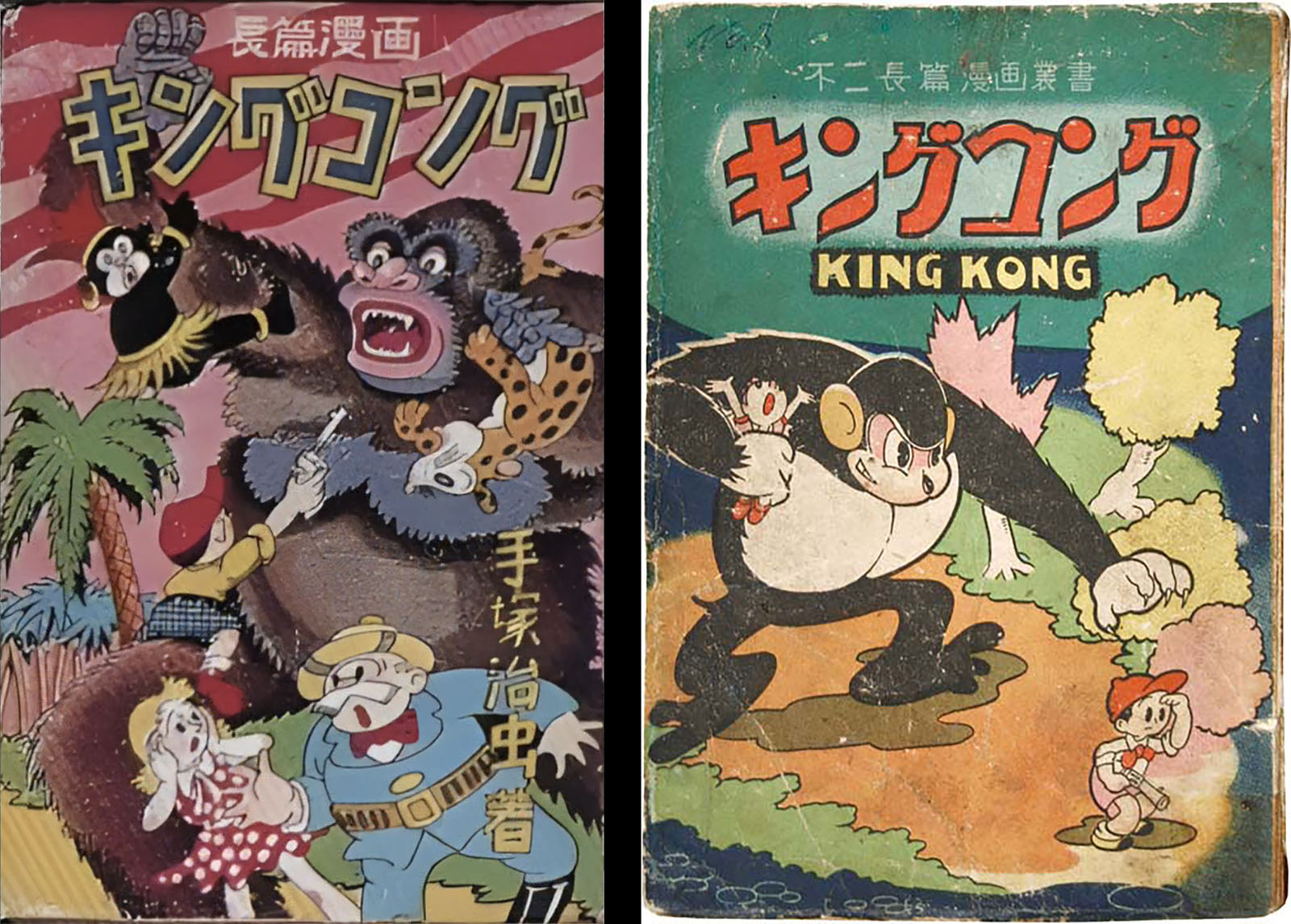
1947: Osamu Tezuka manga
After Kong, giant gorillas came and went in cartoons and comics, and people in Scotland convinced themselves that a living dinosaur (just like one in the movie) swam around in a certain Loch. But King Kong himself didn’t appear in any form. At least not in America.
Osamu Tezuka was on his way to becoming the “God of Manga” in post-war Japan, providing a shattered country with much-needed entertainment on his way to single-handedly creating TV anime in 1963. He was heavily channeling Disney style at the time, so only a glance is needed to see how his take went in its own direction.
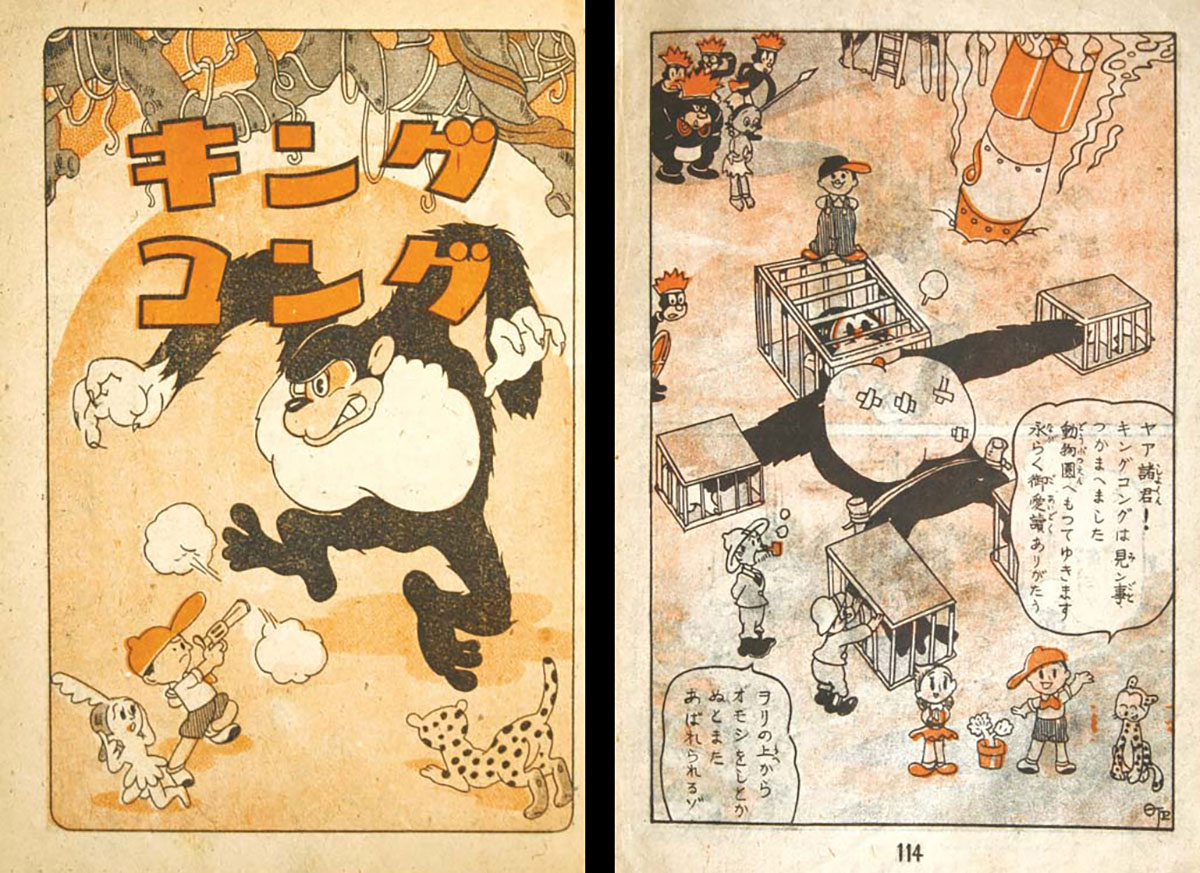
Very few copies of Tezuka’s Kong survive today, and the work has never been reprinted.
Read a short article on it here
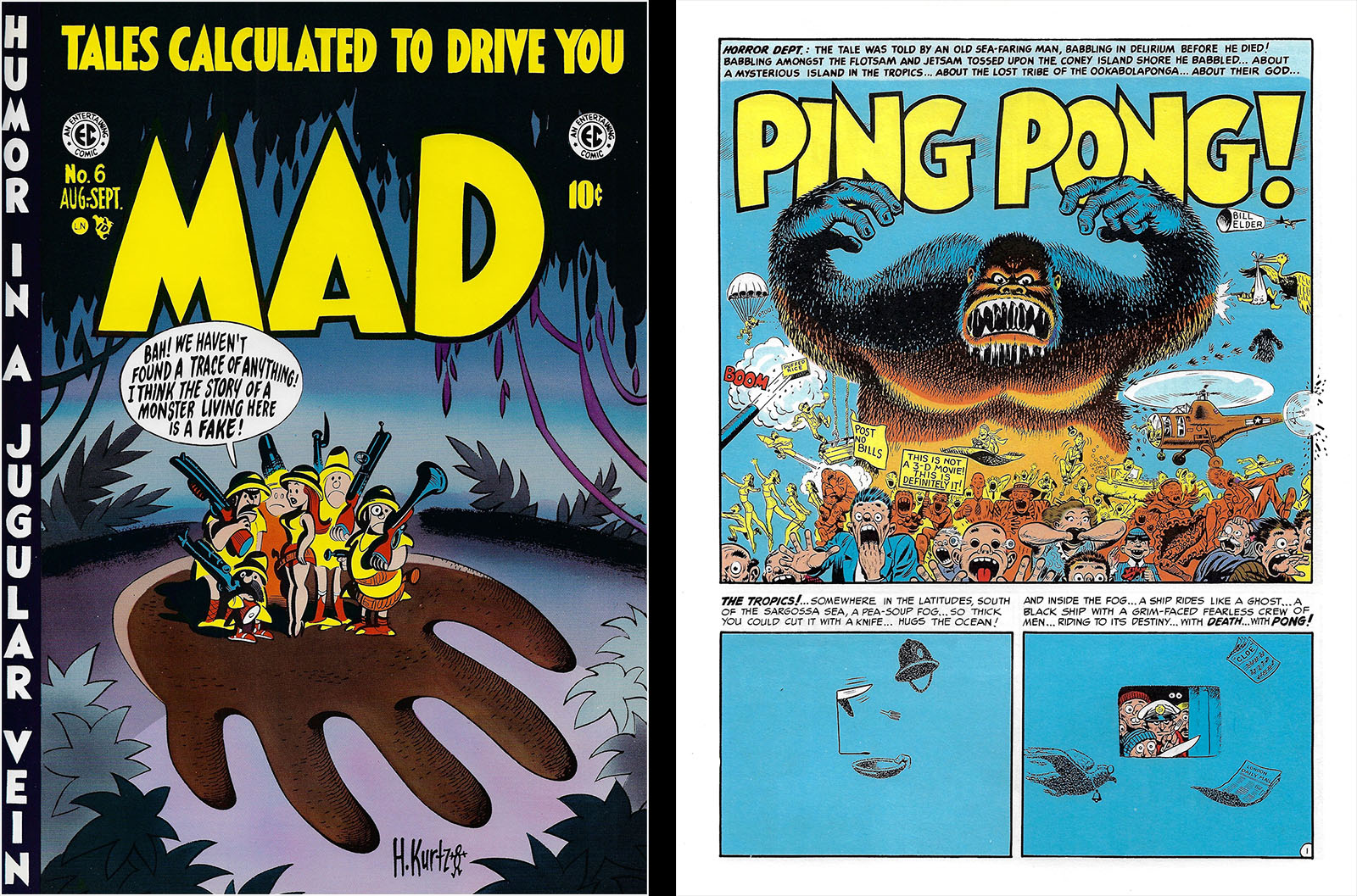
1953: MAD Magazine #6
Twenty years on, Kong was permanently cemented as a cultural reference, making it fair game for cartoonist/illustrator Bill Elder (1921-2008) to satirize it in the August 1953 issue of MAD. Elder was known for packing as many gags into a panel as he could think of, which earned the term “chicken fat” since they “made a meal taste better.”
Read all six pages of PING PONG and see more from Bill Elder here
See the original black & white art at Heritage Auctions here
Read more about Bill Elder: Wikipedia | Lambiek
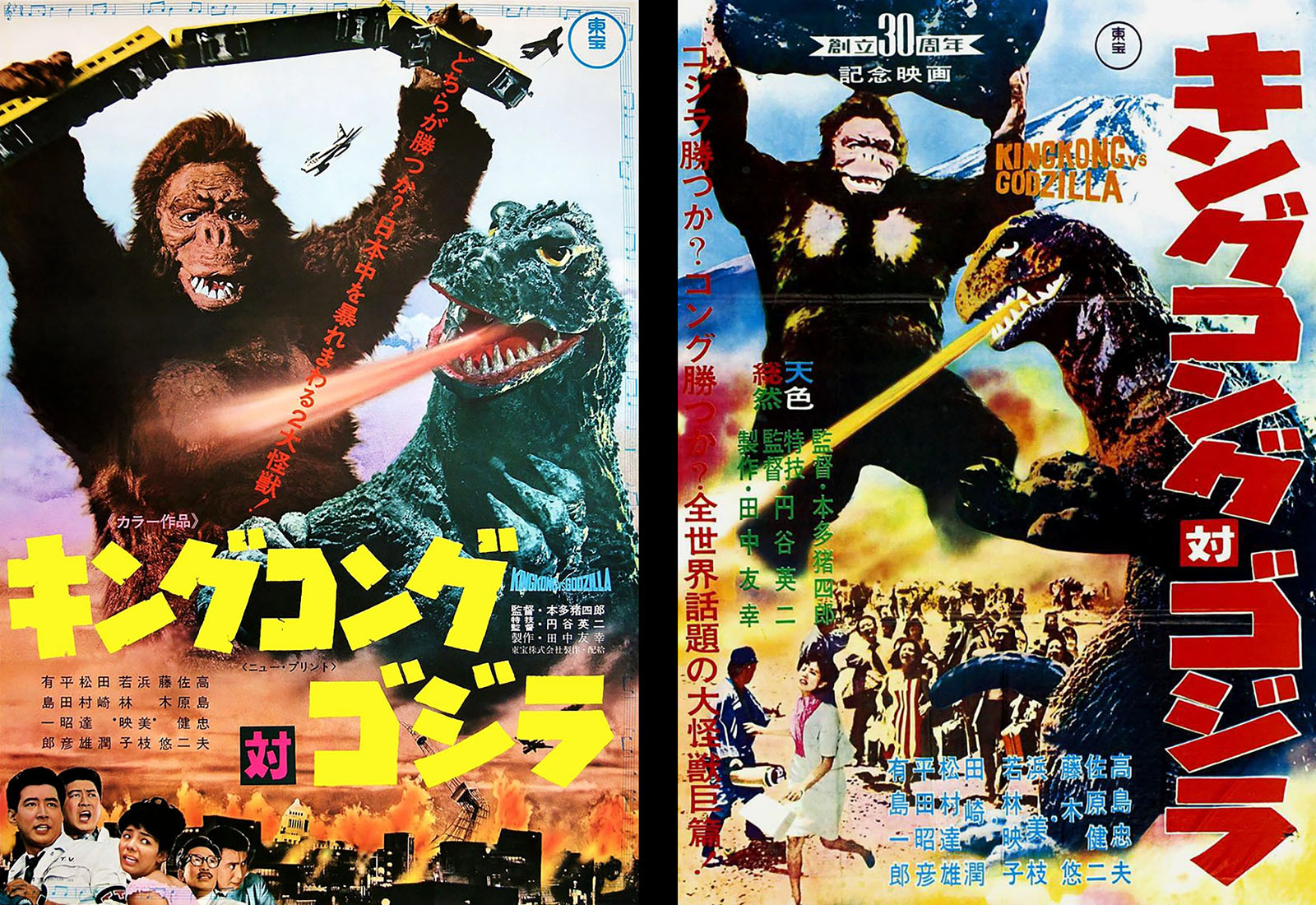
1962: King Kong vs Godzilla
“The Most Collosal Conflict the Screen Has Ever Known” began with quite a different idea that was controversially swiped from Willis O’Brien by filmmaker John Beck, who took it to Toho Studio in Japan. O’Brien wanted to bring Kong back to the screen in a fight against a giant Frankenstein monster. Toho ultimately substituted Godzilla for his third theatrical outing and a legendary kaiju battle was born. (A giant Frankenstein would later appear in a different Toho movie, incidentally.)
The licensing fee paid to RKO for Kong was so large that it cut into the production budget and forced limitations onto the filming. But the story was already breaking boundaries when the director decided to make it a satire on the excesses of corporate publicity. Wanting to skew the movie toward a younger audience, Toho did away with the darker themes of the first two Godzilla movies and made the monster battle more comedic. This in turn set the tone for the franchise throughout the 60s and 70s.
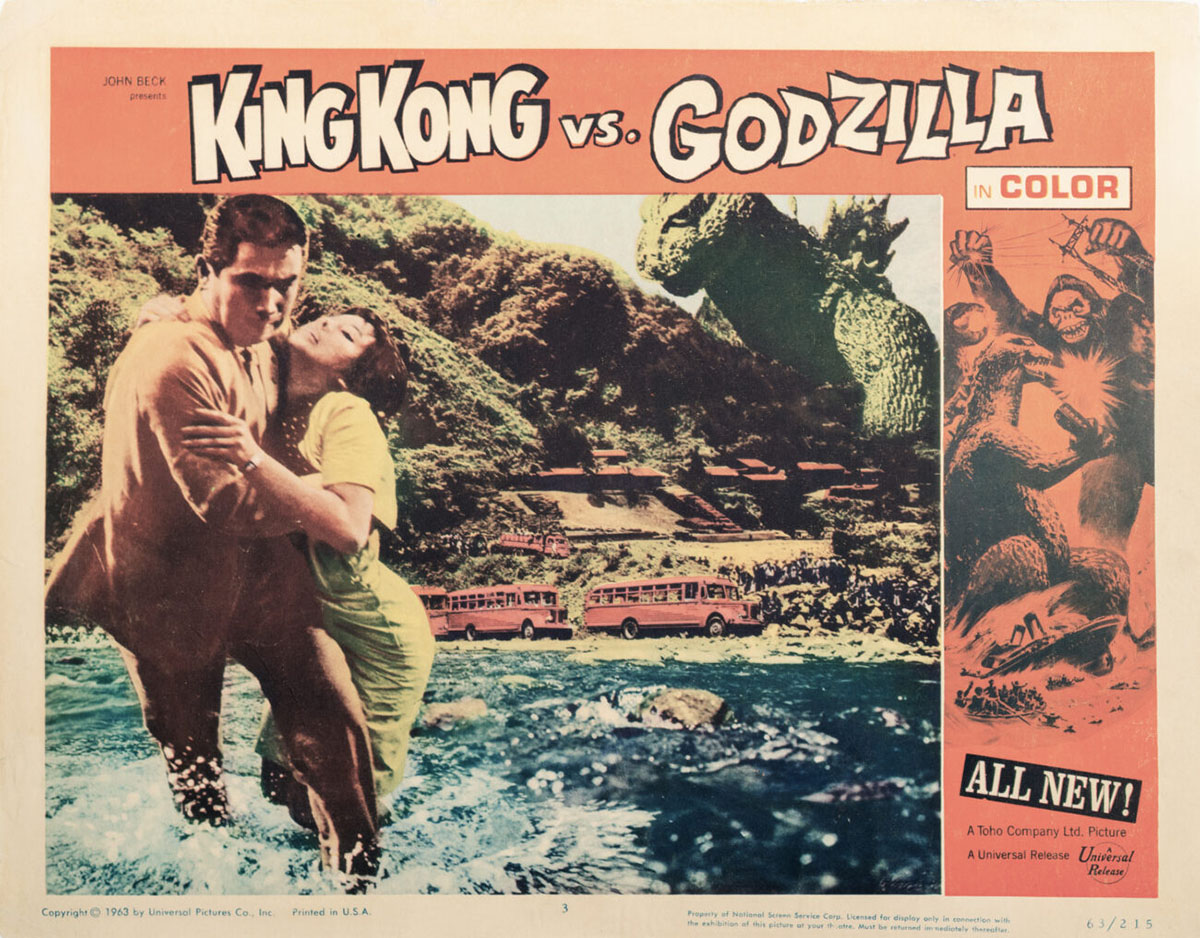
The film was released in Japan August 1962 and John Beck produced the American version for release in June 1963. It went on to become the most profitable Godzilla movie in Japan, but Toho’s desire to make a sequel was quashed by rights issues.
What about a manga? For reasons probably due to licensing cost, this was the ONLY Godzilla film not to get adapted. But it generated ripples that will find their way into this story; the movie had been made without the permission of Merian C. Cooper, and a pot was being stirred.
Read more about King Kong vs Godzilla here: Wikipedia | Toho Kingdom | Wikizilla
1965-69: Hecho en Mexico (1)
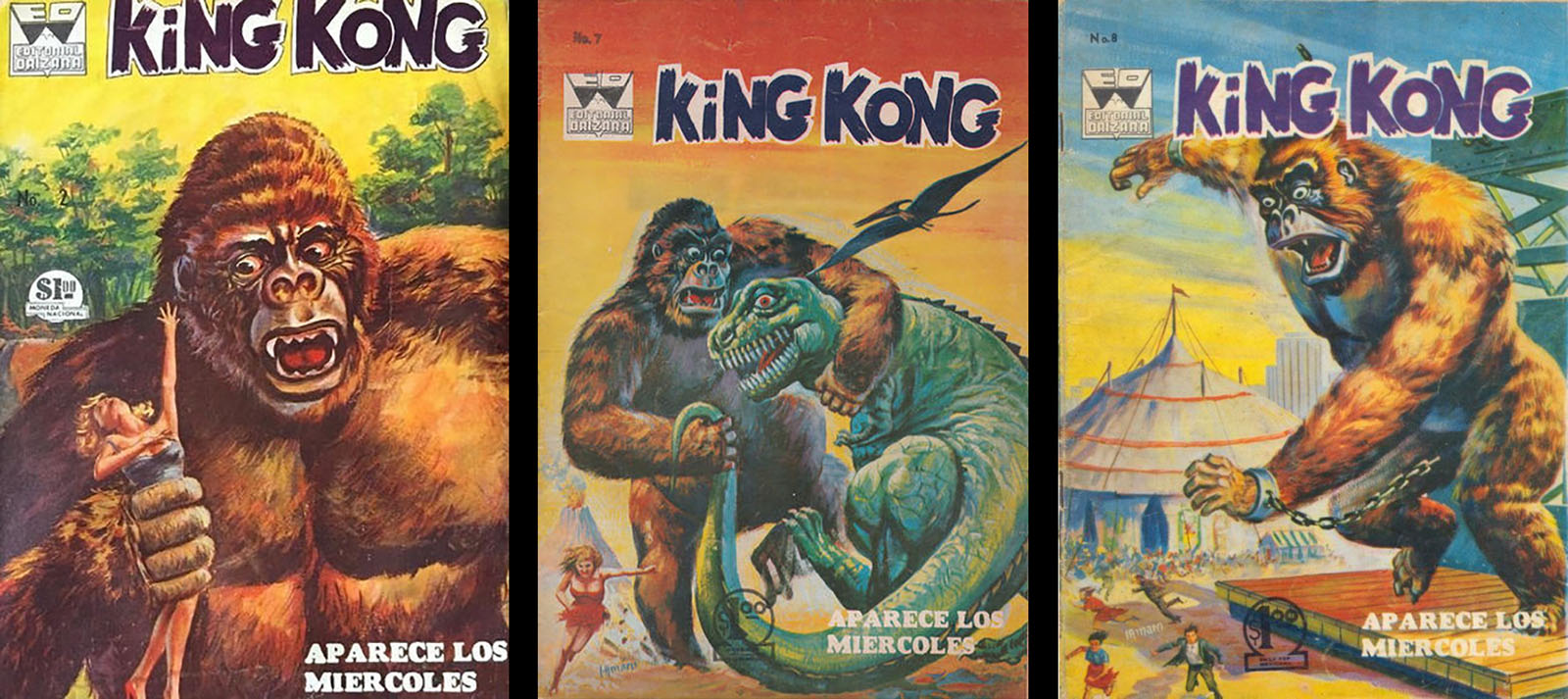
The most long-lived and ambitious King Kong comics came from a land where you don’t need no stinkin’ license. This was a weekly series, published by Editorial Orizaba, that lasted for an incredible 185 issues (32 pages each) going all the way through 1969.
32 pages a week would be physically impossible for any human artist, so it had to be the work of a team. At minimum, it would have taken four artists working in tandem in 4-week cycles. Or at least that’s what I thought. Further research revealed that it was written by one writer (Guillermo Padilla) and drawn by just two artists (J. Amaro and Pedro Cabrales). I have to assume they alternated on odd/even issues. If this is correct, even if they worked with assistants, they still had to finish a staggering 16 pages a week to keep up with the schedule.
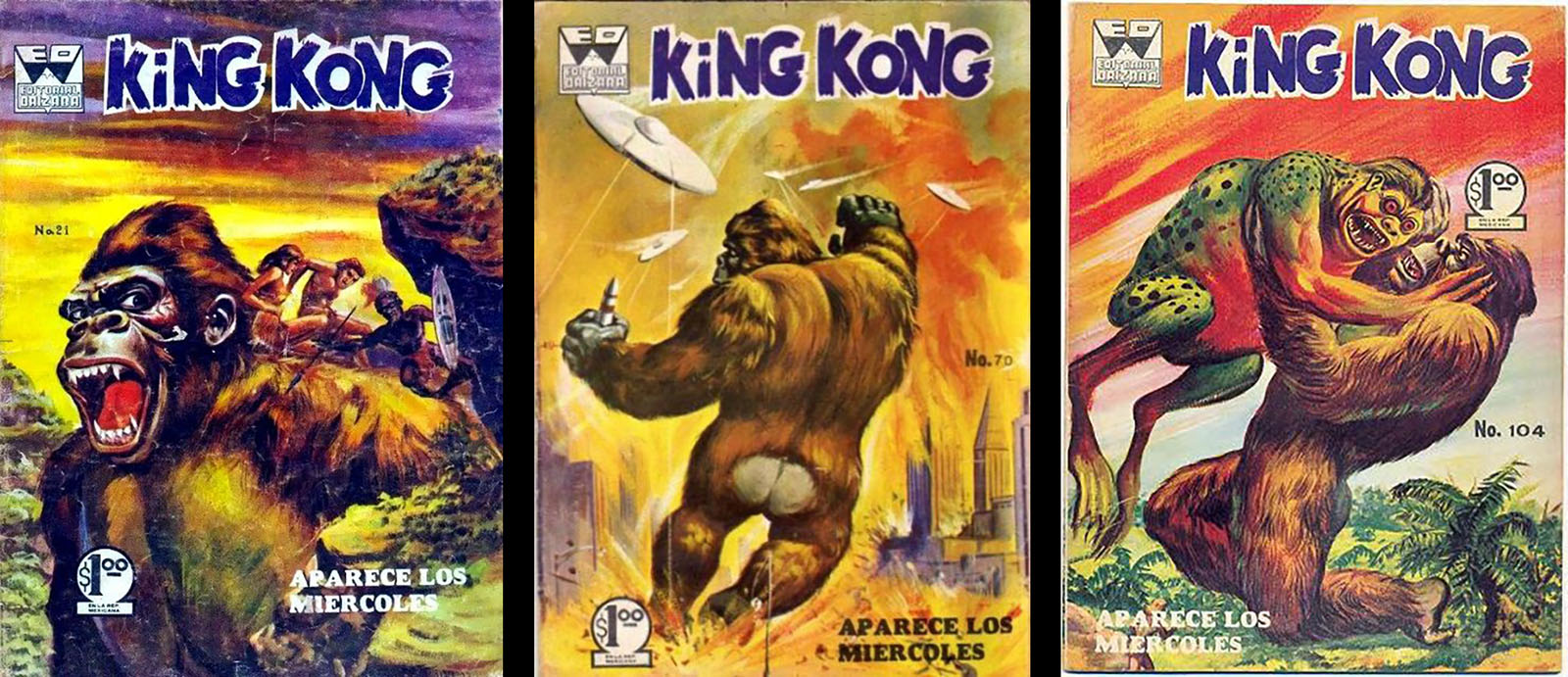
These comics are exceedingly rare now, but were partially reprinted by other South American publishers in the 70s, renamed El Gorilla.
See some interior art here
See a cover gallery here
Read more about the series here
1966-69: Back to Japan
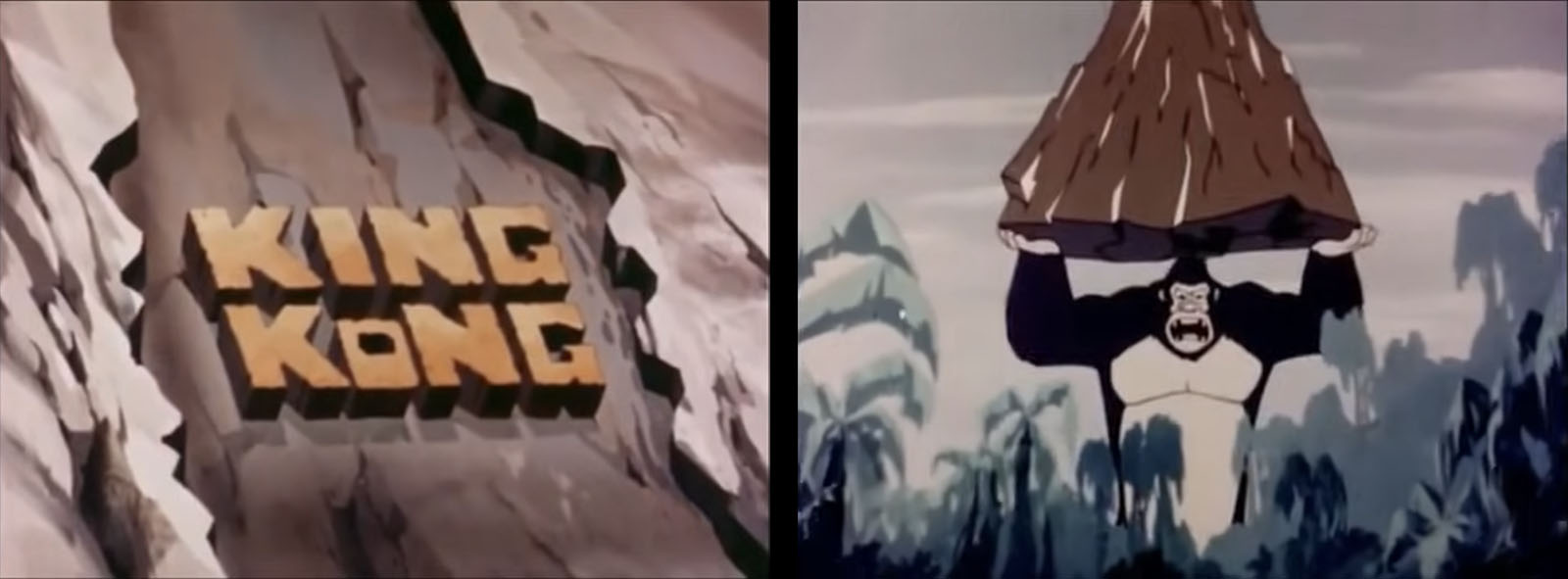
Four years after his tussle with Godzilla, Kong was back for more. This was accomplished through the effort of an American company called Videocraft International, run by Arthur Rankin and Jules Bass. They already had a history of coproductions with Japanese studios, creating the unforgettable stop-motion holiday specials that Gen X kids ate up every Christmas. (Videocraft would later be renamed Rankin/Bass.)
Obtaining the rights to Kong from RKO, Videocraft teamed up with Toei Animation to create a King Kong animated series. It premiered on American TV in September 1966 and since it also aired in Japan starting in December, we can just go ahead and call it an anime.
The series consisted of an hour-long pilot and 24 episodes, each with two 7-minute segments. Every episode also had a “piggyback,” a separate serialized story about a miniature secret agent called Tom of T.H.U.M.B. When the series went into reruns, the pilot was split in half to yield a 26-episode package.
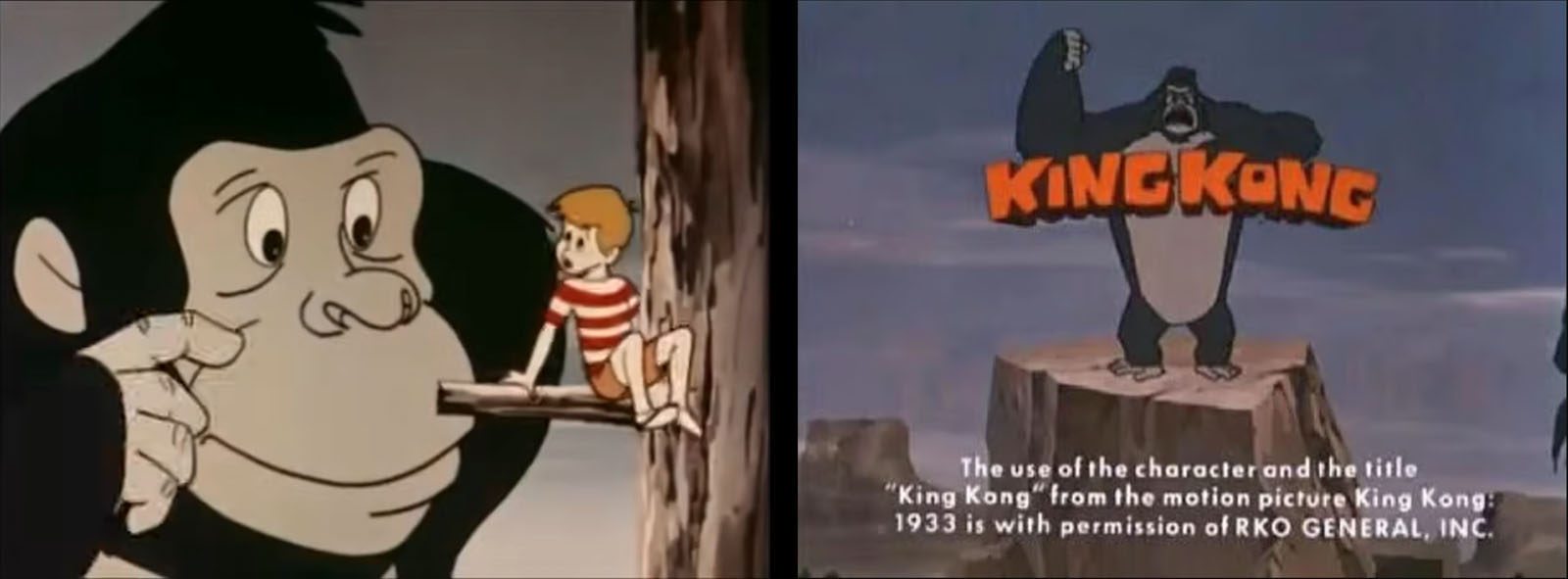
See the opening title here
Read much more about the series here: Cartoon Research | Scifi Japan | Wikipedia
Watch episodes on Youtube here and here
Watch a review by Paper Finz here
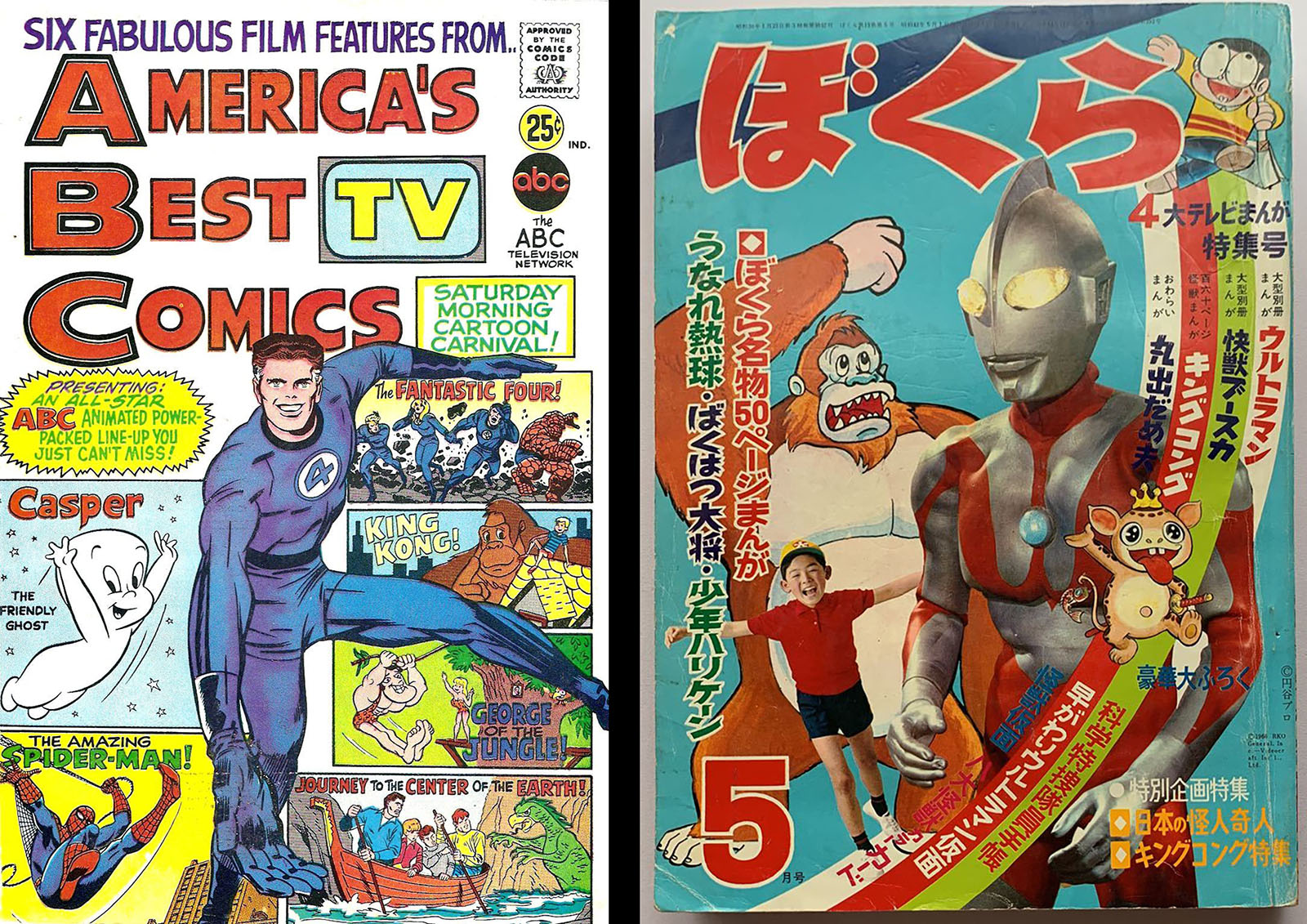
The arrival of the cartoon facilitated Kong’s next leap into comics in two countries. Marvel joined up with ABC Television to create a one-shot 68-page comic book in 1967 called America’s Best TV Comics that promoted the fall cartoon season. The Fantastic Four and Spider-Man were both part of that lineup, and King Kong was featured in a 10-page segment.
In the land of manga, Kong got his own serial (based on the cartoon) in a monthly magazine named Bokura, which had previously featured a few Godzilla adaptations. They were drawn in a very loose style by Akio Ito. In 1975, he received the Japan Cartoonists Association Award for Excellence for his science manga series Tracing My Ancestors for Billions of Years.
See sample pages of this manga here
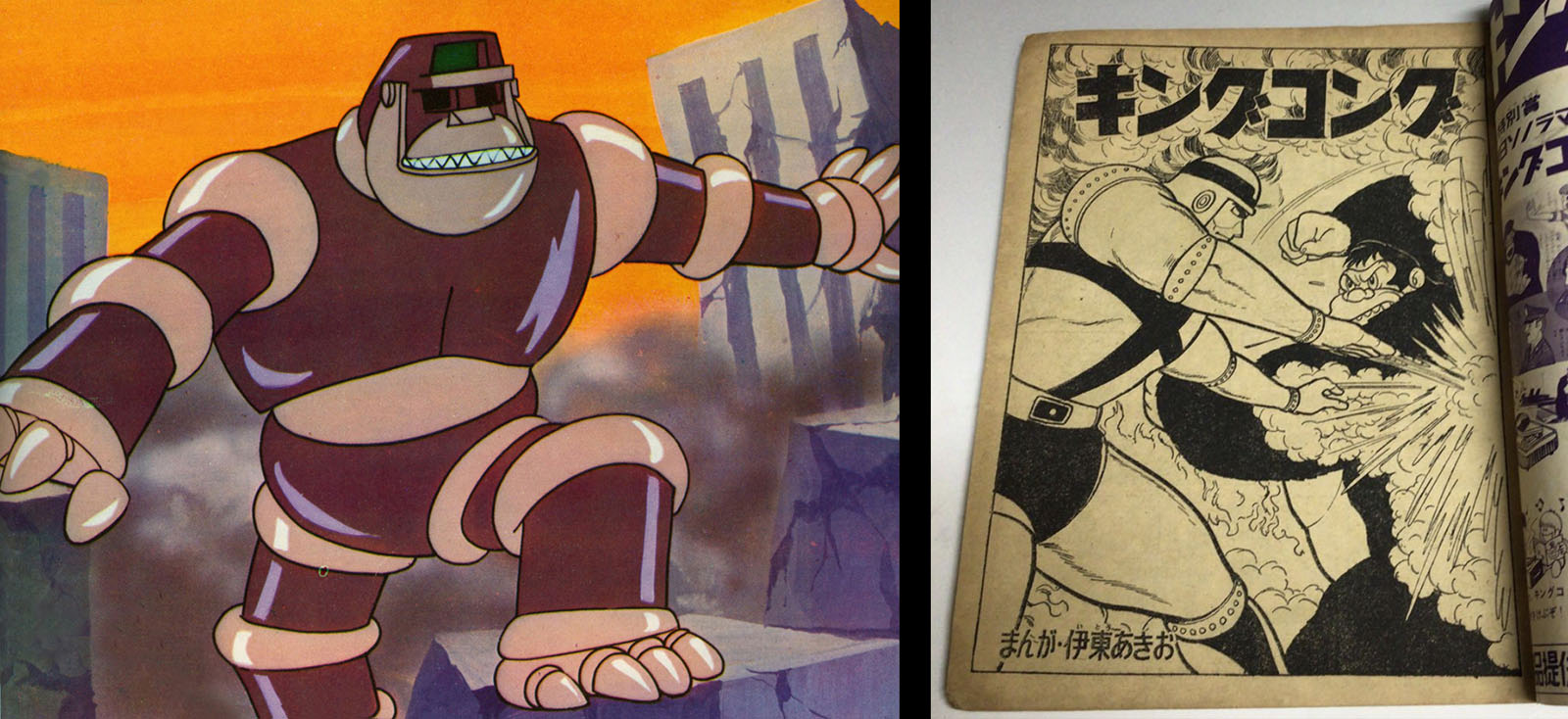
But wait, there’s more! Wherever you find anime and manga, you’re going to find giant robots. And if seeing Kong square off against a giant robot feels familiar, you may already know where this story goes next.
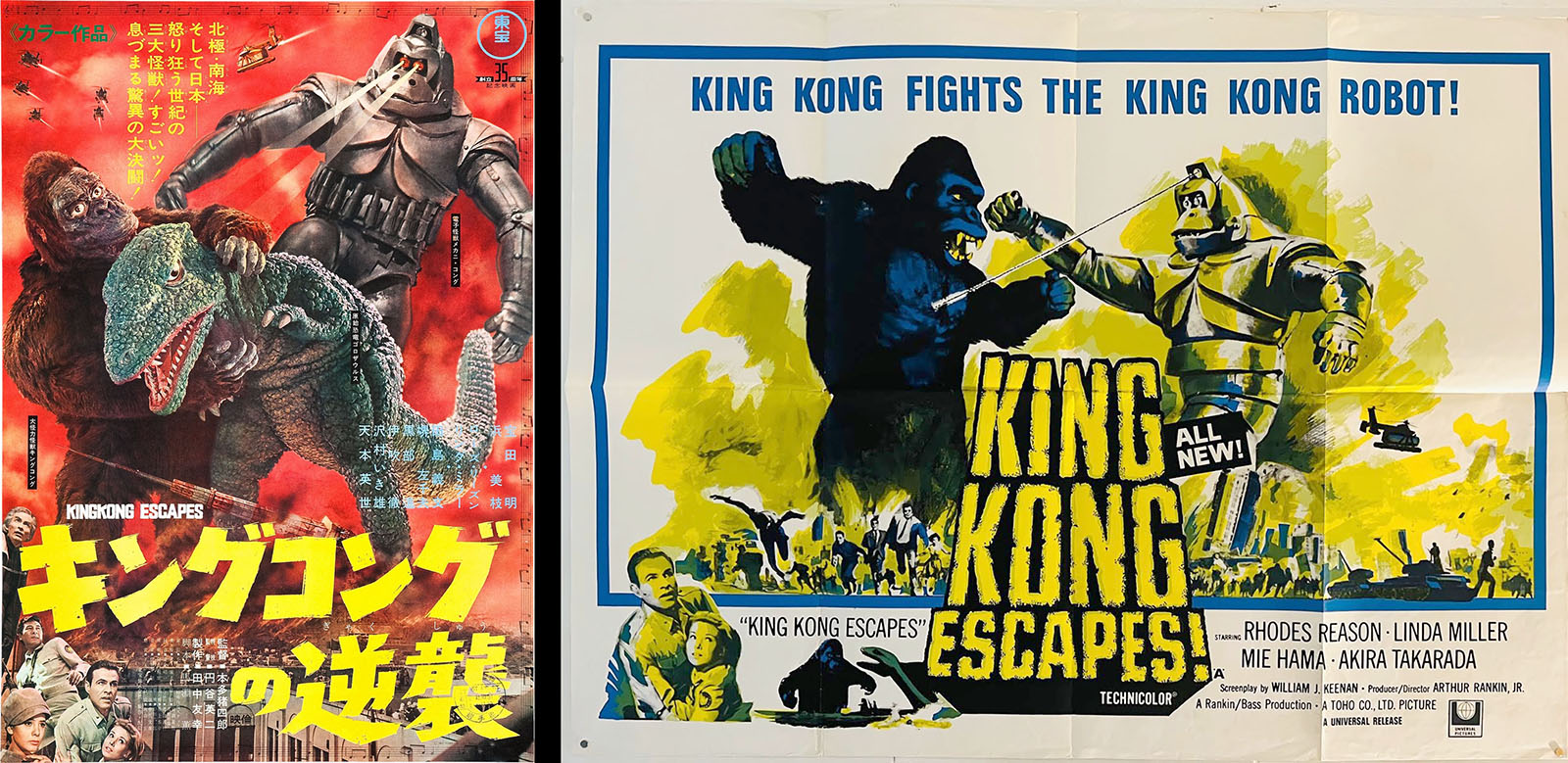
We got King Kong Escapes because of the cartoon series. It emerged as another coproduction, this time between Rankin/Bass and Toho. An earlier script placed Kong on an island and pitted him against a sea monster, but that turned into a Godzilla film instead (with Godzilla taking on some King Kong character traits). Using some of the characters from the cartoon, this movie turned into a very entertaining kaiju slugfest with Kong duking out against Mecha-Kong.
Read much more about King Kong Escapes here: Wikipedia | Toho Kingdom | Wikizilla
It premiered in Japan July 1967 and followed in the US June 1968. Behind the scenes, Merian C. Cooper decided he’d had enough of not getting a piece of this action. However, complex litigation determined that he only controlled rights to the 1932 novelization, NOT the movie that was “adapted” from it.
And that is the point where all these side quests return to the main plot of this twisted tale.
1968: King Kong, the Authorized Edition
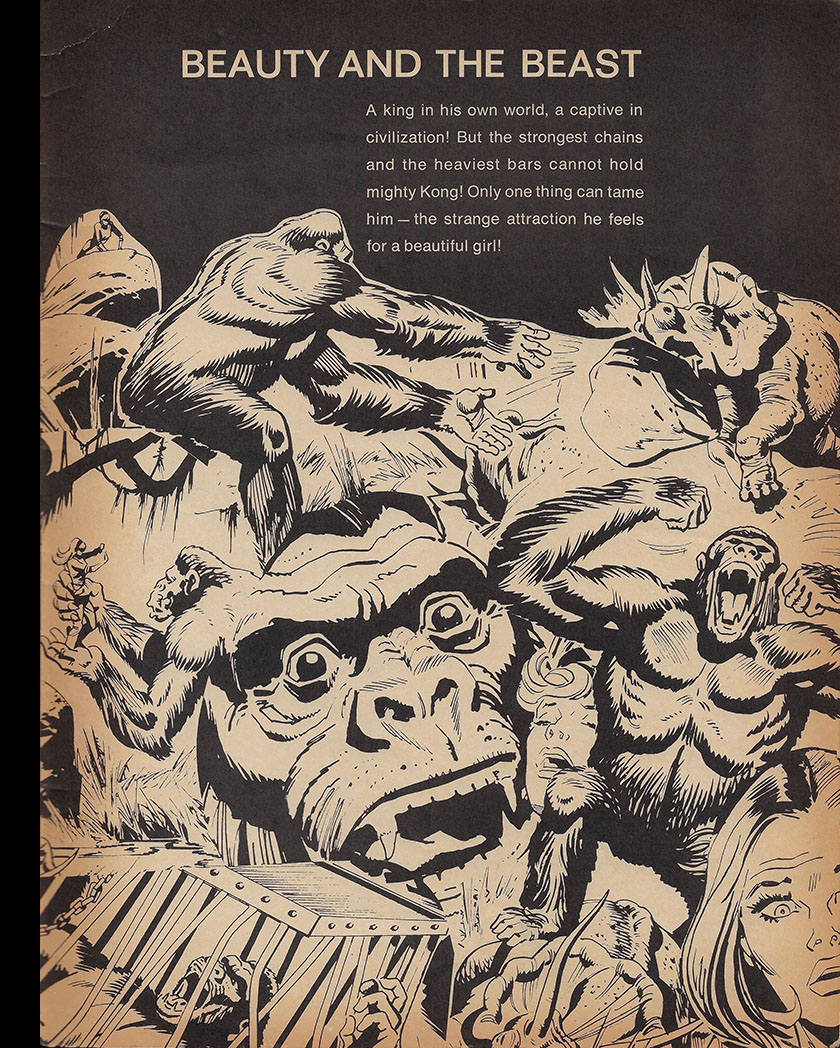
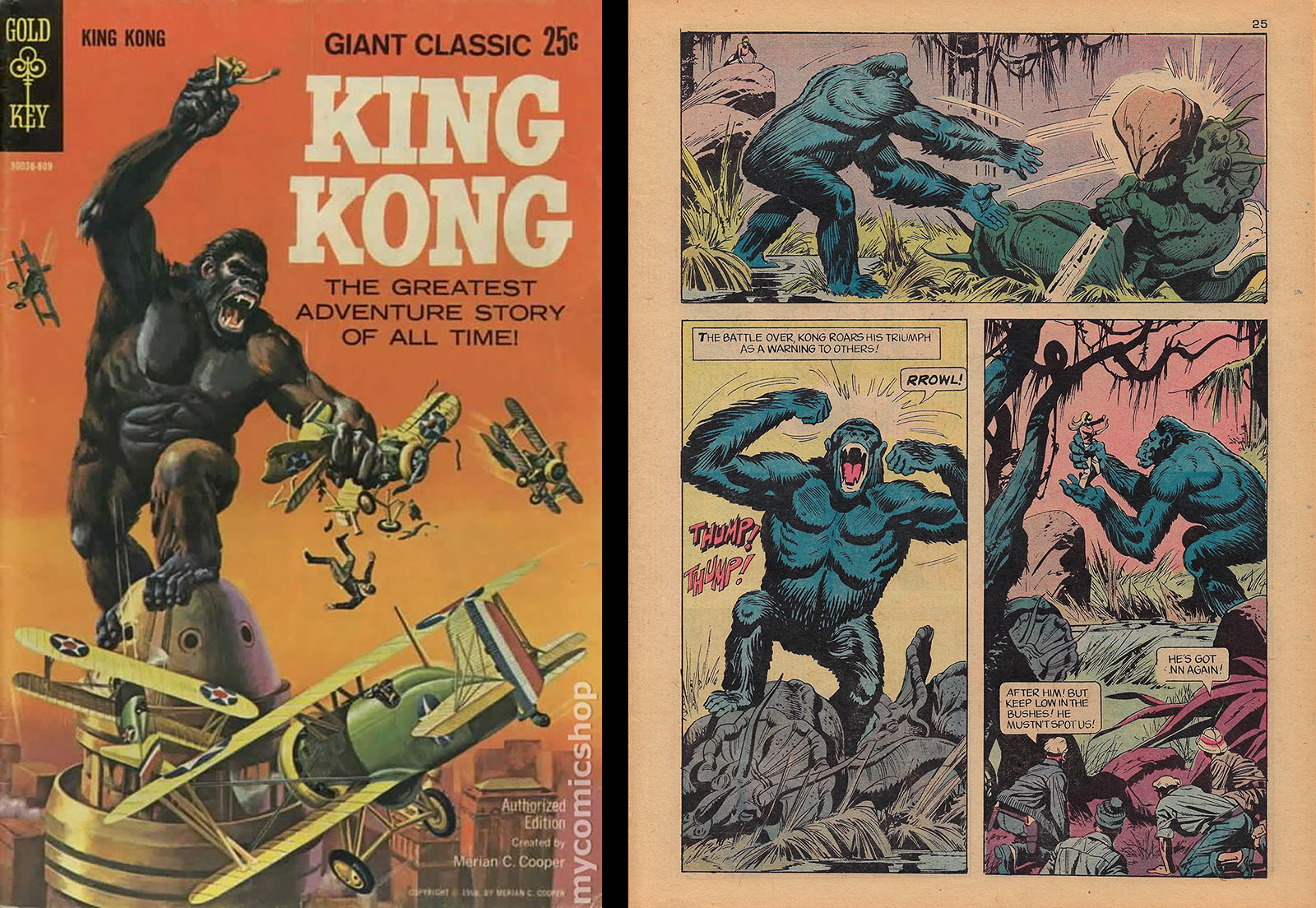
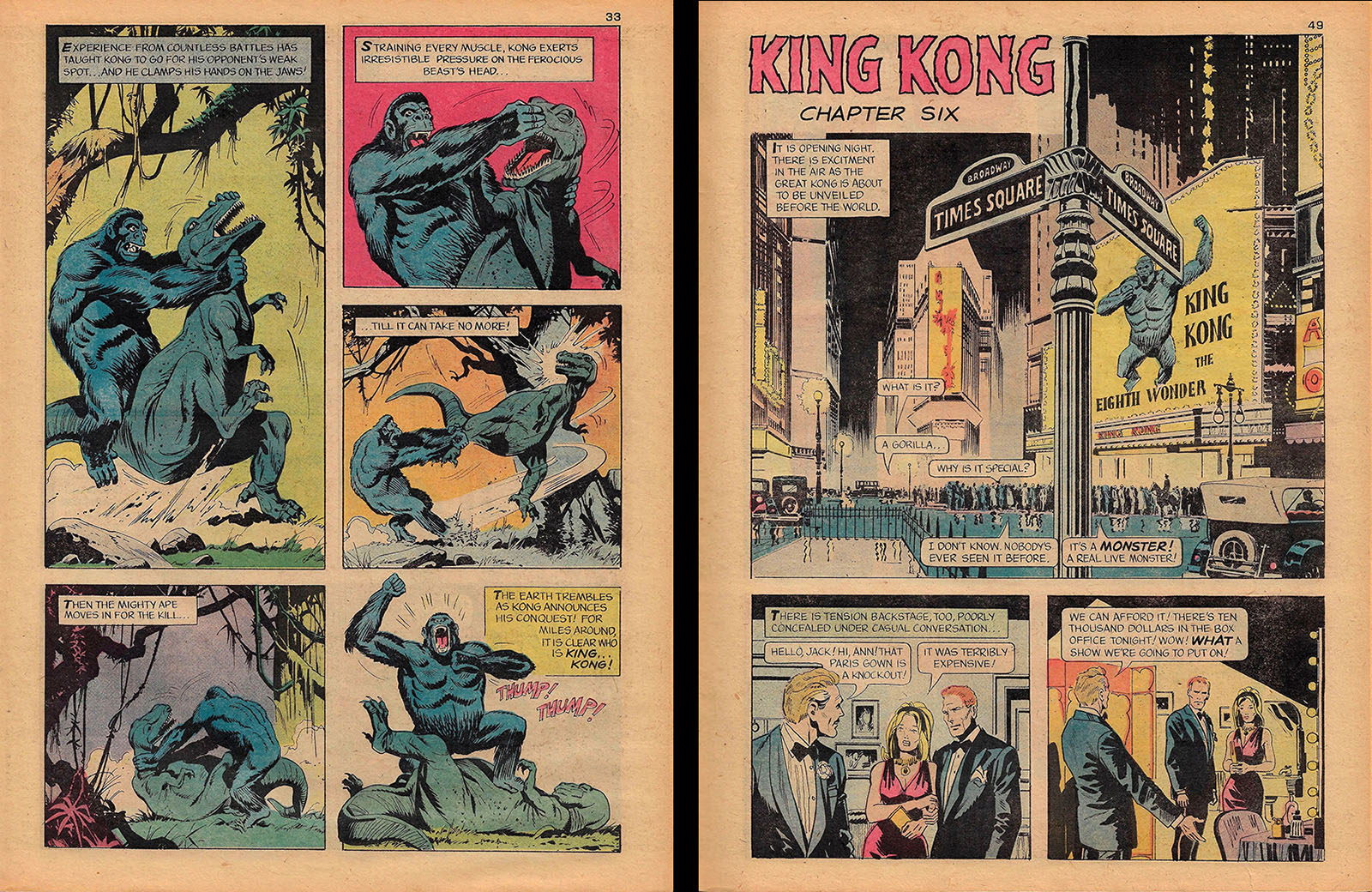
35 years after the premiere, an authentic, straight-up King Kong adaptation finally appeared when Gold Key published a 64-page “Giant Classic authorized edition.” It was adapted by Gary Poole, penciled by Giovanni Ticchi, and inked by Alberto Giolitti, who ran the studio that was commissioned to produce it. The eye-grabbing cover was painted by George Wilson.
Giolitti’s studio was made up of over 50 artists who had drawn adaptations of films and TV shows including Gunsmoke and Star Trek. The illustration quality is top-notch and though some occasional panels are derived from the movie, the story is very specifically based on the novel. Merian C. Cooper’s name appears on the cover and he is listed inside as the copyright owner.
Why didn’t it appear before 1968? Based on all the shenanigans in Japan, my theory is that when Cooper learned that his rights were limited to the novel, he decided to reassert those rights in the public sphere as soon as possible. Thus, he himself commissioned this project. Whether he intended it or not, no further Kong projects were mounted in Japan afterward (though the movies and cartoons continued to play in reruns and revivals).
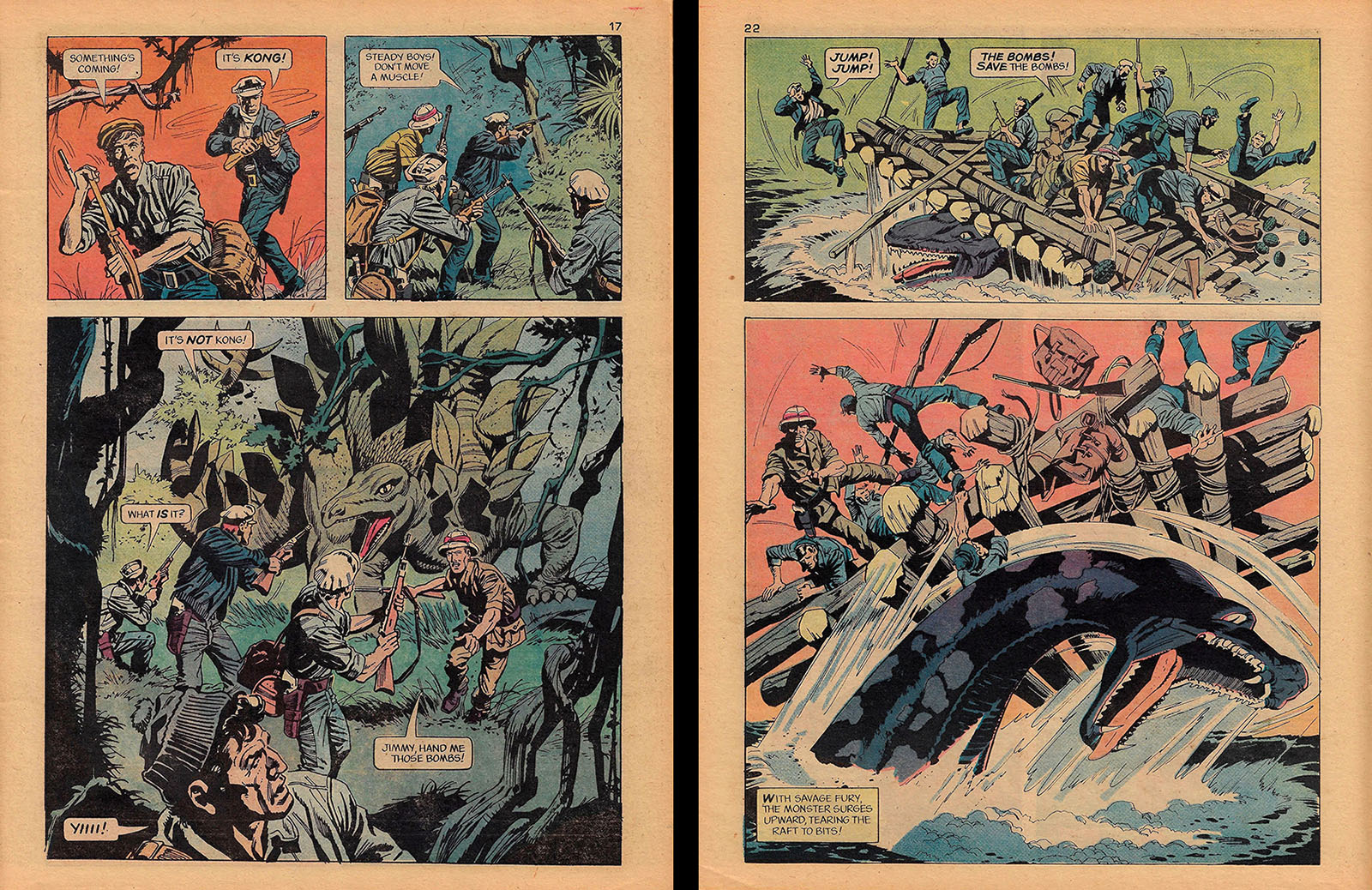
Now then…since I started this article with an intention to examine this comic, here’s where it happens. I was 11 or 12 when I bought this, and I’ve held onto it ever since. 50 years later (gag, choke) I’m still impressed by the rock-solid artwork, the graceful, confident storytelling, and studied attention to dinosaur anatomy.
I was a dinosaur kid from my preschool days, and even in my single-digit years I could recognize a lazy dinosaur drawing in a comic book. And lemme tell you, comic artists in the 70s could get LAZY. God forbid they pick up a science book or two (even though the science was still developing) or visit a museum. It was just way easier for them to make up goofy stand-ins with so many teeth and claws that they couldn’t possibly function as living animals.
Dinosaurs figured prominently in the novel (moreso than in the movie), and placed some onus on Ticchi and Giolitti to get them right. They certainly did, finally bringing lost scenes to life.
Looking back at it, there are only two things I would change about this comic. First, there are very few panels that do justice to the scale of Kong and his dinosaur foes. Panels that include humans handle it well enough, but when the humans aren’t visible, the “camera” flies right up off the ground and the scale is lost. The giants are composed like regular-size people. It would have been far more effective to have them tower over the camera, as if it’s still stuck on the ground being operated by a human.
Second, the color was half-hearted at best. Flat and uninspired, it often relied on dayglo background tones that clashed with the environment (like red or pink backdrops in the jungle) and did almost nothing to enhance the art. It looks cheap, and was probably the best they could do on their 1968 budget.
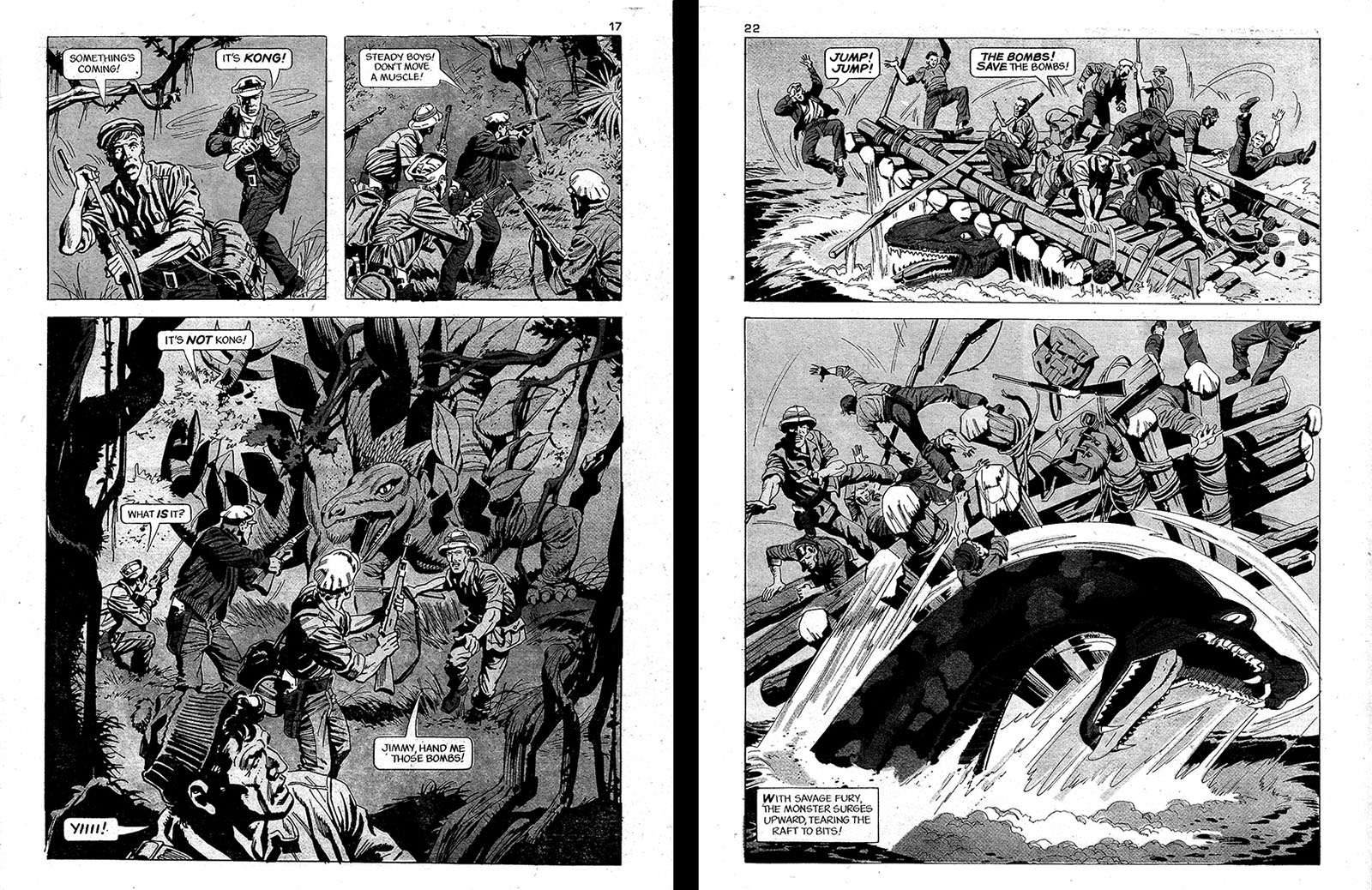
It finally occurred to me while looking through it again that the fix was so easy they didn’t even think of it: grey tones instead of weak color. Another reason the color was off-putting is that we’d lived with a black and white King Kong for 35 years. Even if it looked better than this, color would still be an intruder. Grey tones would have aligned with visual history.
And thus, with the click of a few buttons, I have made that adjustment.
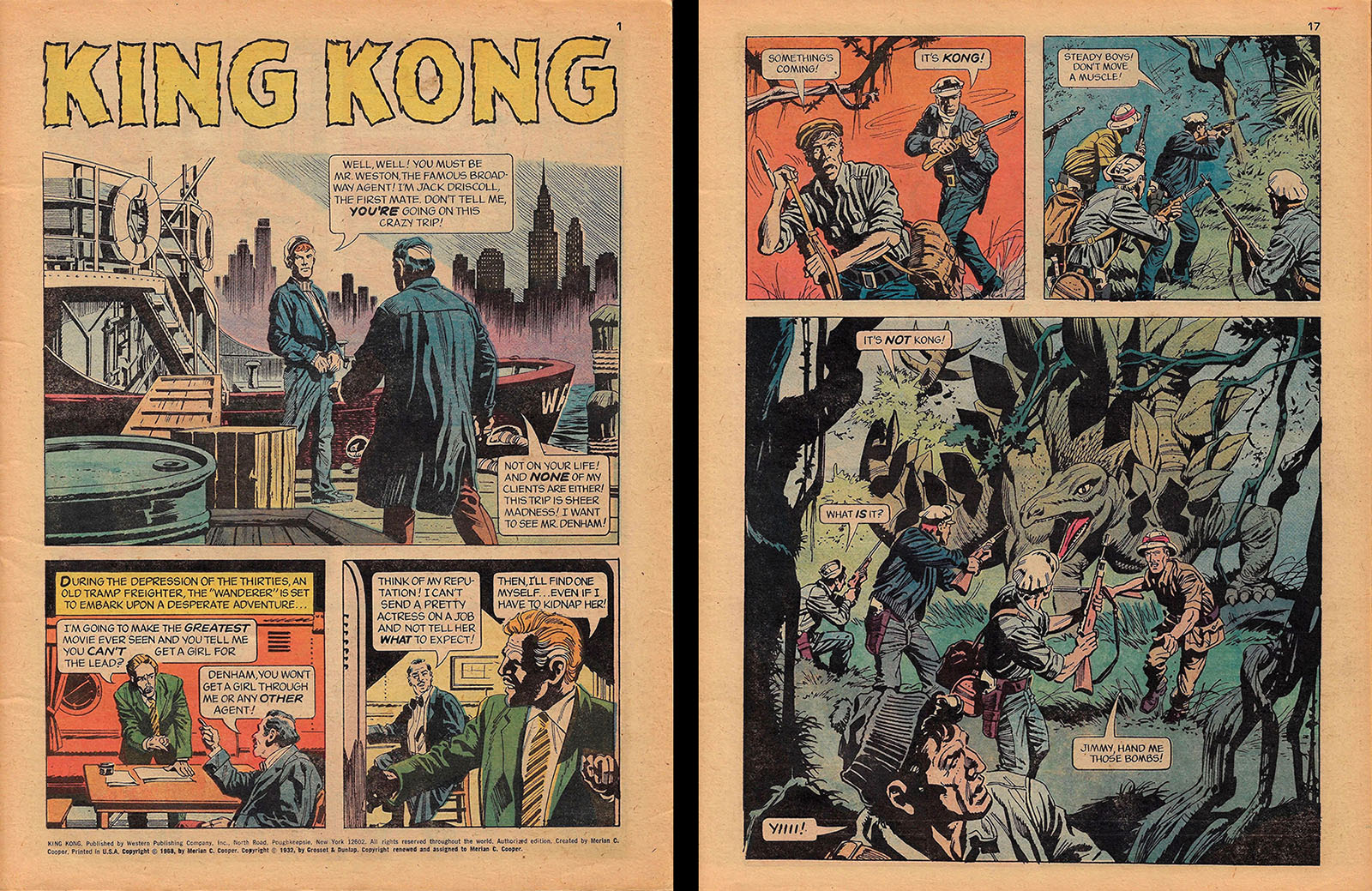
These four galleries present the entire 64-page comic. You’ll see it as published in color, and again in greyscale. See if you agree with me that this was the fix it needed.
Read another review of the comic here
1972: France, too?
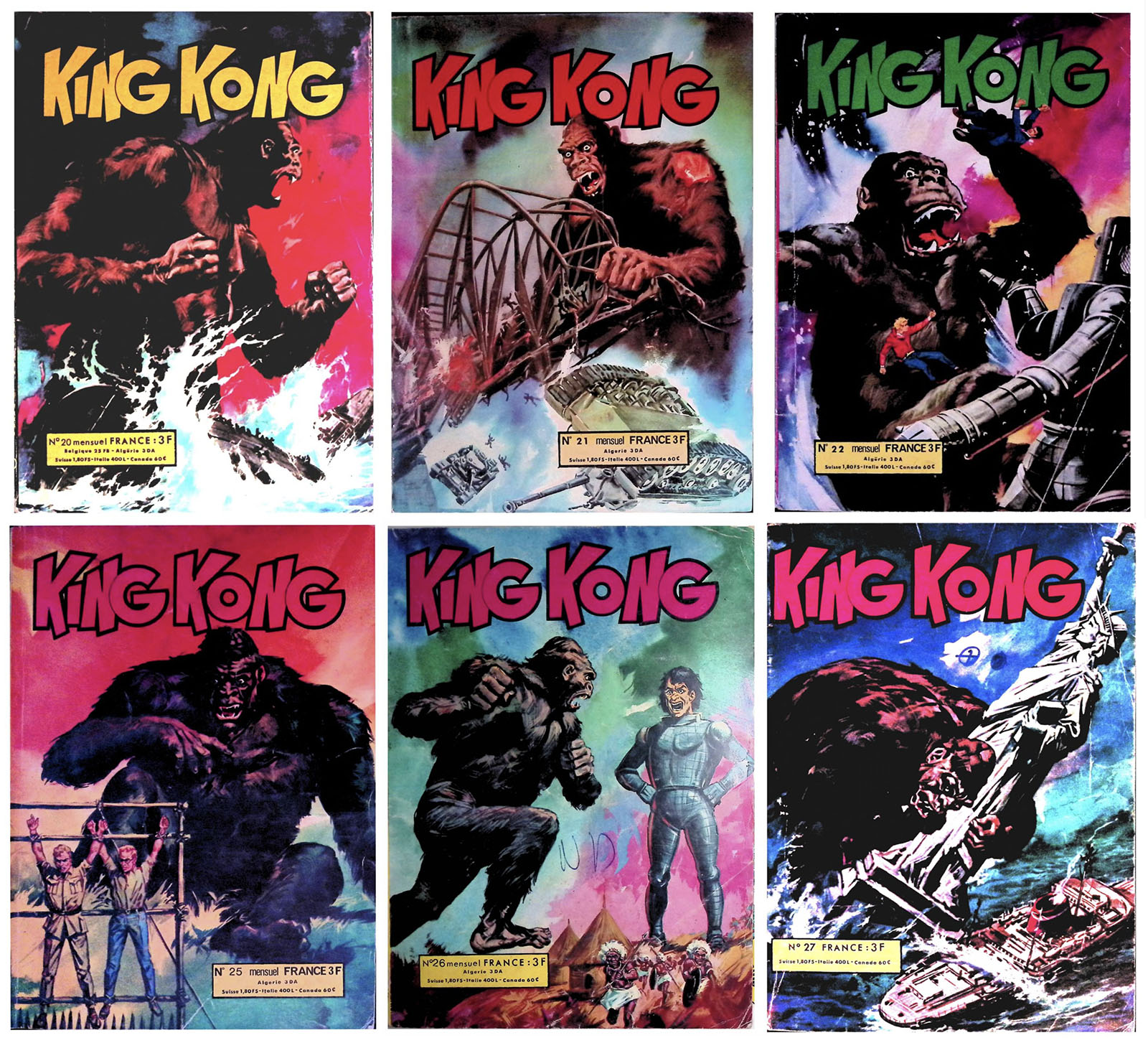
By this time, anyone on Earth had as much right as anyone else to plunder a global icon as long as they could outrun the copyright lawyers. This time it was a French publisher named Éditions de l’Occident that slapped the name onto a series featuring a giant gorilla for a 32-issue series that started in April 1972.
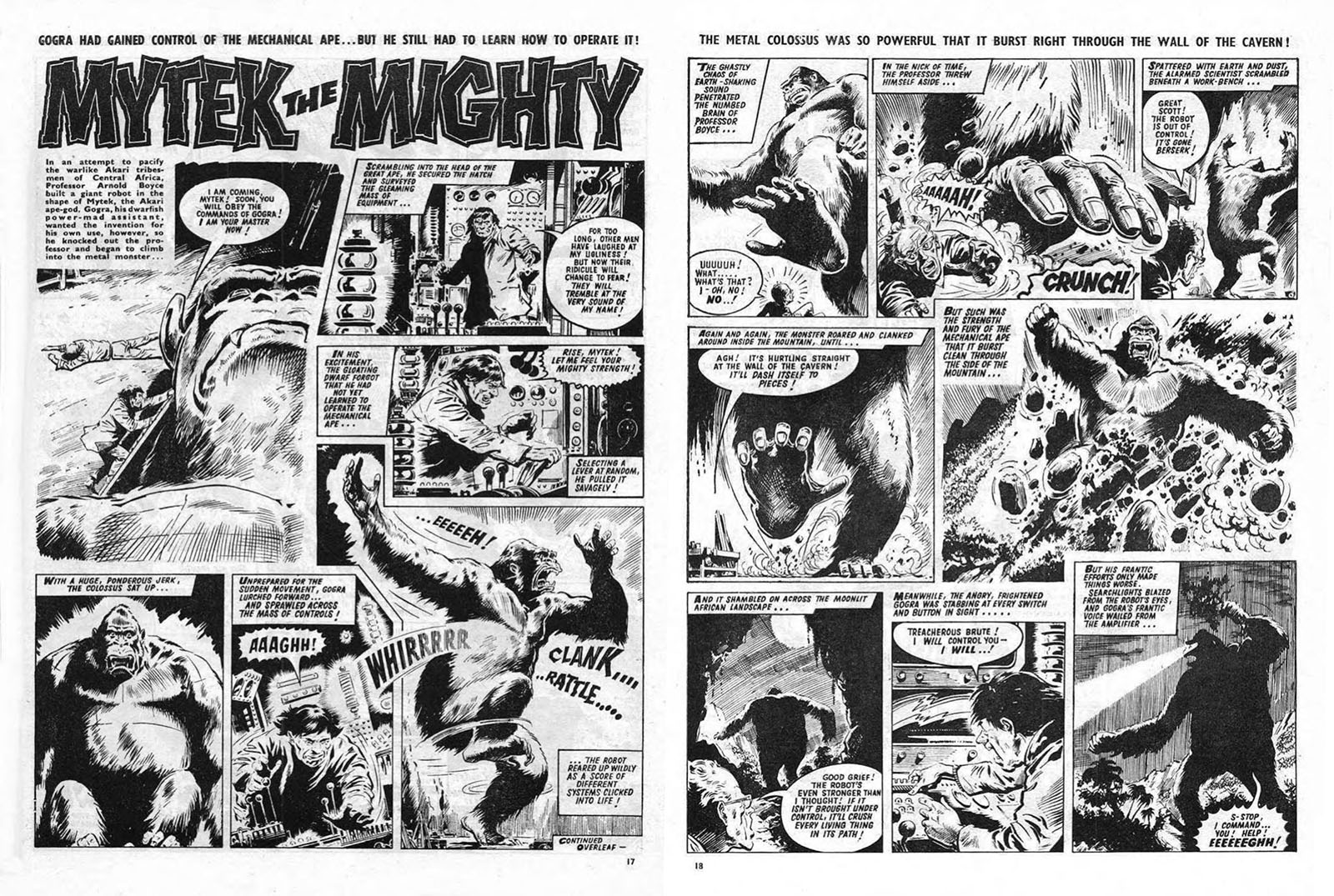
But wait, it wasn’t quite that simple. This project actually originated from England in 1964 under the title Mytek the Mighty from Fleetway Publishing (serialized in a comic called Valiant). Written by Tom Tully and illustrated by Bill Lacey, Eric Bradbury, and others, it featured a giant gorilla robot. When the series was sold for reprint to publishers in Europe, the title was altered. Éditions de l’Occident went with King Kong.
The story:
After his laboratory is destroyed by warriors from the Akari tribe, scientist Arnold Boyce decides to build a colossal robot named Mytek (resembling King Kong) in order to compel the warriors to lay down their arms. He bases it on the tribe’s idol, a symbol of power and destruction that takes the form of a gigantic ape.
Boyce’s assistant, a treacherous dwarf named Gogra, seizes control of the robot and rallies the Akari tribe to help him exact revenge on all of humanity. Although defeated, Gogra manages to escape. Boyce regains control of the massive robot ape, but Gogra goes on to build other immense, incredibly powerful robots in an attempt to defeat Mytek and humanity.
Read more about Mytek the Mighty here
Read the series in English here
See 18 volumes of the French version here
1976: “Dino Kong”
“when Jaws die, nobody cry. When my Kong die, everybody cry.” – Dino De Laurentiis (larger-than-life producer)
Everybody has something dismissive to say about Dino’s remake, but when I saw it in a theater in December ’76, I loved everything about it. Granted, I was just 11 at the time, but this film had everything a kid like me wanted. Except dinosaurs. I would have liked to see dinosaurs instead of the cheesy giant snake puppet.
I had a cassette tape recorder the following year when it was broadcast on TV (over two nights) and I taped it from end to end. Listening to that tape over and over (as an audio drama) taught me things about a film soundtrack, and I gained a greater appreciation for how music, dialogue, and sound effects are mixed to create a storytelling experience. I especially loved the score by John Barry; it’s still one of my favorites.
Listen to the whole thing here
Find the Deluxe Edition CD here
Rewatching the movie in later years, I started to recognize its excesses, both in the filmmaking and in the satirical theme of the story, which paid off the “corporate publicity” angle at the core of King Kong vs Godzilla. When I also realized how horny the film was, I couldn’t help imagining what it must have been like for the poor parents who took kids to see it, squirming in their seats and hoping certain scenes would fly over the little heads next to them. (They definitely flew over mine.)
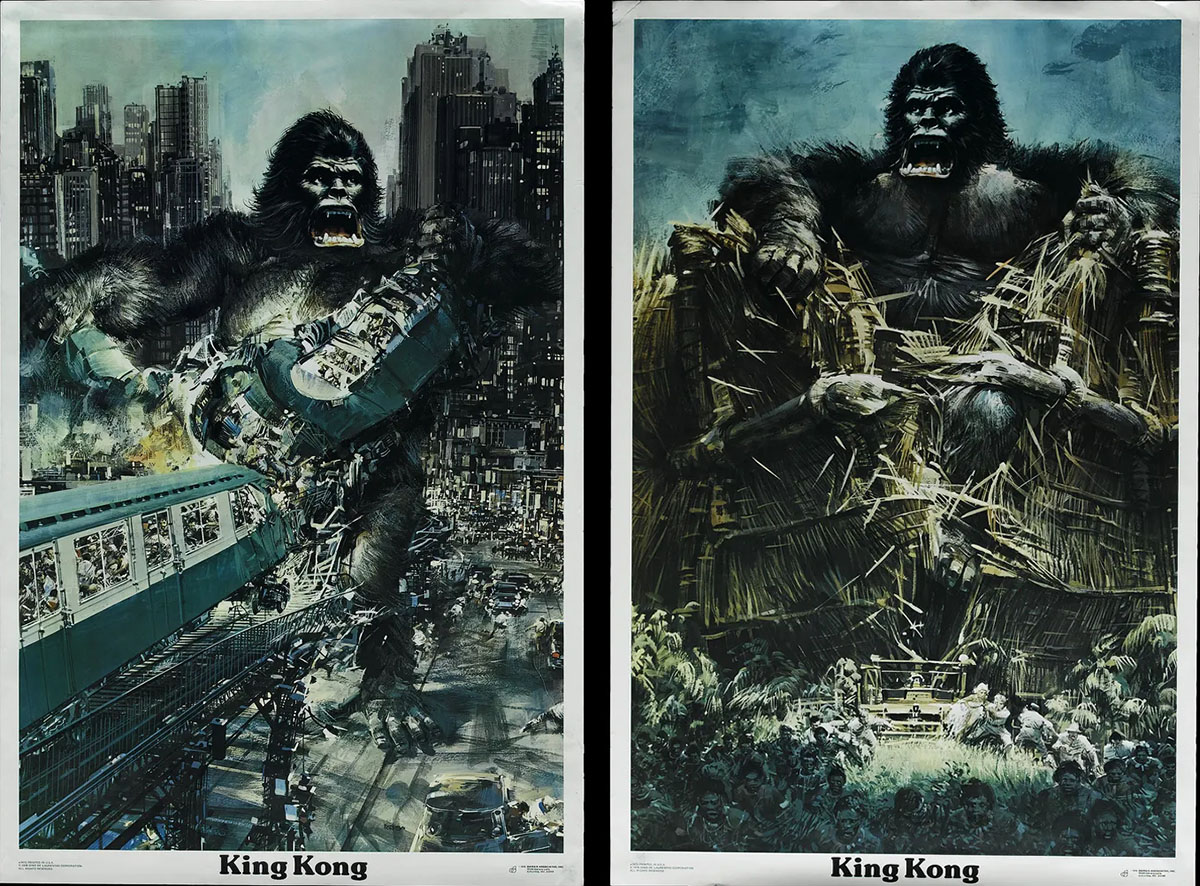
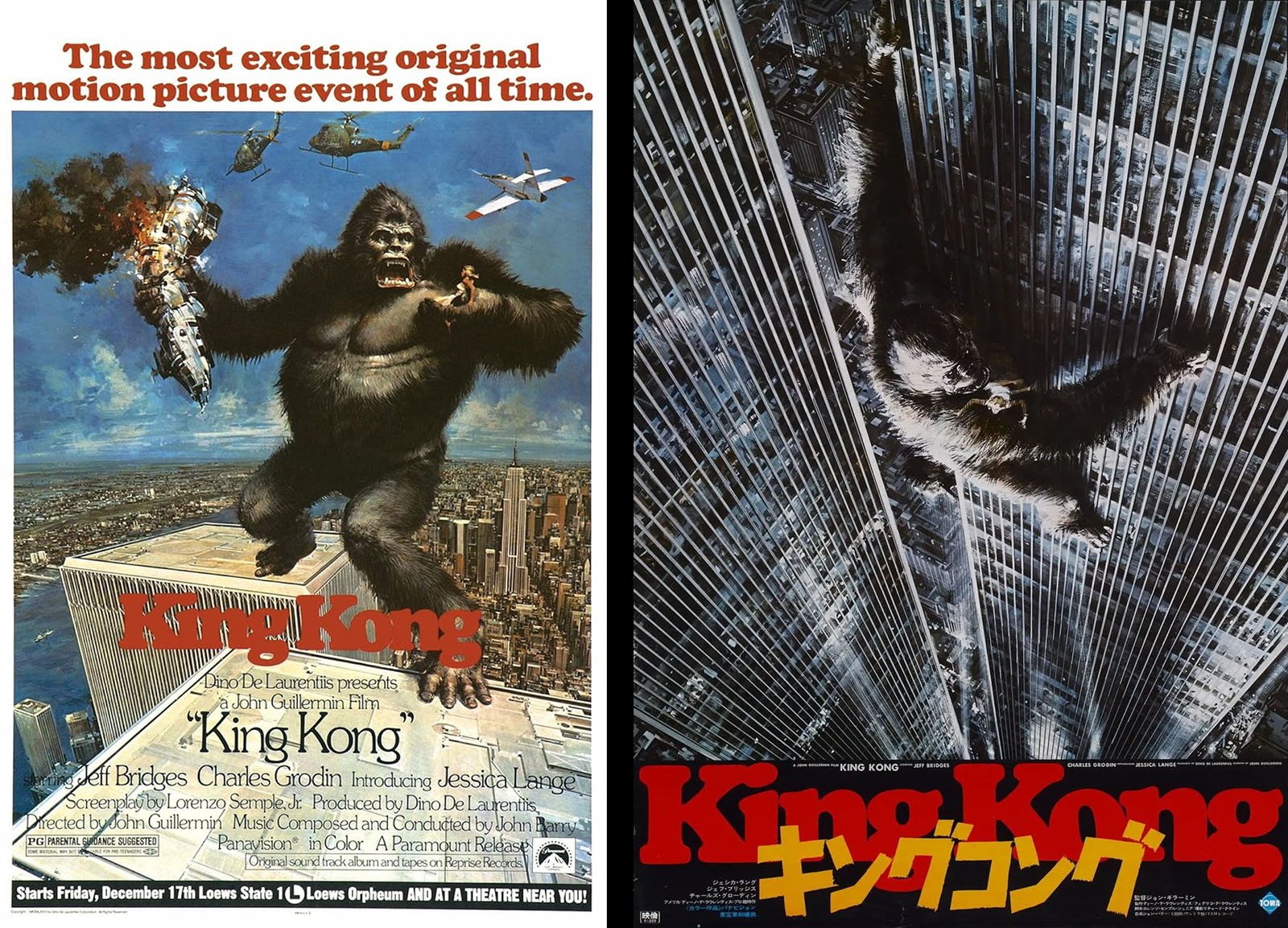
My absolute favorite thing about the movie wasn’t actually on screen; it was the poster art by a very gifted painter named John Berkey (1932-2008). I stared at that main one-sheet, amazed by the power and detail. That gaping jaw reversed the dopey “overbite” look that had been part of Kong’s design since the beginning, making him fiercer and more intimidating.
As time went on, more Berkey images surfaced, having been used as poster art for foreign releases. There were also concept pieces that didn’t appear on posters at all, which dialed up the ferocity even farther.
Click here to see a collected gallery
RELATED LINKS
More John Berkey poster art:
Kong only | Kong and others
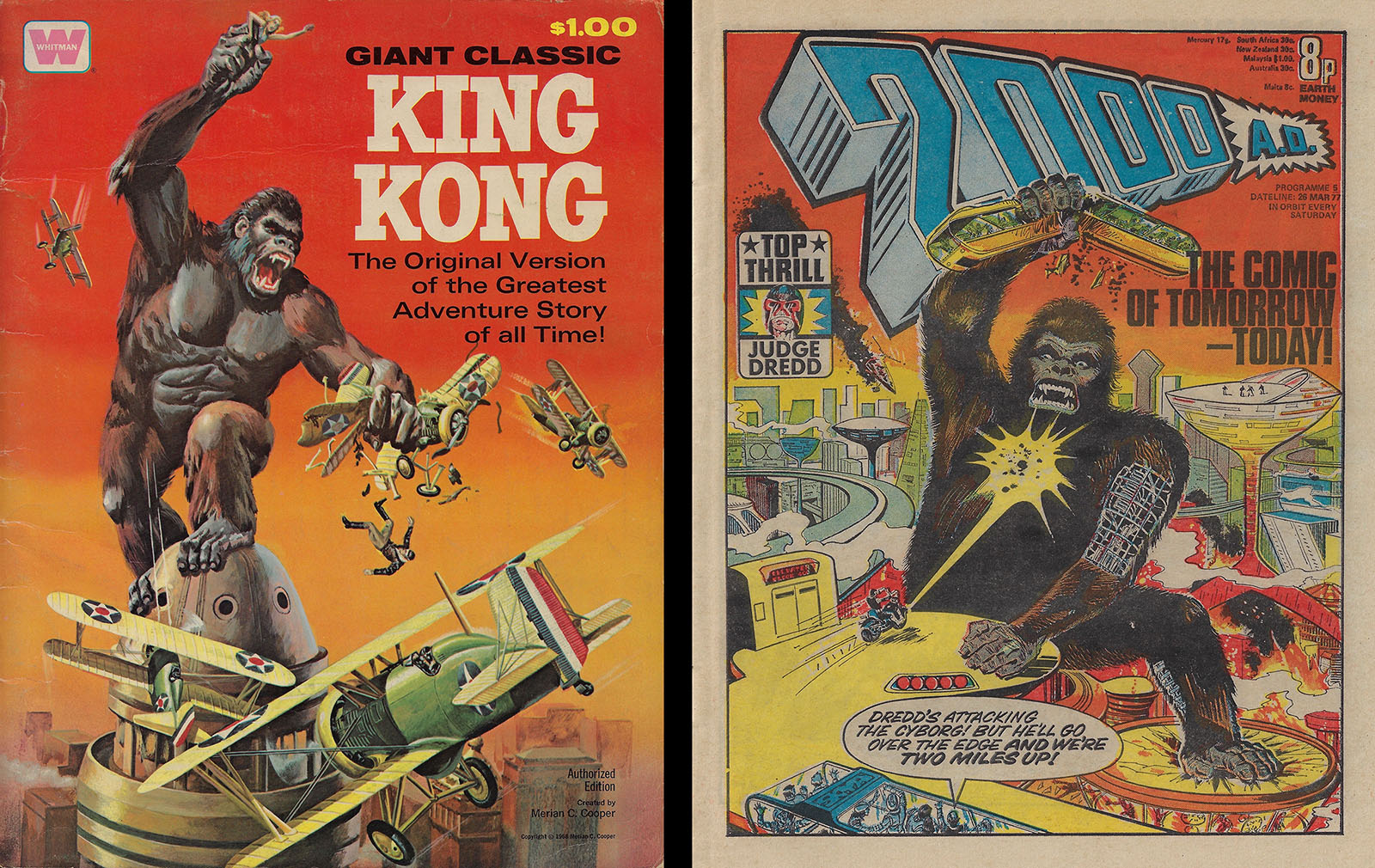
Even though this entry into Kong history didn’t get its own comic adaptation, it brings us back to comics in two ways. First, it spurred a reprint of the 1968 Gold Key version into a new treasury-size edition from Whitman (the one I bought). Second, it found its way into a weekly British sci-fi comic called 2000AD.
Issue 5 of this groundbreaking comic (March 1977) sent Judge Dredd out to round up a giant beast called “Krong” (the John Berkey face design was unmistakabe). Satire is at the core of Judge Dredd, but I doubt the writer (probably Pat Mills) could know how prescient this story would be: fed up with virtual reality as fake entertainment, the curator of a movie monster museum unleashes his analog robotic artifacts to disrupt jaded consumers. The star attraction is Krong, “the greatest film monster ever made.” This, of course, referenced the full-scale robotic “Dino Kong” erected for the movie.
See the Judge Dredd strip in full here
And in case you didn’t know that I’m a lifetime 2000AD reader, rectify that here
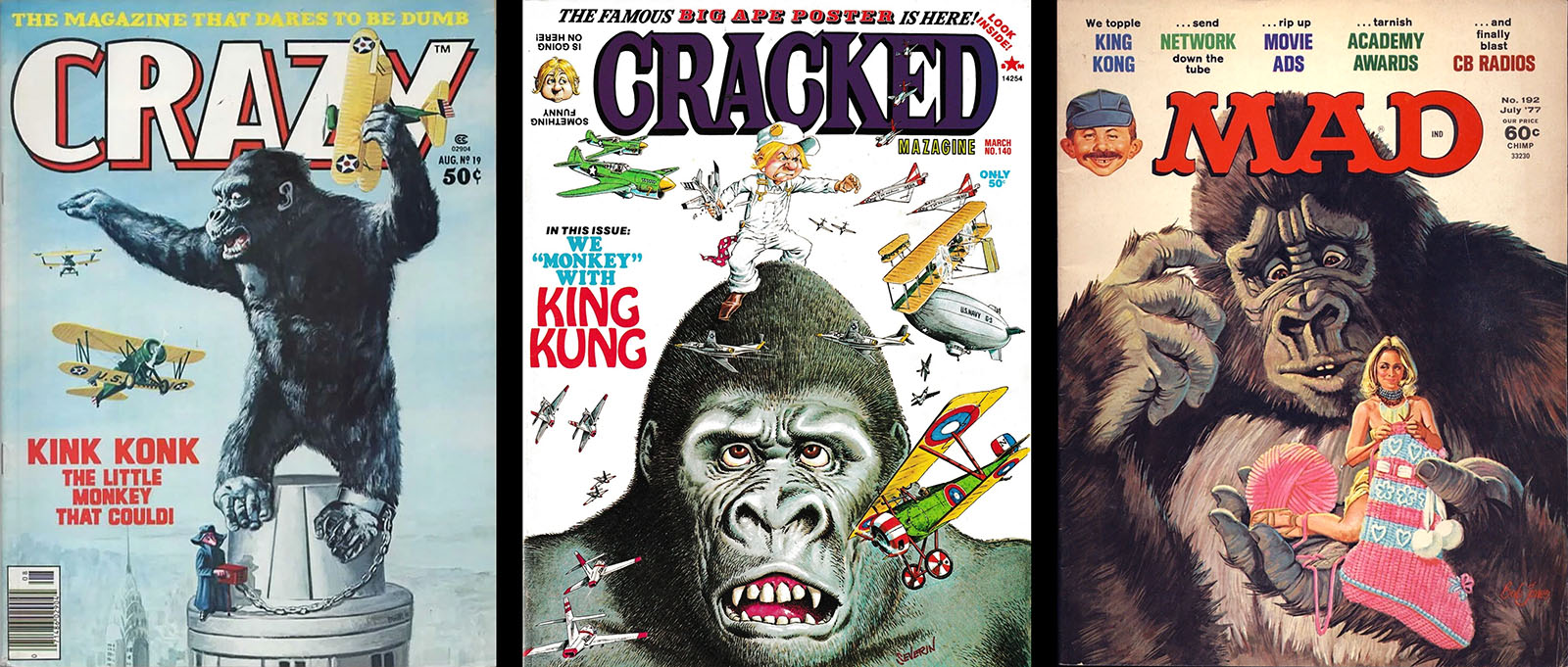
Finally, the humor magazines of the 70s lined up to take their potshots. Crazy #19 (March ’76) preceded the movie and threw all of its water balloons at the original (read it here). Cracked #140 (March ’77) was the first to parody the movie in a strip drawn by the great John Severin (read it here). And MAD #192 (July ’77) brought up the rear with its own take (read it here along with some other Kong kontent).
Behind the scenes, other things were afoot in Kong world. Merian C. Cooper had died three years earlier, and in December 1976 (the premiere month of “Dino Kong”) a judge ruled in “The Cooper Judgment” that the King Kong rights belonged to his estate. The estate then promptly sold film rights to Universal but held onto the novel. This would give us one more bite of the apple 24 years later (keep reading).
1979: Hecho en Mexico (2)
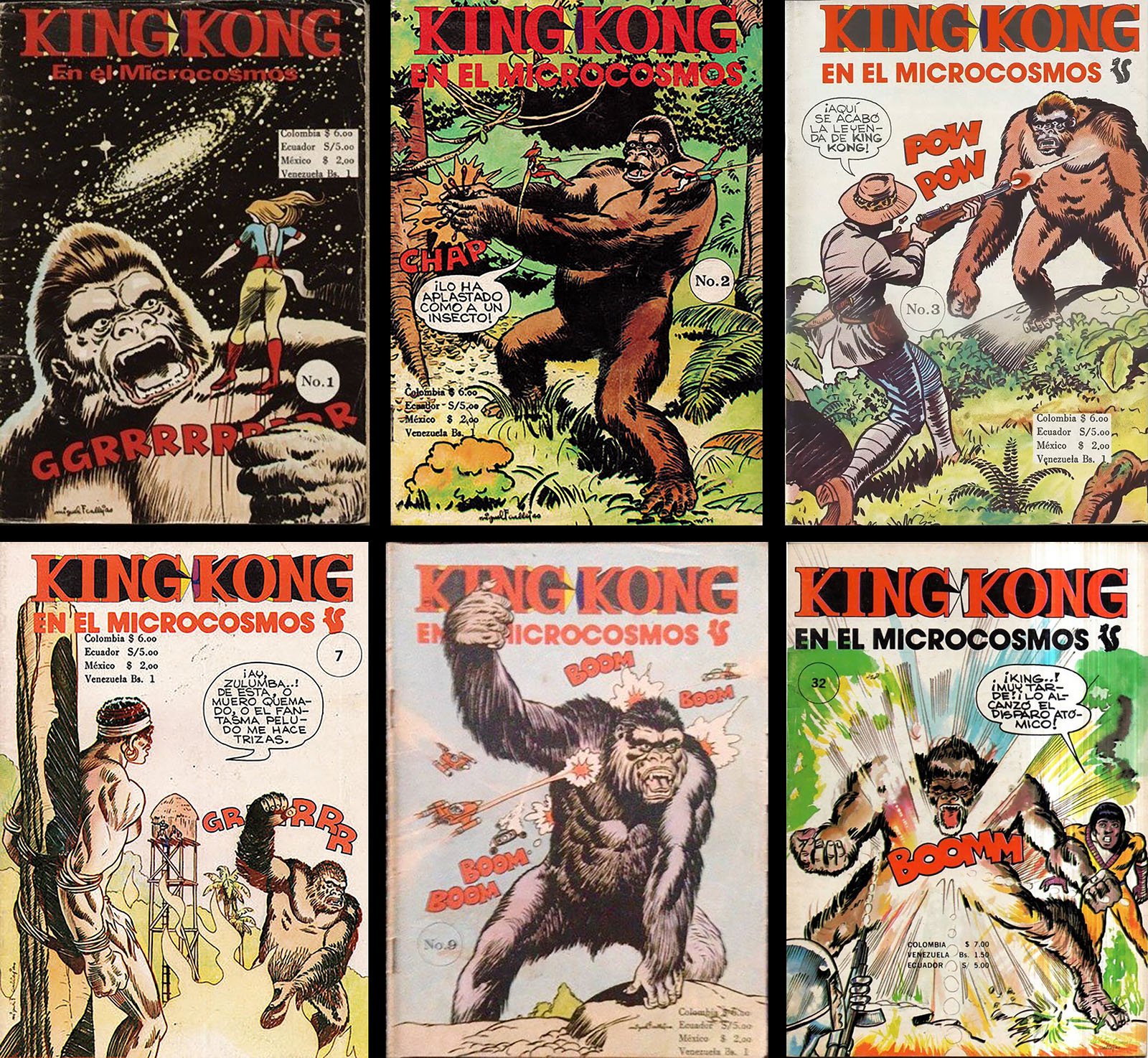
Once again, no stinkin’ license was sought to publish this gem. King Kong in the Microcosmos, published by Editorial America, ran for an impressive 35 issues, all written and drawn by Miguel Callejas. Regardless of the finished quality, I have to render a respectful salute to anyone who could keep that pace for three years. You can’t accomplish something like that without passion to fuel it.
The story: Facing a war on their planet, a group of aliens searches for a warrior to help them. That warrior turns out to be our favorite giant gorilla.
See an overview of the first seven issues here
See a video flip-through here
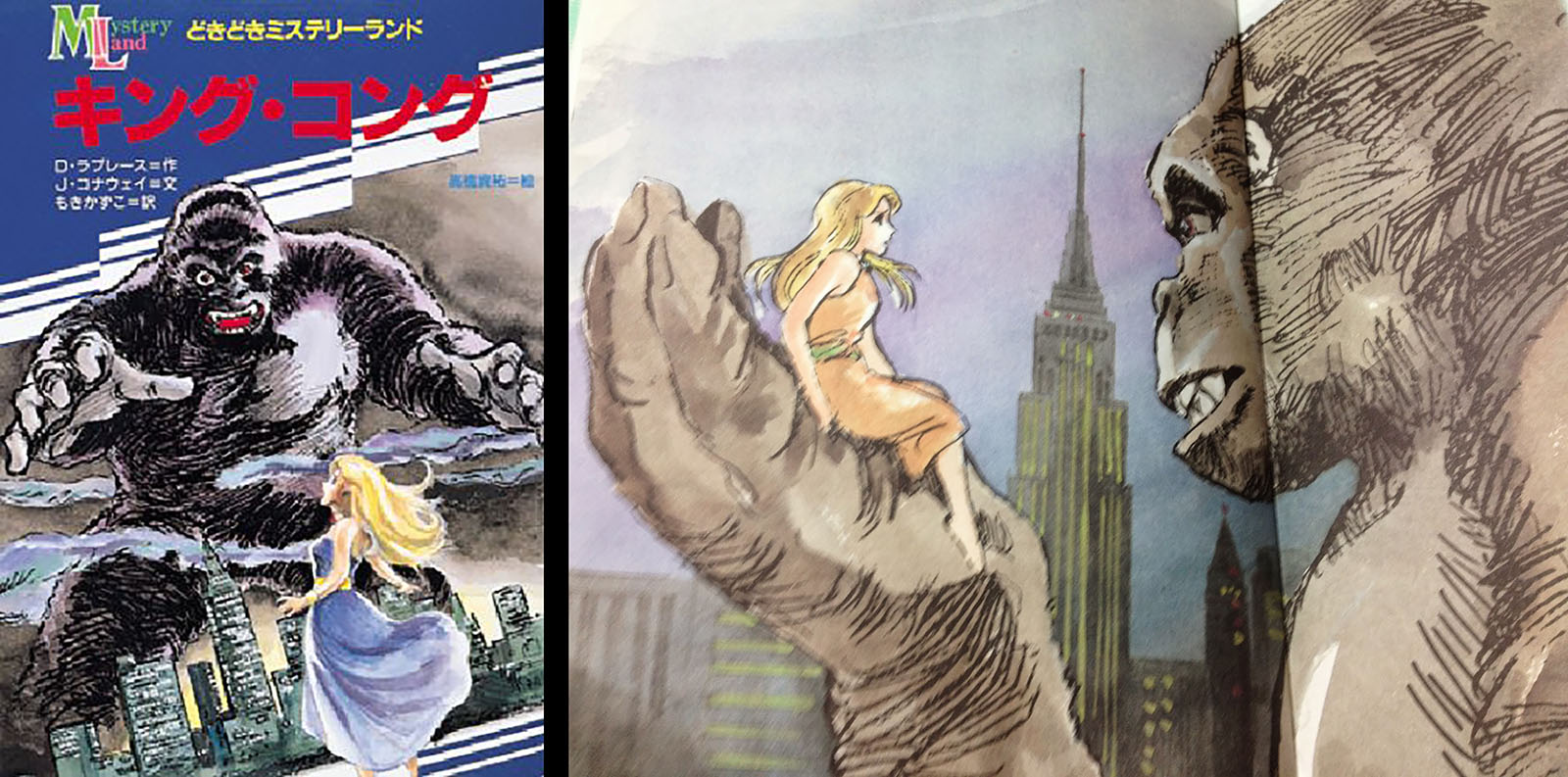
1991: Japanese novelization
Here’s one of the payoffs of the Cooper estate maintaining its rights to the novel: an authorized Japanese edition published by Kinnohoshi-sha in their “Thrilling Mystery Land” series. Delos W. Lovelace was credited as the original author, “J. Conaway” was credited for adaptation (revised for young readers) and Kazuko Moki for translation. Artist Shusuke Takahashi was the illustrator, directly referencing the 1976 movie for some scenes.
See the interior art here
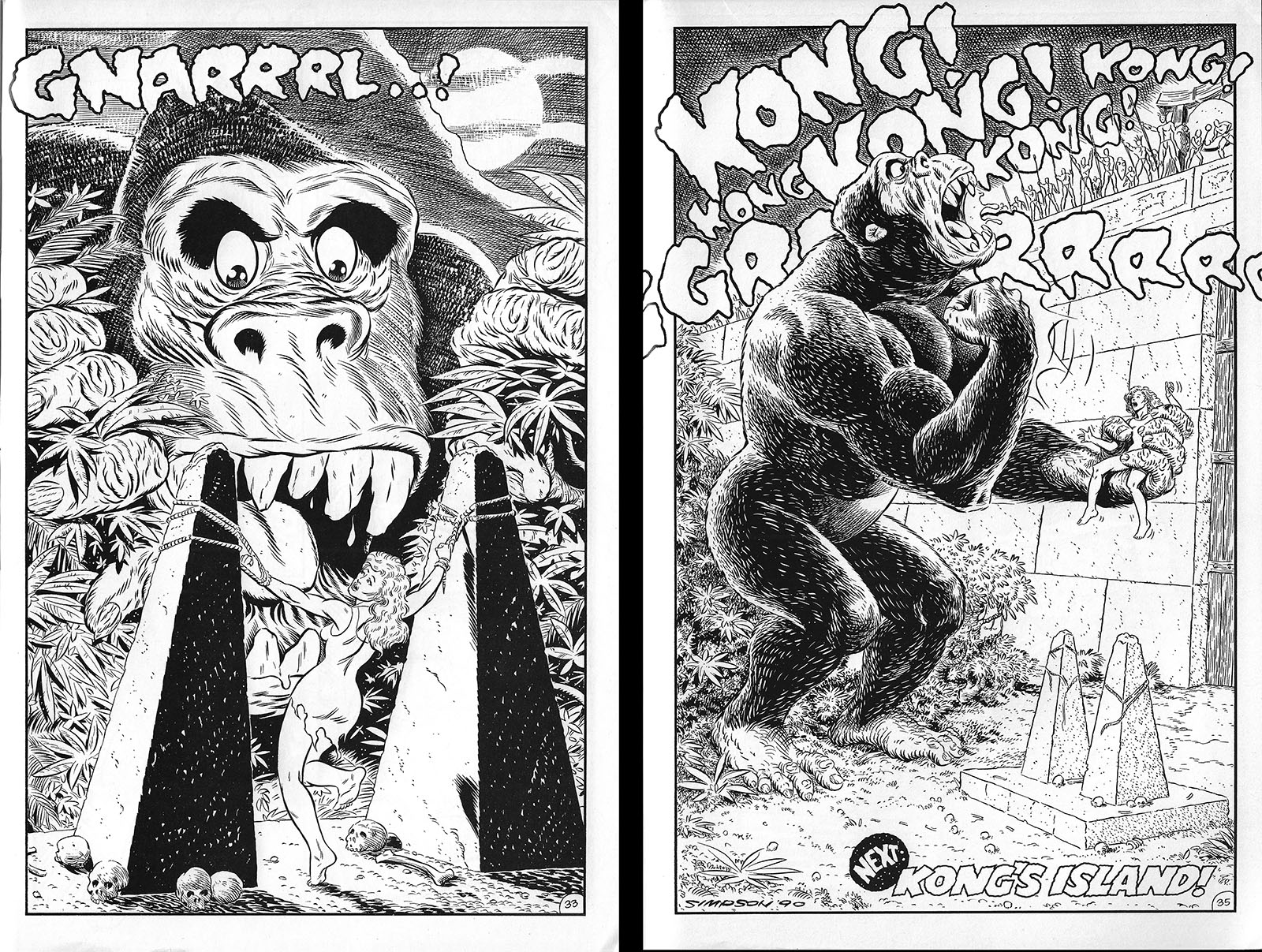
1991: The Monster Comics adaptation
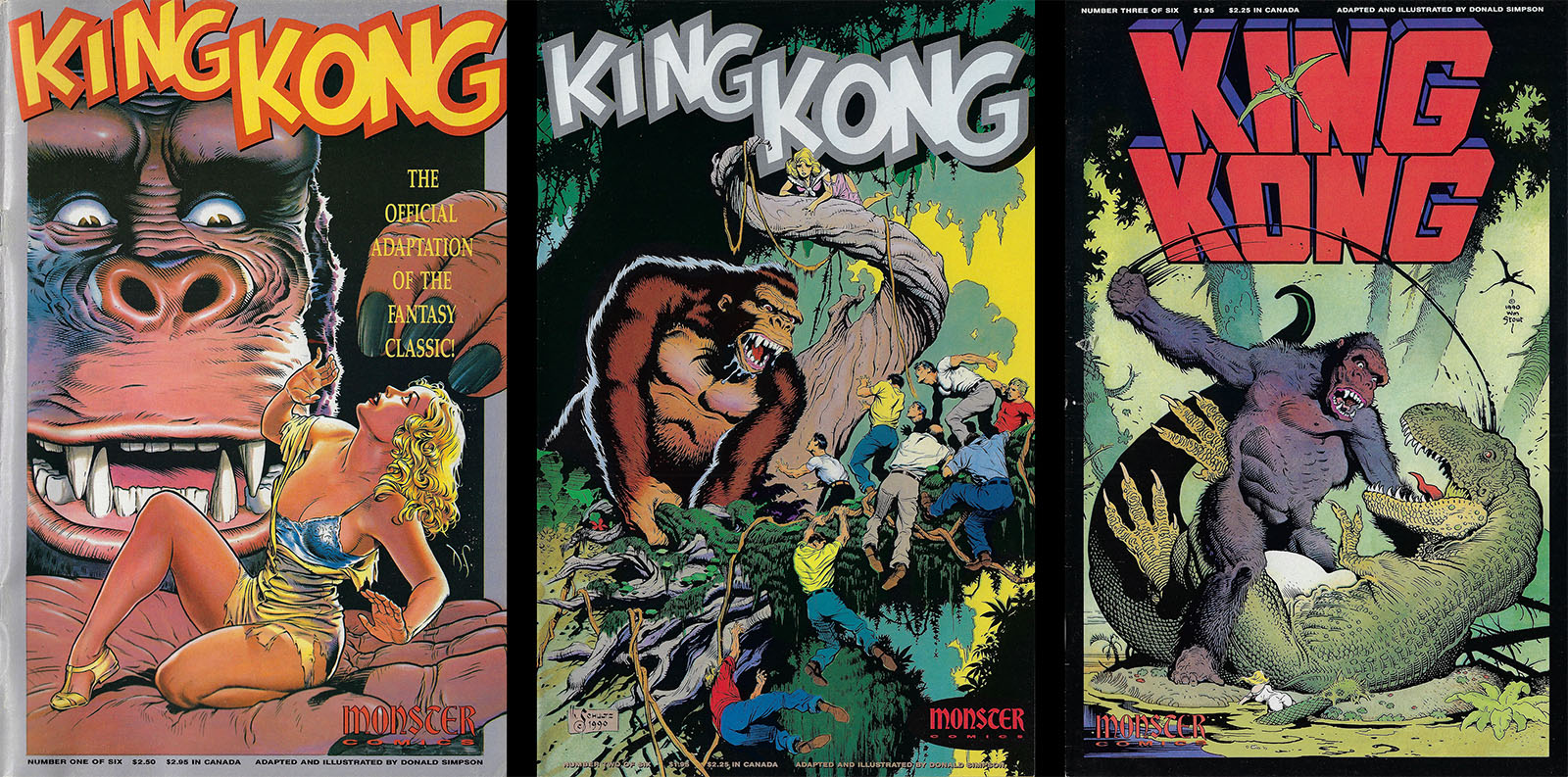
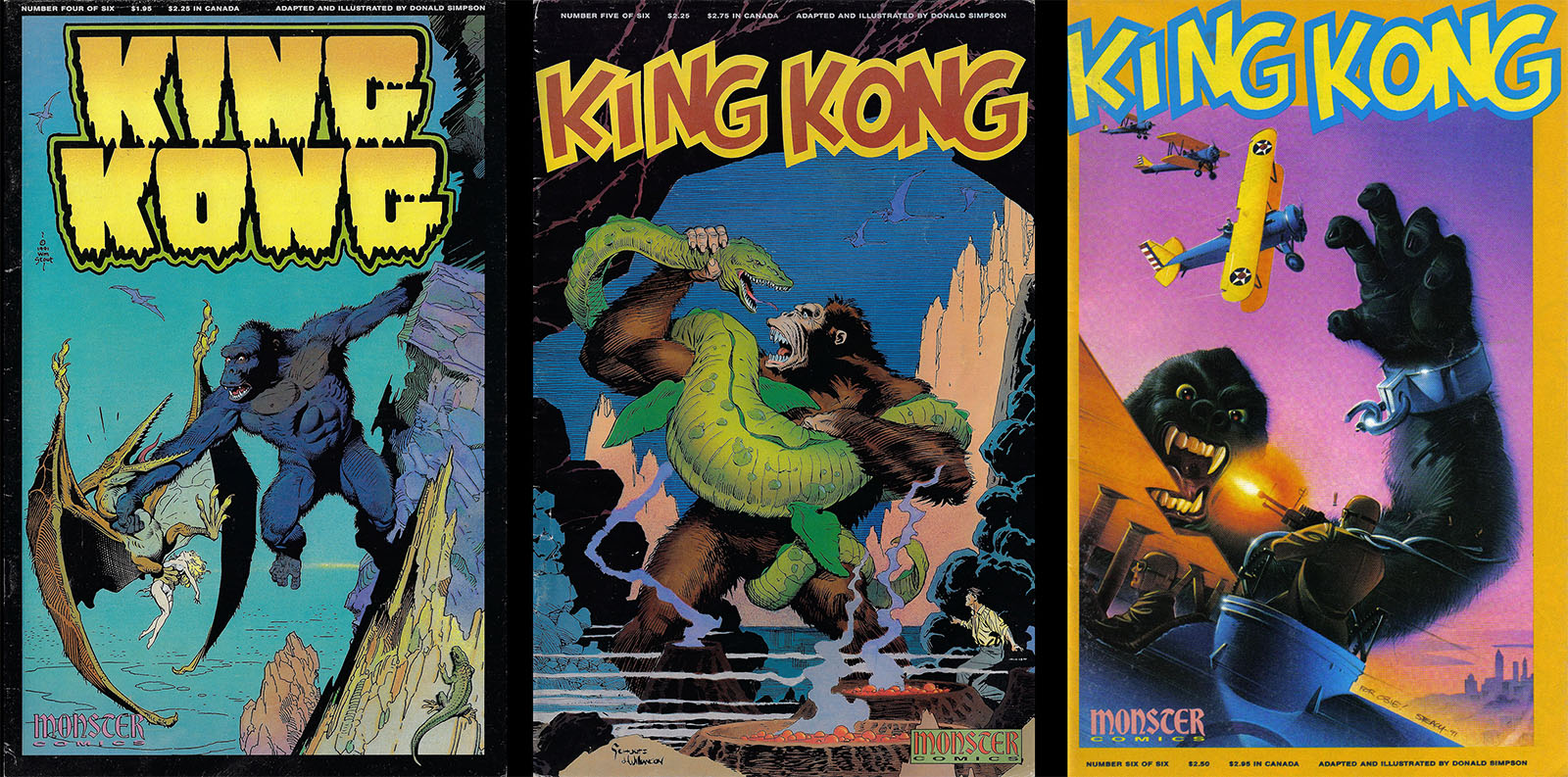
I can’t think of a better way to finish off this article than with something I didn’t know existed when I started. Beginning in February 1991, Fantagraphics published a completely new adaptation based solely on the original novel, fully authorized by the Cooper estate.
Adapted and illustrated by Don Simpson, it was over twice the length of the 1968 version, totaling 134 pages. It was published in six bimonthly issues from February ’91 to March ’92 with multiple artists providing covers. These were heavy hitters who all brought their A-game: Dave Stevens, Mark Schultz, William Stout, Al Williamson, and Ken Steacy.
Don Simpson was no lightweight, either. I first encountered his work on Megaton Man, a superhero parody published by Kitchen Sink Press starting in 1984. The character endured into the 90s through two more publishers, Fiasco Comics and Image Comics.
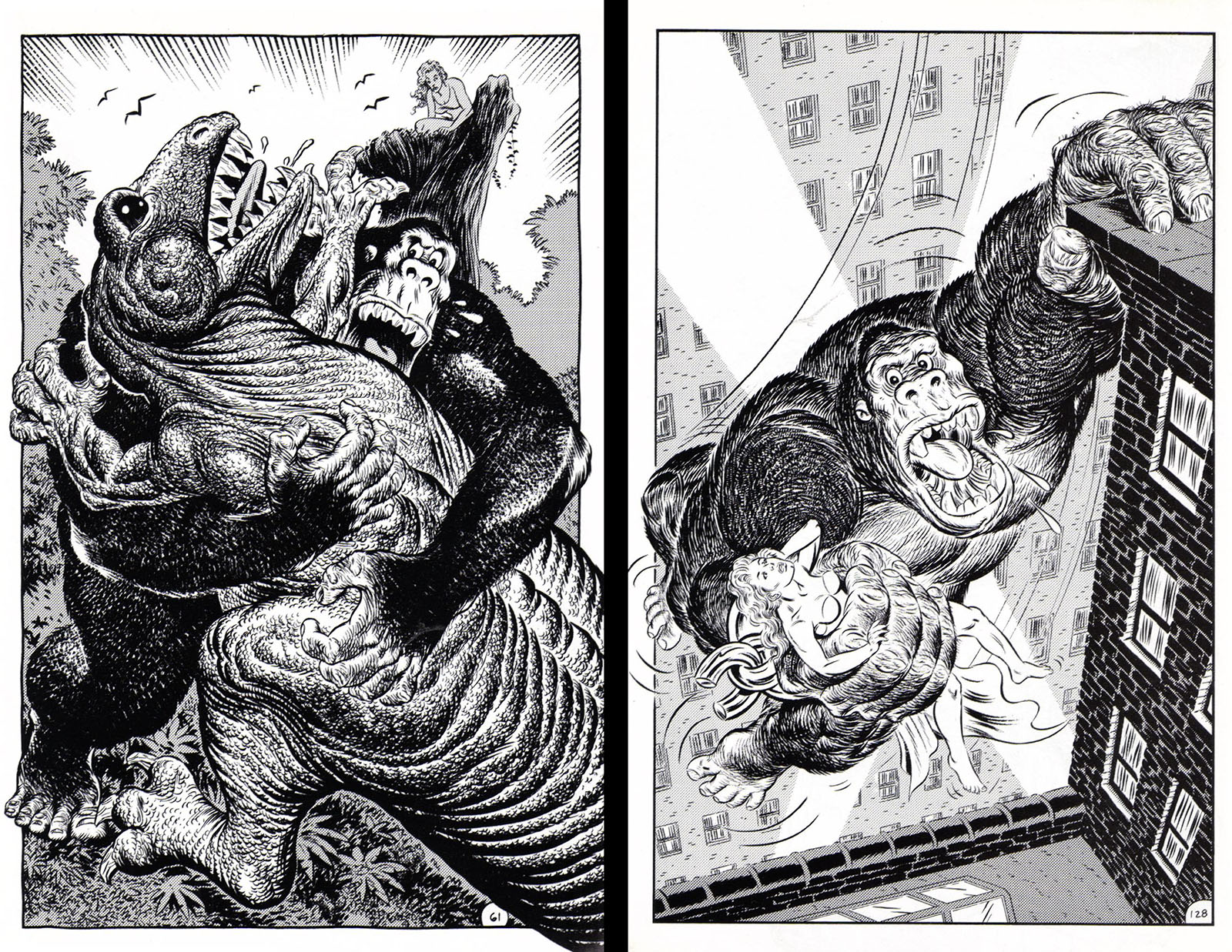
On one hand, Simpson is a cartoonist to the core, so his style won’t appeal to everyone. On the other, his version hewed very closely to the novel, covering everything left out of the original movie (though it does make for a VERY wordy first issue). Thus, this adaptation stands apart and loops us directly back to the very first entry in this historical record.
The “weak tea” coloring of the ’68 edition didn’t repeat here, since it was entirely in black & white. Simpson made up for it with intricate texturing that nicely evokes the noir aspect of the movie. If you don’t mind the goofy gorilla faces and an occasional whiff of parody, you’ve got nothing to worry about.
Read an overview of these comics at Wikizilla here
Read PDFs of all six issues here:
21st Century Kong
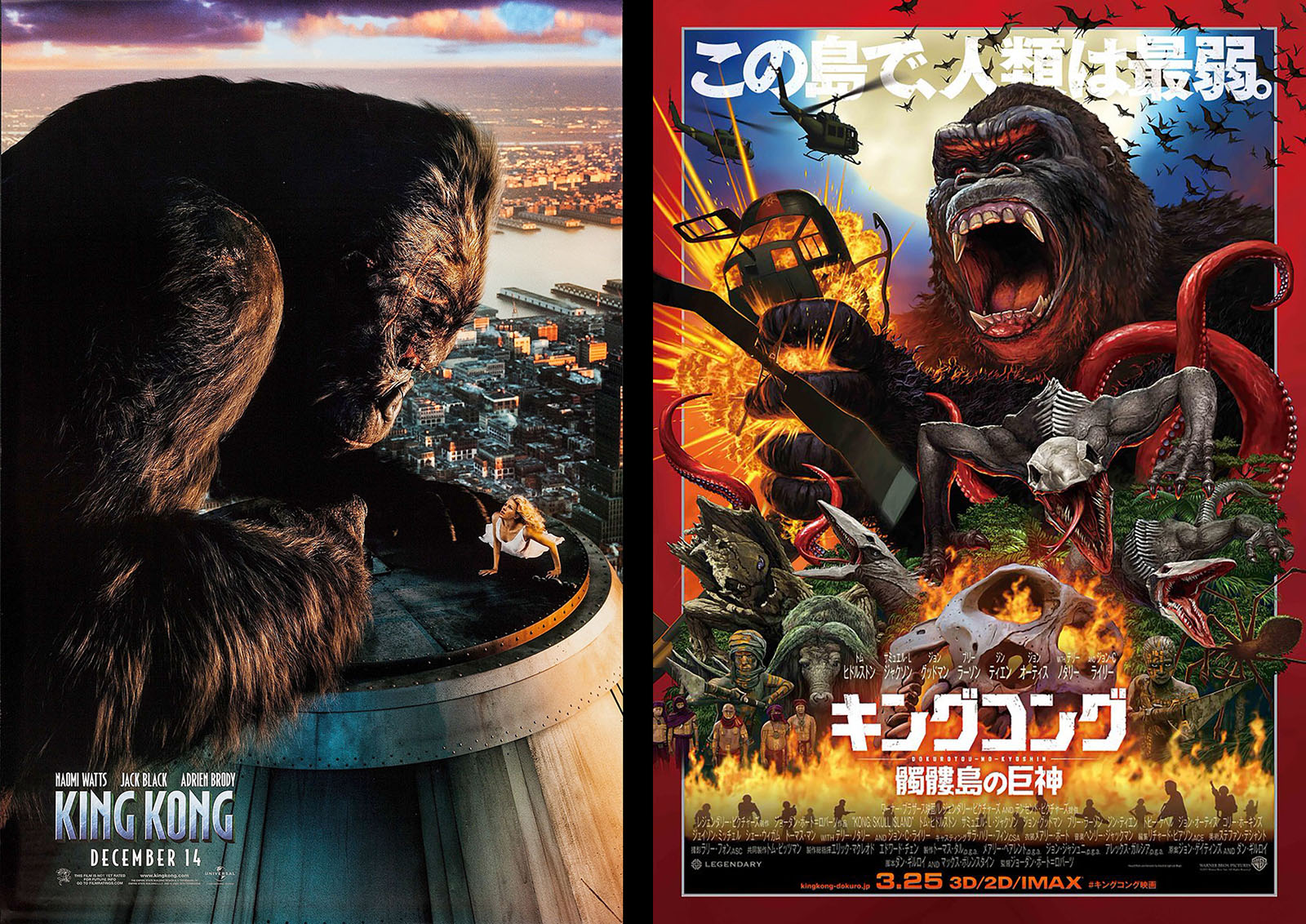
I have to close the curtain somewhere, so I’ll wrap up with a brief note that in the early 00s, Dark Horse comics struggled in vain to land the rights from Universal for yet another adaptation. This barrier was finally broken when Peter Jackson’s 2005 remake came along and gave them a new umbrella to stand under. They published some tie-ins and everything went quiet until Skull Island came out in 2017 to ignite the Legendary Monsterverse. More tie-in comics appeared from Boom! Studios, Legendary Comics, and Dynamite Comics. IDW Comics is now currently servicing your Kong comic needs in 2026.
The novel passed into public domain in 2007, so any number of future adaptations is now possible. I for one am interested to see what the 2033 Kongcentennial brings to us (A compendium of everything I covered in this article would be fun). In the meantime, here are a few more links that will take you down some of those rabbit holes that sucked me in. Good luck climbing back out.
King Kong comics history on Youtube by Paper Finz