
The Man Who Grew Young, 2001

You know that thing where you look back at how a project came to be, and sometimes it doesn’t make any sense at all? Completely impossible to predict from the other end? This graphic novel was one of those.
It began in 1995 when I was lying in bed listening to the NPR morning news show. The word “gorilla” caught my ear, because I was in the midst of developing a TV animation pitch for my Grease Monkey comic book – in which the main character is a gorilla. So any time another gorilla came up in pop culture, it pinged my radar. Here, the gorilla in question was the title character in a novel called Ishmael. The NPR story was an interview with the author, Daniel Quinn.
The more I heard about the book, the more intrigued I got. Ishmael the gorilla was a teacher, educating a human in cultural anthropology from the standpoint of an outsider. Mac, my gorilla in Grease Monkey, had a very similar role concerning human behavior. Quite a coincidence; enough to make me run out and buy a copy of Ishmael.
I didn’t have to worry much about infringement; the premises of Ishmael and Grease Monkey were completely different. But I’m grateful that they had this connection, because it brought me to some life-altering of literature. I’m not kidding about that. Ishmael is a revelation in the same way Howard Zinn’s People’s History of the United States is a revelation. It exposes hidden history by removing the veil of ambient culture. When you finish reading it, the world outside your window will never be the same again.
As I read it, I realized that since it was mostly written in the form of a dialogue between two characters, it was perfectly suited to a stage play. Using the abridged audio book as a reference, I created a script and banded together with some friends to perform it in 1996. For real! We did it once in Thousand Oaks (California) and the second time in Santa Barbara.
The second performance was the more important of the two, because one of the members of the audience was…Daniel Quinn.
I don’t remember exactly how I got in touch with him. I seem to recall that he brazenly published his address in the 1992 hardcover edition of Ishmael to invite reader responses. Maybe it was that. Anyway, I got his address and wrote a letter to introduce myself. I included a Grease Monkey comic book, and asked for Daniel’s blessing on the “dramatic reading” of his work. I included my phone number, but didn’t expect him to use it.
Some time after that, my phone rang. “Hi, Tim, this is Daniel Quinn calling.”
He enjoyed the comics and encouraged me to go ahead with the performance. A few e-mails want back and forth and he told me that he would be in Santa Barbara for something. Maybe a bookstore signing. (I really wish I’d kept a better record of all this.)
Anyway, that’s how fate conspired to get Daniel into a room with little old me and my friends, and for him to watch us present his work in front of a small audience. I invited him up on stage afterward to speak, and he obliged. It was a glorious evening.
The next time I heard from Daniel, he asked if I’d like to collaborate with him on a future book. Thanks, NPR!!!

Daniel struggled in his writing career before Ishmael became an international bestseller, but he thrived in its wake. Many other books followed, all expanding on what Ishmael had started. Among his many projects was a screenplay titled The Man Who Grew Young. Daniel lamented that it would probably never get made into a film, but when he realized that he had a comic book artist in his orbit, he decided to take it down a different path.
He sent me the script and a proposal in early 1997, and I agreed to it without hesitation. It was a simple enough arrangement; he’d pay me half of a generous fee to start and the other half when I finished. Measuring it by page count, it would be the most lucrative comic assignment I’d ever gotten. There was no publisher lined up yet, but Daniel was confident that he would land one when the time came.
My first task was to adapt the script. It was written to be shot on film, and I knew from experience that not all of it would translate well. Scenes that play silently on screen, or rely on intricate, continuous motion, tend not to translate well to the page. On the other hand, the presence of words can make up for a lot, especially if you have a narrator. It was astonishing to me that I suddenly found myself rewriting the work of Daniel Quinn, but he trusted that I knew what I was doing and approved my draft with no objections.
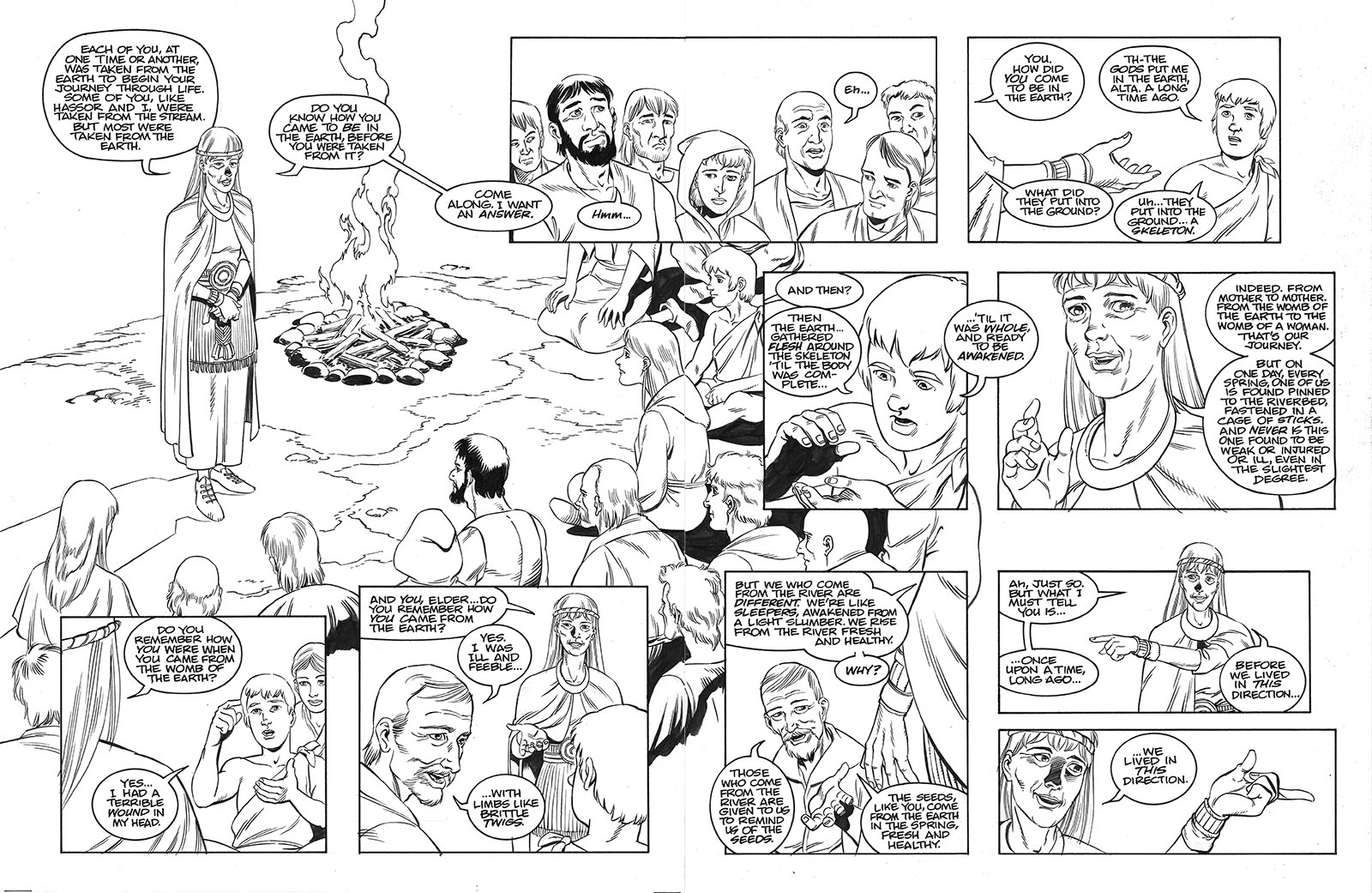
From there, I turned the script into rough layouts. I arrived at a total of 98 pages, which would have been about four issues of a comic book, but this was going to be a self-contained graphic novel. Since it took a long (backward) walk through world history, Daniel helped assemble reference material for me, not an easy task in the pre-Google age. I would be completely responsible for the visuals, all the way through finished color.
Unfortunately, 1997 was not a good year for me to start a project this big. It was my first full year as a TV animation director (on Extreme Ghostbusters), so I could no longer make comics my priority. I was also going through the end of my first marriage and needed a lot of “me” time to process that. As a result, I only got a few early pages done and had to set the rest aside. Daniel was sorry to hear it, but there wasn’t a hard deadline for the project, and he had faith in me to finish what I started.
It languished through most of 1998, but as I got my feet back under me I picked it up again with renewed vigor. Postponing the work turned out to be the right choice, since I was returning to fully inked artwork for the first time since the summer of ’95. Since then, I’d drawn all my comics in pencil and converted them to “ink” in Photoshop. I thought this project would look a lot better with brush inking, so I took the time I needed to revive my technique. Photoshop would now be used exclusively for color and effects.

The book was full of things I’d never drawn before. As I mentioned earlier, it traveled back in time and the main character (Adam) was witness to the dismantling of civilization. A far cry from my usual space adventures. But I wanted to do right by Daniel, and also prove to myself that a I had some range beyond sci-fi. More importantly, this was going to be a graphic novel for readers who didn’t ordinarily read comics, so I wanted them to have an comfortable experience. It was easy to imagine an average 1990s superhero artist faking their way through it and fooling no one in the end. This book was worthy of more effort than that.
I kept Daniel supplied with proofs of the pages as I finished them, and he was overjoyed all the way to the finish line in 2000. By then I had gained a lot more experience in animation and knew it was my new home. I’d also worked my way through all the personal stuff and found my next life partner. The hard work at all these different levels had paid off.
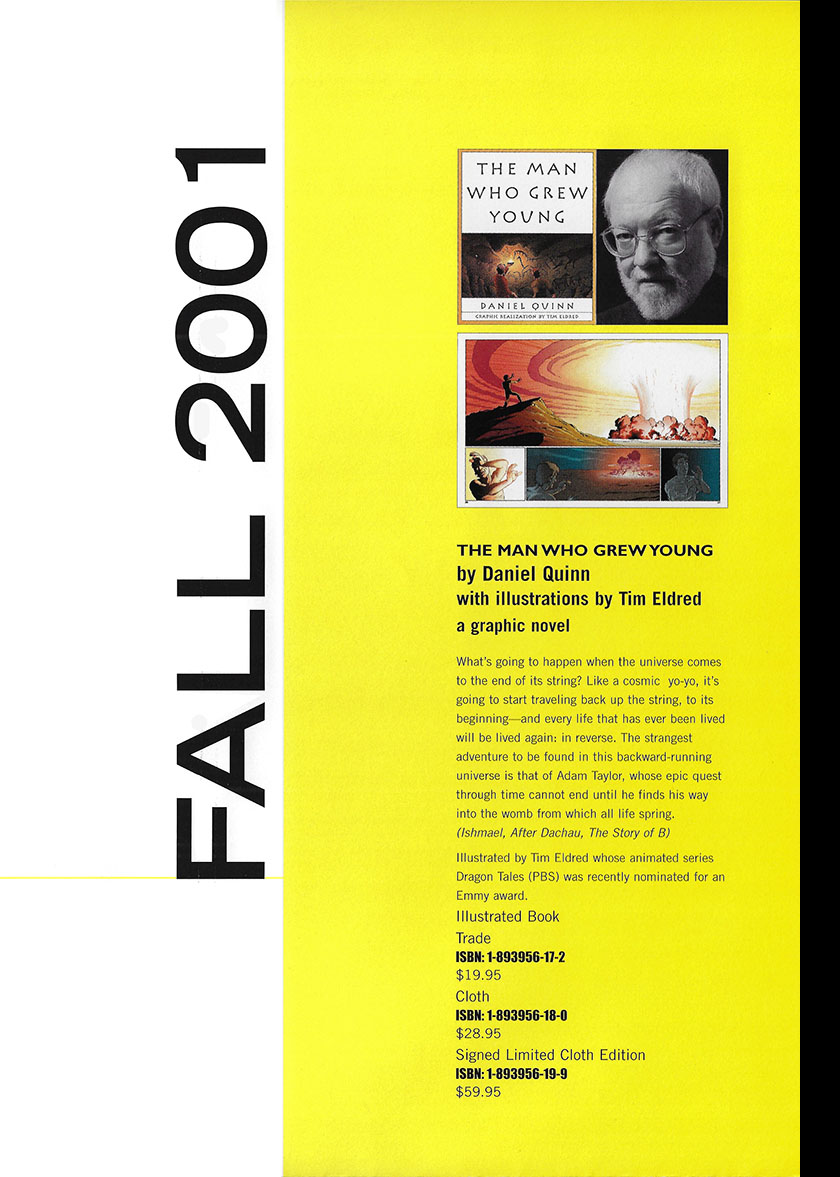
The next thing I heard was that a publisher had been selected: a progressive indie company named Context Books, based in New York. Through another labyrinth of unexpected events, I took my first trip there in the spring of 2001. A TV cartoon I’d directed, Dragon Tales, was up for a Daytime Emmy and the studio sent me there to attend the ceremony. It didn’t result in a win, but it did give me a chance to visit Context Books in person.
There, I met editor Beau Friedlander, who had founded his company in ’98 (my off-year). The Man Who Grew Young was going to be his first project with Daniel Quinn and his first graphic novel, so I was able to give him a lot of valuable technical advice in how to handle the digital files I’d created. The book itself was finally published in the fall of 2001 (simultaneously in hardcover and softcover) with the very best print quality my work has ever seen.
After all this, I went on to draw new Grease Monkey comics. One chapter invoked Ishmael, so sent a photocopy to Daniel. He was delighted and wished me luck, but I’m sorry to say we drifted out of touch from there. He published several more books, and made his final departure in 2018.
I’m sure I asked Beau Friedlander at some point if he’d be interested in publishing my Grease Monkey graphic novel, but this obviously did not come to pass since Tor published it a few years later. I’m not surprised at all to learn that Beau pursued a rowdy career in progressive media and is still at it today. Good for him.
And with that, I’ll turn you over to the book itself. It’s utterly unlike everything else in my catalog, but if I were asked to pick the five published works I’m proudest of, this would be an easy one.

Softcover and hardcover editions. Each measured about 8″ x 10″
OFFICIAL DESCRIPTION
Daniel Quinn strikes again with this full-color, illustrated novel. What’s going to happen when the universe comes to the end of its string? Like a cosmic yo-yo, it’s going to start traveling back UP the string, to its beginning — and every life that has ever been lived will be lived in reverse. The strangest adventure to be found in this backward-running universe is that of Adam Taylor, whose epic quest through time cannot end until he finds his way into the womb that gave birth to us all.

Preface (8 pages)
Part 1 (30 pages)

Part 2 (19 pages)
Part 3 (42 pages)
RELATED LINKS
TMWGY page at the Ishmael website
Daniel Quinn’s page at goodreads